Beech AT-11 Kansan
The Beechcraft Model 18 (or “Twin Beech”, as it is also known) is a 6- to 11-seat, twin-engined, low-wing, tailwheel light aircraft manufactured by the Beech Aircraft Corporation of Wichita, Kansas. Continuously produced from 1937 to November 1969 (over 32 years, a world record at the time), over 9,000 were built, making it one of the world’s most widely used light aircraft. Sold worldwide as a civilian executive, utility, cargo aircraft, and passenger airliner on tailwheels, nosewheels, skis, or floats, it was also used as a military aircraft.
During and after World War II, over 4,500 Beech 18s were used in military service—as light transport, light bomber (for China), aircrew trainer (for bombing, navigation, and gunnery), photo-reconnaissance, and “mother ship” for target drones—including United States Army Air Forces (USAAF) C-45 Expeditor, AT-7 Navigator, and AT-11 Kansan; and United States Navy (USN) UC-45J Navigator, SNB-1 Kansan, and others. In World War II, over 90% of USAAF bombardiers and navigators trained in these aircraft.
In the early postwar era, the Beech 18 was the pre-eminent “business aircraft” and “feeder airliner”. Besides carrying passengers, its civilian uses have included aerial spraying, sterile insect release, fish stocking, dry-ice cloud seeding, aerial firefighting, air-mail delivery, ambulance service, numerous movie productions, skydiving, freight, weapon- and drug-smuggling, engine testbed, skywriting, banner towing, and stunt aircraft. Many are privately owned, around the world, with 240 in the U.S. still on the FAA Aircraft Registry in August 2017.
Design and development
By the late 1930s, Beechcraft management speculated that a demand would exist for a new design dubbed the Model 18, which would have a military application, and increased the main production facilities. The design was mainly conventional for the time, including twin radial engines, all-metal semimonocoque construction with fabric-covered control surfaces, and tailwheel undercarriage. Less conventional was the twin-tailfin configuration. The Model 18 can be mistaken for the larger Lockheed Electra series of airliners, which closely resemble it. Early production aircraft were powered either by two 330-hp (250-kW) Jacobs L-6s or 350-hp (260-kW) Wright R-760Es. The 450-hp (336-kW) Pratt & Whitney R-985 became the definitive engine from the prewar C18S onwards. The Beech 18 prototype first flew on January 15th, 1937.
The aircraft has used a variety of engines and has had a number of airframe modifications to increase gross weight and speed. At least one aircraft was modified to a 600-hp (447-kW) Pratt & Whitney R-1340 powerplant configuration. With the added weight of about 200 lb (91 kg) per engine, the concept of a Model 18 fitted with R-1340 engines was deemed unsatisfactory due to the weakest structural area of the aircraft being the engine mounts. Nearly every airframe component has been modified.
In 1955, deliveries of the Model E18S commenced; the E18S featured a fuselage that was extended 6 in (150 mm) higher for more headroom in the passenger cabin. All later Beech 18s (sometimes called Super 18s) featured this taller fuselage, and some earlier models (including one AT-11) have been modified to this larger fuselage. The Model H18, introduced in 1963, featured optional tricycle undercarriage. Unusually, the undercarriage was developed for earlier-model aircraft under an STC by Volpar, and installed in H18s at the factory during manufacture. A total of 109 H18s was built with tricycle undercarriage, and another 240 earlier-model aircraft were modified with this.
Construction of the Beechcraft Model 18 ended in 1970 with a final Model H18 going to Miyazaki Aviation College, Japan. Through the years, 32 variations of the basic design had flown, over 200 improvement modification kits were developed, and almost 8,000 aircraft were built. In one case, the aircraft was modified to a triple tail, trigear, humpbacked configuration and appeared similar to a miniature Lockheed Constellation. Another distinctive conversion was carried out by Pacific Airmotive as the PacAero Tradewind. This featured a lengthened nose to accommodate the tricycle nosewheel, and the Model 18’s twin tailfins were replaced by a single fin.

Twin Beech Hal Far Malta
Operational history
Production got an early boost when Nationalist China paid the company US$750,000 for six M18R light bombers, but by the time of the U.S. entry into World War II, only 39 Model 18s had been sold, of which 29 were for civilian customers. Work began in earnest on a variant specifically for training United States Army Air Forces (USAAF) military pilots, bombardiers, and navigators. The effort resulted in the Army AT-7. Further development led to the AT-11 navigation trainer, C-45 military transport, and F-2 (the “F” standing for “Fotorecon”, short for “photographic reconnaissance”). The United States Navy first adopted the Beech 18 as the JRB-1, equivalent to the F-2, followed by the JRB-2 transport; the JRB was initially named the Voyager, but this name did not enter common use, and JRBs were generally called Expeditors like their USAAF counterparts. The first JRB-1 obtained by the Navy, bureau number (BuNo) 09771, was converted from the last civil Model 18 built before production was earmarked solely for the military for the duration of the war. The Navy subsequently obtained more Model 18s as the JRB-3 (C-45B), JRB-4 (UC-45F), SNB-1 Kansan (AT-11), SNB-2 (AT-7), and SNB-2C (AT-7C). Existing naval Twin Beeches were subsequently modified into the SNB-2H air ambulance, SNB-2P reconnaissance trainer, and SNB-3Q electronic countermeasures trainer. The United States Coast Guard acquired seven JRB-4 and JRB-5 aircraft from the Navy between 1943 and 1947; they were primarily used as utility transports, with one aircraft later converted for aerial mapping, and another used for proficiency flying.
After the war, the USAAF became the United States Air Force (USAF), and the USAF Strategic Air Command had Model 18 variants (AT-11 Kansans, C-45 Expeditors, F-2 Expeditors, and UC-45 Expeditors) from 1946 until 1951. In 1950, the Navy still had around 1,200 JRB and SNB aircraft in inventory. From 1951 to 1955, the USAF had many of its aircraft remanufactured with new fuselages, wing center sections, and undercarriages to take advantage of the improvements to the civil models since the end of World War II. Eventually, 900 aircraft were remanufactured to be similar to the then-current Model D18S and given new designations, constructor’s numbers, and Air Force serial numbers. The USN had many of its surviving aircraft remanufactured as well, resulting in the JRB-6, the SNB-5, and SNB-5P. The Coast Guard retired its JRBs in 1956 and sold most of them as surplus in 1959, but one was retained by the United States Coast Guard Reserve until at least 1972. With the adoption of the 1962 United States Tri-Service aircraft designation system, the Navy’s SNB-5 and SNB-5P became the TC-45J and RC-45J respectively, later becoming the UC-45J as their primary mission shifted from aircrew training to utility transport work. The C-45 flew in USAF service until 1963, the USN retired its last UC-45J in 1972, while the U.S. Army flew its C-45s until 1976. In later years, the military called these aircraft “bug smashers” in reference to their extensive use supplying mandatory flight hours for desk-bound aviators in the Pentagon.
Beech 18s were used extensively by Air America during the Vietnam War; initially more-or-less standard ex-military C-45 examples were used, but then the airline had 12 aircraft modified by Conrad Conversions in 1963 and 1964 to increase performance and load-carrying capacity. The modified aircraft were known as Conrad Ten-Twos, as the maximum takeoff weight (MTOW) was increased to 10,200 lb (4,600 kg). The increase was achieved by several airframe modifications, including increased horizontal stabilizer angle-of-incidence, redesigned undercarriage doors, and aerodynamically improved wingtips. Air America then had Volpar convert 14 aircraft to turboprop power, fitted with Garrett AiResearch TPE-331 engines; modified aircraft were called Volpar Turbo Beeches, and also had a further increase in MTOW to 10,286 lb (4,666 kg).
Spar problems
The wing spar of the Model 18 was fabricated by welding an assembly of tubular steel. The configuration of the tubes in combination with drilled holes from aftermarket STC modifications on some of these aircraft have allowed the spar to become susceptible to corrosion and cracking while in service. This prompted the FAA to issue an Airworthiness Directive in 1975, mandating the fitting of a spar strap to some Model 18s. This led, in turn, to the retirement of a large number of STC-modified Model 18s when owners determined the aircraft were worth less than the cost of the modifications. The corrosion on unmodified spars was not a problem; it occurred due to the additional exposed surface area created through the STC hole-drilling process. Further requirements have been mandated by the FAA and other national airworthiness authorities, including regular removal of the spar strap to allow the strap to be checked for cracks and corrosion and the spar to be X-rayed. In Australia, the airworthiness authority has placed a life limit on the airframe, beyond which aircraft are not allowed to fly.
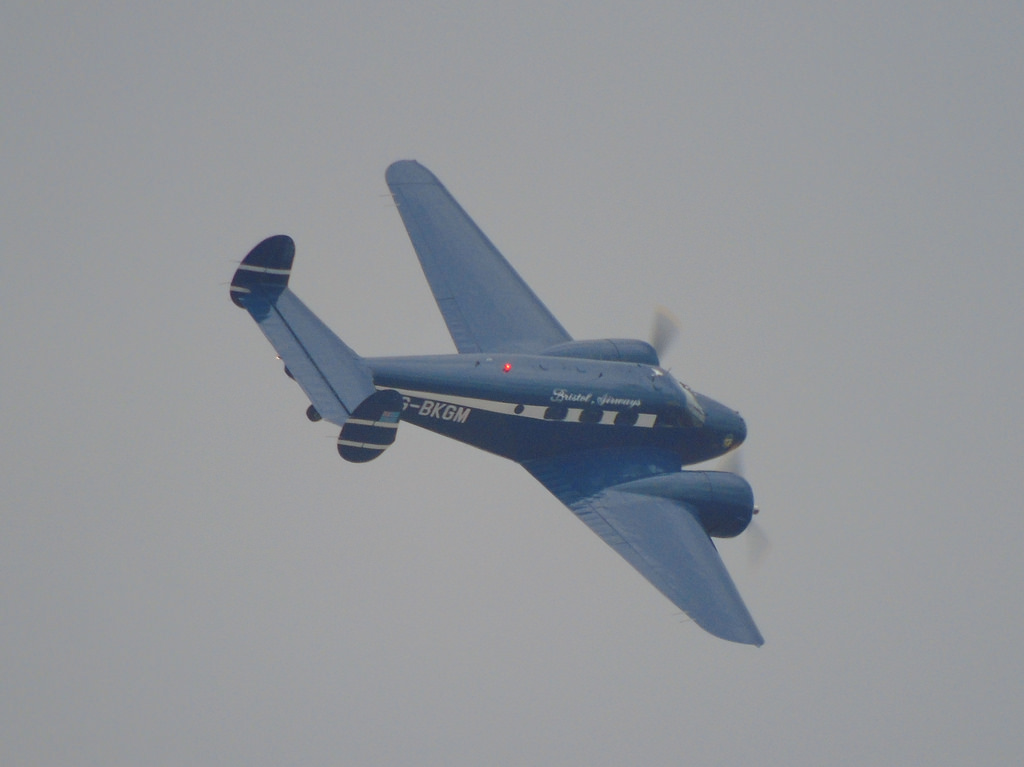
Twin Beech G-BKGM Bristol Airways
Accidents and incidents
The Beechcraft Model 18 family has been involved in the following notable accidents and incidents:
- April 25th, 1951: Cubana de Aviación Flight 493, a Douglas DC-4 bound from Miami to Havana, registration CU-T188, collided with a U.S. Navy SNB-1, bureau number 39939, on a practice instrument approach to Naval Air Station Key West. The collision and ensuing crashes killed all 34 passengers and five crew aboard the DC-4 and all five crew aboard the SNB. The accident occurred at midday, weather was clear with unlimited visibility, and both flight crews had been cleared to fly under visual flight rules, being expected to “see and avoid” other aircraft; the student flying the SNB was wearing view-limiting goggles, but the other SNB crew were not, and were expected to keep watch. Ground witnesses said that neither aircraft took evasive action prior to the collision, and the Civil Aeronautics Board attributed the accident to the failure of both flight crews to see and avoid conflicting air traffic.
- 1967: Mohammed bin Awad bin Laden was killed in the crash of a Beechcraft 18 in Saudi Arabia.
December 10th, 1967: American soul music singer Otis Redding, four members of his backing band the Bar-Kays, the pilot, and another member of Redding’s entourage were killed in the crash of Redding’s H18, registration N390R, into Lake Monona on approach to Truax Field in Wisconsin. The National Transportation Safety Board (NTSB) was unable to determine the cause of the crash, noting that the left engine and propeller were not recovered. Trumpet player Ben Cauley, the sole survivor of the crash, subsequently revived the Bar-Kays together with another band member who was aboard a different aircraft. - September 20th, 1973: American folk music singer-songwriter Jim Croce, four members of his entourage, and the pilot were killed when their chartered E18S, registration N50JR, crashed into a tree on takeoff from Natchitoches Regional Airport in Louisiana. The NTSB attributed the accident to reduced visibility due to fog, and to physical impairment of the pilot, who had severe coronary artery disease and had run 3 mi (4.8 km) to the airport. An investigation conducted for a lawsuit against the charter company attributed the accident solely to pilot error, citing his downwind takeoff into a “black hole” of severe darkness, causing him to experience spatial disorientation.
- September 26th, 1978: Air Caribbean Flight 309, an air taxi flight by a D18S, registration N500L, crashed on approach to Isla Verde International Airport in Puerto Rico, killing the pilot and the five passengers aboard the aircraft and causing substantial property damage and injuries to bystanders on the ground. The pilot could not communicate with approach control and was following directions relayed by local tower controllers, who told the pilot to make a turn and maintain separation from a Lockheed L-1011 that was overtaking the flight, but the pilot did not turn, and the D18S passed underneath and very close to the L-1011. Both the NTSB and a U.S. District Court ruling attributed the crash to the D18S pilot’s failure to correctly follow visual flight rules and air traffic control instructions to maintain separation from the much larger L-1011, causing a loss of aircraft control due to wake turbulence. A contributing factor was the pilot’s difficulties in communication with controllers.
- July 4th, 1987: Ten people, including all then-current members of The Montana Band, were killed when the pilot of their chartered D18S, N132E, failed to clear a hillside near Lakeside, Montana, while performing a flypast of the venue where the band had performed earlier. The pilot performed an “abrupt” climb and performed a “hammerhead stall” maneuver, reversing direction and entering a dive. The accident was attributed to the pilot’s poor judgment and failure to maintain altitude during unauthorized attempted aerobatics.

SNB-2 Navigator
Hobbymaster & Skymax updated photo gallery.
Check out the latest HM photos below. Please click on the images or links to go straight to the model page to order your model now.


|
|

|
|

|
|

|
|

|
|

|
|

|
|

|
|

|
|

|
|

|
|

|
|

|
|

|
|

|
|

|
|

|
|

|
|

|
|

|
|

|
|
|

|
|

|
|

|
|

|
|

|
|

|
|

|
|

|
|

|
|

|
|

|
|

|
|

|
|

|
|

|
|

|
|

|
|

|
|

|
|

|
Thank you for reading this week’s Newsletter.
Richard.
Flying Tigers.