A portrait from 1943. Group Captain A G “Sailor” Malan, Officer Commanding No. 145 Wing based at Merston, climbing in to the cockpit of his Supermarine Spitfire before taking off from Appledram, Sussex.
Adolph Gysbert Malan DSO & Bar, DFC & Bar (24th March 1910 – 17th September 1963), better known as Sailor Malan, was a South African fighter pilot in the Royal Air Force (RAF), who led No. 74 Squadron RAF during the height of the Battle of Britain. Under his leadership No. 74 Squadron became one of the RAF’s best units. Malan scored 27 kills, seven shared destroyed, three probably destroyed and 16 damaged.
Malan survived the war to become involved in the anti-apartheid movement in his country. His younger brother, Francis (“George”) Malan, was killed flying with No. 72 Squadron RAF as a Spitfire pilot in Tunisia, on 26th April 1943.

Adolph Gysbert Malan, DSO & Bar, DFC & Bar
Malan was born in Wellington, Western Cape, then part of the Cape Colony. He joined the South African Training Ship General Botha in 1924 or 1925 as a naval cadet (cadet number 168), and on 5th January 1928 engaged as an officer cadet (seaman’s discharge number R42512) aboard the Landsdown Castle of the Union-Castle Line of the International Mercantile Marine Co. which later earned him the nickname of “Sailor” amongst his pilot colleagues.
In 1935 the RAF started the rapid expansion of its pilot corps, and Malan was one of the people who joined up. He learned to fly in the Tiger Moth at an elementary flying school near Bristol, flying for the first time on 6th January 1936. Commissioned an acting pilot officer on 2nd March, he completed training by the end of the year, and was sent to join 74 Squadron on 20th December 1936. He was confirmed as a pilot officer on 6th January 1937, and was appointed to acting flight commander of “A” Flight, flying Spitfires, in August. He was promoted to acting flying officer on 20th May 1938 and promoted to substantive flying officer on 6th July. He received another promotion to acting flight lieutenant on 2nd March 1939, six months before the outbreak of war.
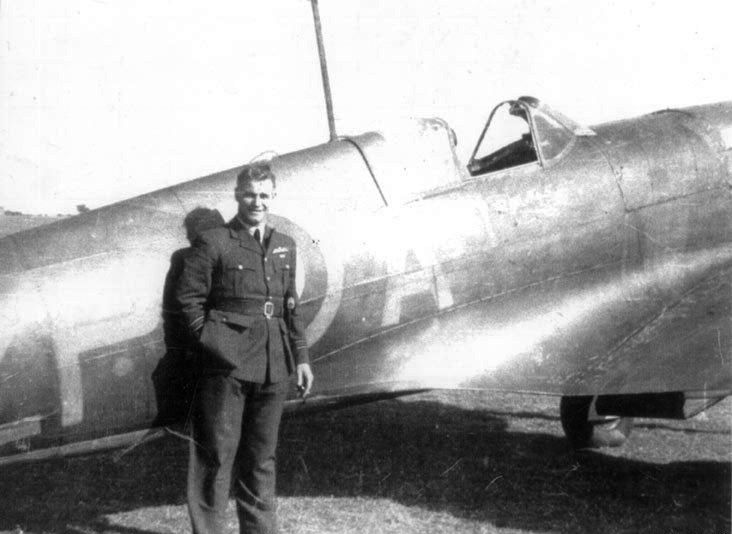
Acting F/L Adolph G “Sailor” Malan of No 74 Squadron RAF
No. 74 Squadron saw its first action only 15 hours after war was declared, sent to intercept a bomber raid that turned out to be returning RAF planes. On 6th September 1939, “A” Flight was scrambled to intercept a suspected enemy radar track and ran into the Hurricanes of No. 56 Squadron RAF. Believing 56 to be the enemy, Malan ordered an attack. Paddy Byrne and John Freeborn downed two RAF aircraft, killing one officer, Montague Hulton-Harrop, in this friendly fire incident, which became known as the Battle of Barking Creek. At the subsequent courts-martial, Malan denied responsibility for the attack. He testified for the prosecution against his own pilots stating that Freeborn had been irresponsible, impetuous, and had not taken proper heed of vital communications. This prompted Freeborn’s counsel, Sir Patrick Hastings to call Malan a bare-faced liar. Hastings was assisted in defending the pilots by Roger Bushell, the London barrister and RAF Auxiliary pilot who later led the Great Escape from Stalag Luft III. The court ruled the entire incident was an unfortunate error and acquitted both pilots.

Still from gun camera film shot by Flight Lieutenant A G “Sailor” Malan, leader of ‘A’ Flight, No. 74 Squadron RAF, recording his first aerial victory, a Heinkel He 111 over Dunkirk. Although debris and billowing smoke issue from the Heinkel’s starboard engine and the starboard undercarriage has dropped, Malan’s claim was categorised as unconfirmed since he did not observe the aircraft’s destruction. ‘A’ Flight was based at Hornchurch but was flying out of Rochford at this time in order to shorten the patrol range to France. By the end of July 1941, Malan had achieved a total of 27 and seven shared confirmed victories, and two and one shared unconfirmed victories to become the highest scoring pilot of the war in Fighter Command.
Events soon overtook the squadron. After fierce fighting over Dunkirk during the evacuation of Dunkirk on 28th June 1940, Malan was awarded the Distinguished Flying Cross having achieved five ‘kills’. During this battle he first exhibited his fearless and implacable fighting spirit. In one incident he was able to coolly change the light bulb in his gunsight while in combat and then quickly return to the fray. During the night of 19th/20th June Malan flew a night sortie in bright moonlight and shot down two Heinkel He-111 bombers, a then unique feat for which a bar to his DFC was awarded. On 6th July, he was promoted to the substantive rank of flight lieutenant.
Malan and his senior pilots also decided to abandon the “vic” formation used by the RAF, and turned to a looser formation (the “finger-four”) similar to the four aircraft Schwarm the Luftwaffe had developed during the Spanish Civil War. Legend has it that on 28th July he met Werner Mölders in combat, damaging his plane and wounding him, but failing to bring him down. Recent research has suggested however that Mölders was wounded in a fight with No. 41 Squadron RAF.

Battle of Britain ace, ‘Sailor’ Malan in the cockpit of his Spitfire
On 8th August, Malan was given command of 74 Squadron and promoted to acting squadron leader. This was at the height of the Battle of Britain. Three days later, on 11th August, action started at 7 am when 74 was sent to intercept a raid near Dover, but this was followed by another three raids, lasting all day. At the end of the day, 74 had claimed to have shot down 38 aircraft, and was known from then on as “Sailor’s August the Eleventh”. Malan himself simply commented, “thus ended a very successful morning of combat.” He received a bar to his DFC on 13th August.
On the ground, Malan was remembered as an inveterate gambler and often owed his subordinates money. Malan was older than most of his charges and although sociable and relaxed off-duty, he spent most of his time with his wife and family living near Biggin Hill. He would soon develop a routine of flying the first sortie of the day and then handing the squadron to a subordinate while he stayed on the ground to do paperwork. Despite frosty relations after the Battle of Barking Creek he would often give command of the squadron to John Freeborn (himself an ace of note), showing Malan’s ability to keep the personal and professional separate.
Malan commanded 74 Squadron with strict discipline and did not suffer fools gladly, and could be high-handed with sergeant pilots (many non-commissioned pilots were joining the RAF at this time). He could also be reluctant to hand out decorations, and he had a strict yardstick by which he would make recommendations for medals: six kills confirmed for a DFC, twelve for a bar to the DFC; eighteen for a DSO.
On 29th December 1941 Malan was added to the select list of airmen who had sat for one of Cuthbert Orde’s iconic charcoal portraits. He also had the far rarer honour of having Orde paint a full colour painting.

611 Squadron Biggin Hill 23rd September 1942 – 1st July 1943 Sqn. pilots with Gp. Cpt. Sailor Malan
On 24th December, Malan received the Distinguished Service Order, and on 22nd July 1941, a bar to the Order. On 10th March 1941 he was appointed as one of the first wing leaders for the offensive operations that spring and summer, leading the Biggin Hill Wing until mid August, when he was rested from operations. He finished his active fighter career in 1941 with 27 kills destroyed, 7 shared destroyed and 2 unconfirmed, 3 probables and 16 damaged, at the time the RAF’s leading ace, and one of the highest scoring pilots to have served wholly with Fighter Command during World War II. He was transferred to the reserve as a squadron leader on 6th January 1942.
After tours to the USA and the Central Gunnery School, Malan was promoted to temporary wing commander on 1st September 1942 and became station commander at Biggin Hill, receiving a promotion to war substantive wing commander on 1st July 1943. Malan remained keen to fly on operations, often ignoring standing orders for station commanders not to risk getting shot down. In October 1943 he became officer commanding 19 Fighter Wing, RAF Second Tactical Air Force, then commander of the 145 (Free French) Fighter Wing in time for D-day, leading a section of the wing over the beaches during the late afternoon.

Armstrong centre, left is Sq/Ldr. Slater AFC Killed on the 14th March 1943 with right Gp/Cpt. Sailor Malan
Although not an instinctive, gifted pilot Malan was an exceptional shot and a very aggressive air fighter, and above all a superb tactician who instilled the methods and techniques he had honed in 1940 into successive generations of young fighter pilots who followed him.
Malan developed a set of simple rules for fighter pilots, to be disseminated throughout RAF Fighter Command, which eventually could be found tacked to the wall of most airbases:-
TEN OF MY RULES FOR AIR FIGHTING
Wait until you see the whites of his eyes. Fire short bursts of one to two seconds only when your sights are definitely “ON”.
Whilst shooting think of nothing else, brace the whole of your body: have both hands on the stick: concentrate on your ring sight.
Always keep a sharp lookout. “Keep your finger out”.
Height gives you the initiative.
Always turn and face the attack.
Make your decisions promptly. It is better to act quickly even though your tactics are not the best.
Never fly straight and level for more than 30 seconds in the combat area.
When diving to attack always leave a proportion of your formation above to act as a top guard.
INITIATIVE, AGGRESSION, AIR DISCIPLINE, and TEAMWORK are words that MEAN something in Air Fighting.
Go in quickly – Punch hard – Get out!

On 5th April 1946, Malan resigned his RAF commission, retaining the rank of group captain and returned to South Africa where he joined the Torch Commando a joint project of the anti-fascist ex-servicemen’s organisation, the Springbok Legion and the War Veterans Action committee. Sailor Malan became the president of that new organization. In Malan’s words, it was “established to oppose the police state, abuse of state power, censorship, racism, the removal of the coloured vote and other oppressive manifestations of the creeping fascism of the National Party regime”.
Amongst the leading members of the Springbok Legion were many ex-servicemen who would later join the African National Congress and its armed wing, Umkhonto we Sizwe under the leadership of Nelson Mandela. Amongst these were Joe Slovo, Jack Hodgson, Wolfie Kodesh, Brian Bunting and Fred Carneson. After the National Party came to power and began to implement its policies, many found the Springbok Legion, founded in 1941, to be too left orientated and too radical. In 1950 members of the Springbok Legion began to work with other more liberal organizations and even the United Party official opposition, to find new ways to mobilise protest support against a string of Apartheid laws.
In 1951 the Springbok Legion, formed a protest group together with the War Veterans Action Committee, to appeal to a broader base of ex-servicemen, which they called the ‘Torch Commando’, as a tactic to fight the National Party’s plans to remove Cape’s “coloured” voters from the roll. Harry Schwarz, an ex-serviceman and later a leading figure in the anti-apartheid movement was one of the founders of the organization. The Torch Commando fought a battle for more than five years, and at its height had 250,000 members. The government was so alarmed by the number of judges, public servants and military officers joining the organisation that a new law was passed to ban anyone in public service or the military from joining. The National Party tried to purge the memory of the Springbok Legion, Torch Commando and of Sailor Malan from history because there was a fear that young Afrikaners in particular might want to emulate Malan.

Torch Commando manifesto (freedom being the central theme)

Sailor Malan at a Torch Commando Rally in Cape Town with 10 thousand South African WW2 veterans on protest.
At its largest Torch Commando protest rally, the Springbok Legion attracted 75,000 people. In a speech at a rally outside City Hall in Johannesburg, Malan made reference to the ideals for which the Second World War was fought: “The strength of this gathering is evidence that the men and women who fought in the war for freedom still cherish what they fought for. We are determined not to be denied the fruits of that victory.”
Malan died in 1963 from Parkinson’s Disease, at the time a rare and essentially mysterious malady. A considerable sum of money was raised in his name to further study the disease, a fund that continues to this day.
The Nationalist government of the day (several of whom (including Balthazar John Vorster Prime Minister of South Africa 1966-78 were openly war-time Nazi sympathizers and members of the Ossewabrandwag) controversially denied Malan a State funeral in 1963. This active snub further entrenched increasing post-independent anti-British sentiment within South Africa after 1948 and outraged many South African WW2 veterans who had regarded Malan as a South African WW2 hero and as a patriot . The perception that the Nationalists acted more favorably to another South African Sidney Robie Liebbrandt (deceased 1966 had allegedly spied for Germany, sentenced to death for high treason and later pardoned and whom the Nazis had landed by boat off the South African coast in 1941), only added salt to the wound left by the refusal of a State funeral for Malan.
He was survived by his wife, Lynda, son Jonathan, and daughter Valerie.

Battle of Britain Film 1969 actor Robert Shaw
In the 1969 war film Battle of Britain, the Robert Shaw character ‘Squadron Leader Skipper’ was explicitly based on Malan, as recounted by director Guy Hamilton in the documentary ‘A Film for the Few’, which was included with the 2004 Special Edition DVD release. At one point early in the film, Skipper gives advanced air combat manoeuvring training to an inexperienced pilot, and angrily barks “Never fly straight and level for more than 30 seconds in the combat area!” —quoting one of Malan’s rules.
Hobbymaster Spitfire Mk.I K9953/ZP-A, Flt. Lt. Adolph Malan, No. 74 Squadron, Hornchurch, May/June 1940
I have added all the latest 1/48th scale models from Hobbymaster. Please click on the photo below to take a closer look at the latest MKI Spitfire from Hobbymaster.

New Hobbymaster Pre-Order models now available to order at Flying Tigers.
I have added all the latest Hobbymaster models to the website and they are available to pre-order now. Please CLICK HERE to see them all or click on the individual images below to go straight to the model of your choice.


Oxford Diecast Military Vehicles
I have added loads of new models which are either available from stock or available to pre-order. Please click on the individual photos below to go to the model of your choice, or CLICK HERE to see them all.
Great models to add to your dioramas, I have shown just a few of them below…and more to be added over the following week !


That’s all for this week. Thanks for taking time out to read this week’s Newsletter.
Richard.
Flying Tigers.