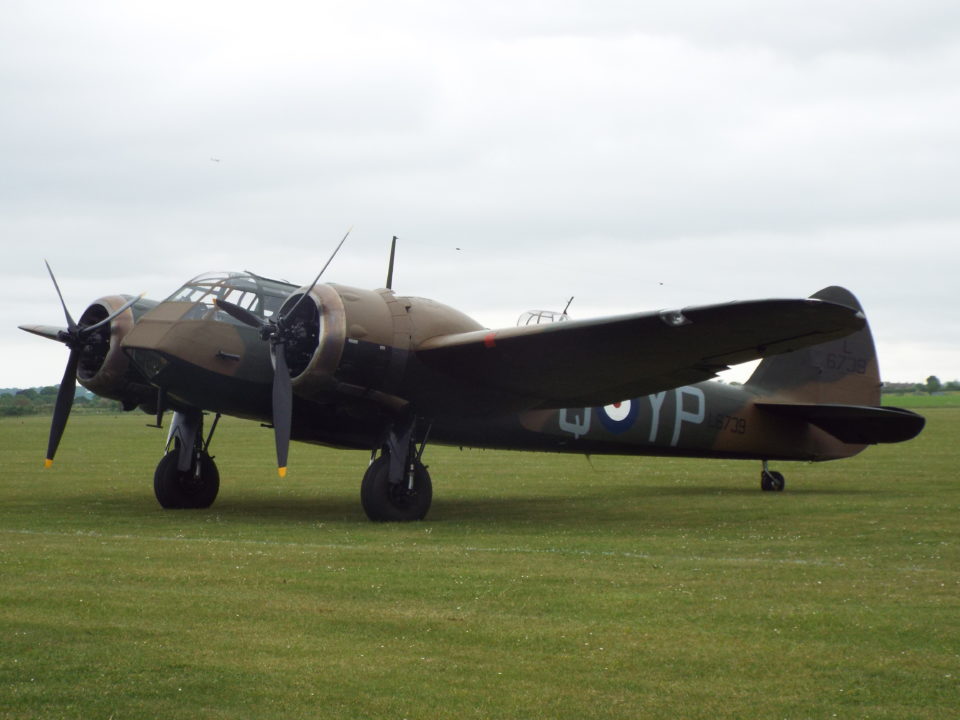
Bristol Blenheim Duxford VE Day Airshow 23rd May 2015
The Bristol Blenheim is a British light bomber aircraft designed and built by the Bristol Aeroplane Company that was used extensively in the first two years of the Second World War. It was adapted as an interim long-range and night fighter, pending the availability of the Beaufighter. It was one of the first British aircraft to have all-metal stressed-skin construction, retractable landing gear, flaps, a powered gun turret and variable-pitch propellers.
A Canadian-built variant named the Bolingbroke was used as an anti-submarine patrol aircraft and trainer. The Blenheim Mk I outran most biplane fighters in the late 1930s but stood little chance against the German Messerschmitt Bf 109 during daylight operations, though it proved very successful as a night fighter. The Mark IV variant was equally unsuccessful in its daylight bombing role, suffering many losses in the early stages of the war.
In 1934, Lord Rothermere, owner of the Daily Mail newspaper, challenged the British aviation industry to build a high-speed aircraft capable of carrying six passengers and two crew members. At the time, German firms were producing a variety of record-breaking high-speed designs, such as the single-engined Heinkel He 70, and Rothermere wanted to recapture the title of fastest civilian aircraft in Europe. Bristol had been working on a suitable design as the ‘Type 135’ since July 1933, and further adapted it to produce the Type 142 to meet Rothermere’s requirements.
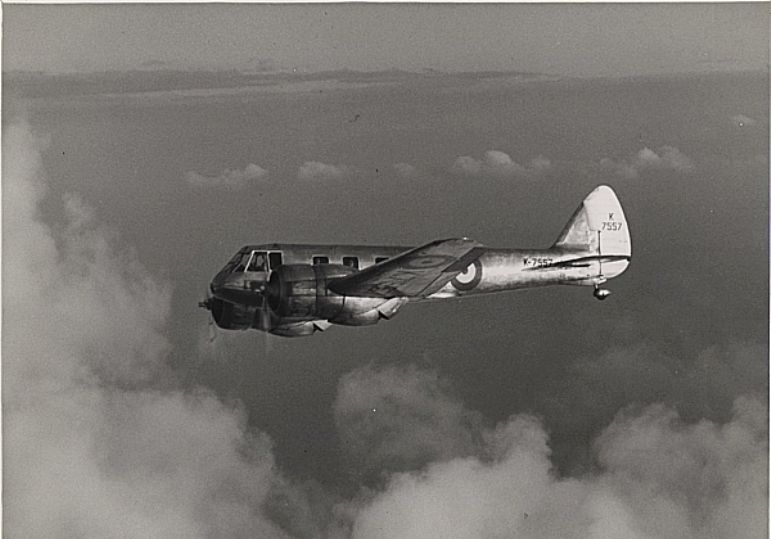
K7557 Britain First in flight circa 1935
Named ‘Britain First’, this first flew at Filton on 12th April 1935 and proved to be faster than any fighter in service with the Royal Air Force at the time. The Air Ministry was obviously interested in such an aircraft and quickly sent out Specification B.28/35 for prototypes of a bomber version; the ‘Type 142M’ (M for military). The main change was to move the wing from a low-wing to a mid-wing position, allowing room under the main spar for a bomb bay. The aircraft was all-metal with two Bristol Mercury VIII air-cooled radial engines, each of 860 hp (640 kW). It carried a crew of three – pilot, navigator/bombardier and telegraphist/air gunner. Armament comprised a single forward-firing .303 in (7.7 mm) Browning machine gun outboard of the port engine and a .303 in (7.7 mm) Lewis Gun in a semi-retracting Bristol Type B Mk I dorsal turret firing to the rear. From 1939 onwards, the Lewis gun was replaced by the more modern .303 in (7.7 mm) Vickers VGO machine gun of the same calibre. A 1,000 lb (450 kg) bomb load could be carried in the internal bay.
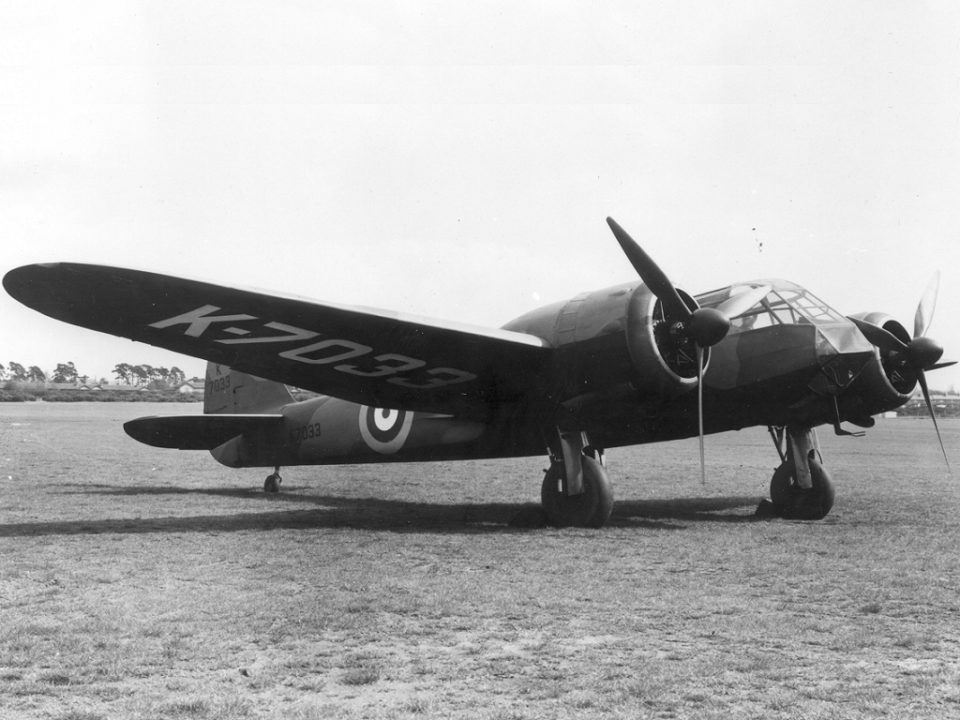
Bristol Blenheim prototype K7033
To achieve its relatively high speed, the Blenheim had a very small fuselage cross-section, with its upper front glazing all at one angle in the form of a “step-less cockpit”, that used no separate windscreen panels for the pilot, a notable feature of a substantial majority of German bomber designs, first conceived during the war years. The pilot’s quarters on the left side of the nose were so cramped that the control yoke obscured all flight instruments while engine instruments eliminated the forward view on landings. Most secondary instruments were arranged along the left side of the cockpit, with essential items like propeller pitch control actually placed behind the pilot where they had to be operated by feel alone. Like most contemporary British aircraft, the bomb bay doors were kept closed with bungee cords and opened under the weight of the released bombs. Because there was no way to predict how long it would take for the bombs to force the doors open, bombing accuracy was consequently poor.
The aircraft was ordered directly from the drawing board with the first production model serving as the only prototype. The service name then became Blenheim Mk I after the famous battle during the War of the Spanish Succession. Subsequent deliveries started on 10th March 1937, with 114 Squadron being the first squadron to receive the Blenheim. The aircraft was built under license by countries including Finland and Yugoslavia, which built 60 aircraft. Other countries bought it, including Romania, Greece and Turkey. Total production of the Blenheim Mk I in England was 1,351 aircraft.
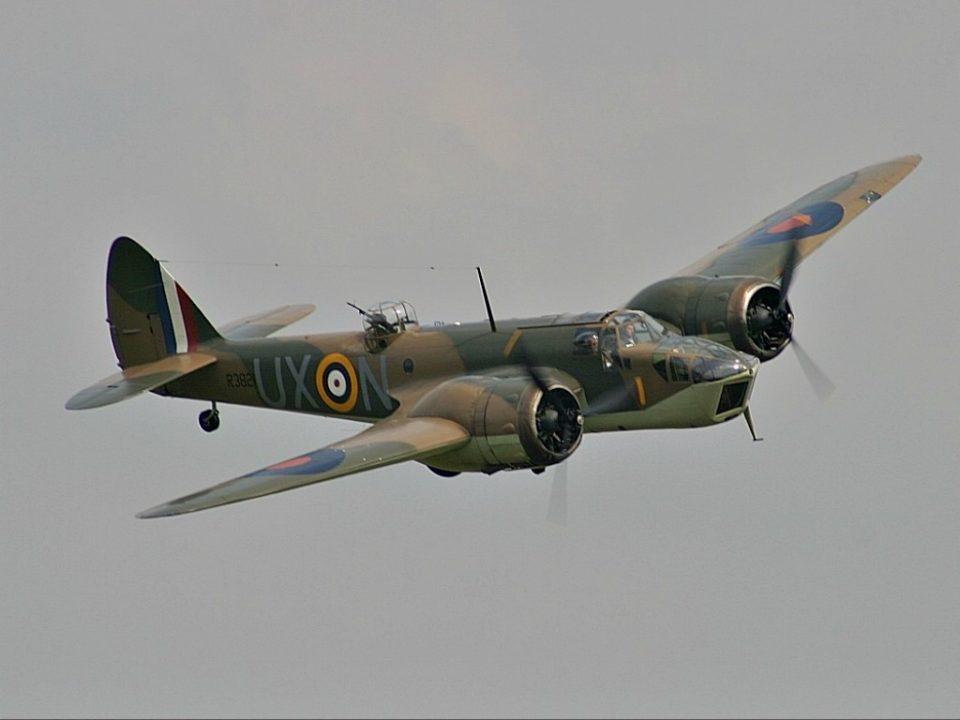
Bristol Blenheim Mk IV
Work on an extended-range reconnaissance version started as the Blenheim Mk II, which increased tankage from 278 gal (1,264 L) to 468 gal (2,127 L), but only one was completed. Another modification resulted in the Blenheim Mk III, which lengthened the nose, and thereby dispensed with the “step-less cockpit” format of the Mk.I in introducing a true windscreen in front of the pilot, to provide more room for the bombardier. This required the nose to be “scooped out” in front of the pilot to maintain visibility during take-off and landing. However both of these modifications were instead combined, along with a newer version of the Mercury engine with 905 hp (675 kW) and the turret acquired a pair of Brownings instead of the Vickers K; creating the Blenheim Mk IV. A total of 3,307 were produced.
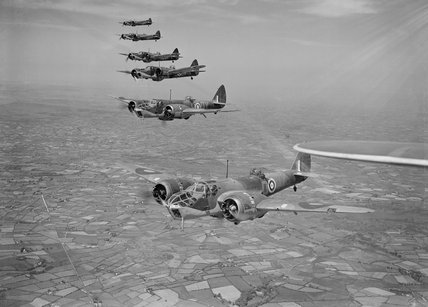
Bristol Blenheim Mk IVFs of No. 254 Squadron RAF flying from Aldergrove in Northern Ireland
Another modification led to a long-range fighter version; the Blenheim Mk IF. For this role, about 200 Blenheims were fitted with a gun pack under the fuselage for four .303 in (7.7 mm) Brownings. Later, the Airborne Intercept (AI) Mk III or IV radar was fitted to some aircraft in use as night fighters; these were the first British fighters to be equipped with radar. Their performance was marginal as a fighter, but they served as an interim type, pending availability of the Beaufighter. About 60 Mk IVs were also equipped with the gun pack as the Mk IVF and were used by Coastal Command to protect convoys from German long-range bombers.
The last bomber variant was conceived as an armoured ground attack aircraft, with a solid nose containing four more Browning machine guns. Originally known as the Bisley, (after the shooting competitions held at Bisley), the production aircraft were renamed Blenheim Mk V and featured a strengthened structure, pilot armour, interchangeable nose gun pack or bombardier position, and yet another Mercury variant, this time with 950 hp (710 kW). The Mk V was ordered for conventional bombing operations, with the removal of armour and most of the glazed nose section. The Mk V, or Type 160, was used primarily in the Middle East and Far East.
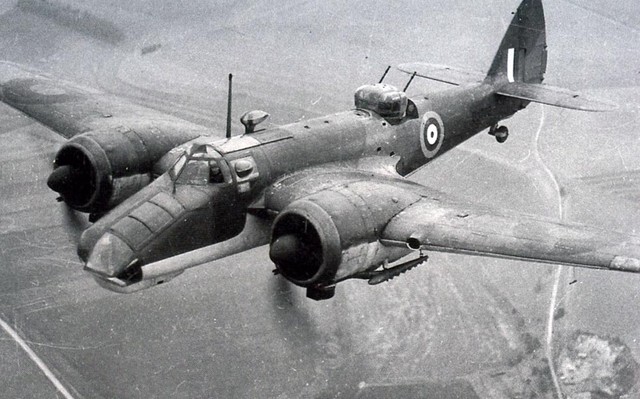
Bristol Blenheim MK V
The Blenheim served as the basis for the Beaufort torpedo bomber, which itself led to the Beaufighter, with the lineage performing two complete circles of bomber-to-fighter.
On the day that war was declared on Germany, a Blenheim piloted by Flying Officer Andrew McPherson was the first British aircraft to cross the German coast and the following morning 15 Blenheims from three squadrons set off on one of the first bombing missions. With the rapid advances in technology which had taken place in the late 1930s, by then the aircraft was already obsolescent. The Blenheim was regarded as a pleasant aircraft to fly, although it did have some characteristics which could catch even experienced pilots by surprise. It had become heavier as extra service equipment was installed; much of this was found to be needed through operational experience. This, coupled with the rapid performance increases of fighters, had eclipsed the Blenheim’s speed advantage.
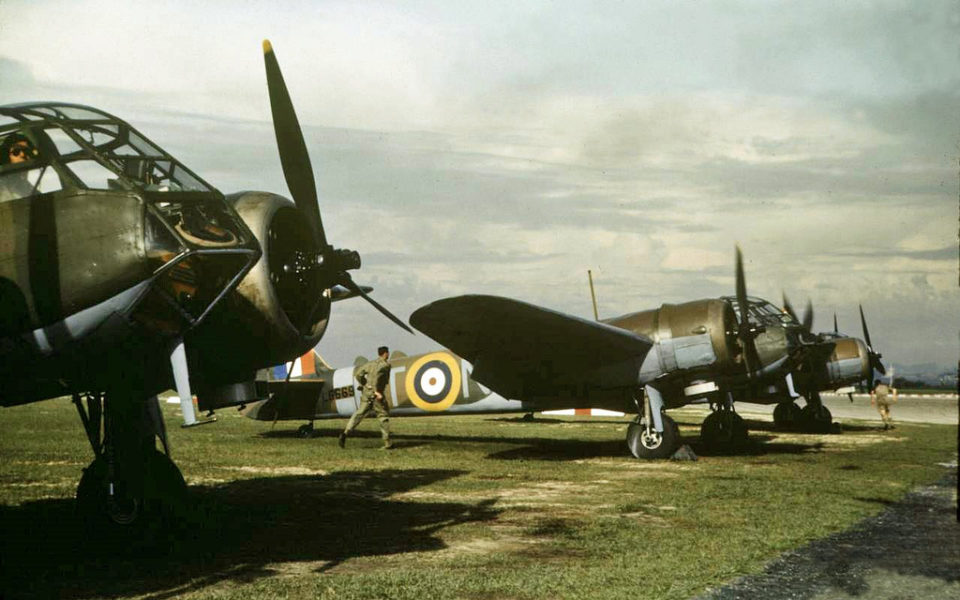
Blenheim Mk1F, Singapore, April 1941.
The light armament of one .303 in (7.7 mm) Vickers VGO in the turret and one .303 in (7.7 mm) Browning machine gun in the port wing was seldom able to deter fighter opposition. Squadrons were forced to use several different improvisations in an attempt to provide better defensive armament, until officially sanctioned modifications were able to be introduced in early 1940. The Blenheim also proved to be vulnerable to flak, especially around the rear fuselage. Flexible, self-sealing liners had been fitted to the fuel tanks but they were still not fully protected against the 20 mm MG FF cannon carried by the Luftwaffe’s Bf 109s and Bf 110s.
After France fell to Germany in June 1940, the Free French Air Force was formed at RAF Odiham in the form of Groupe Mixte de Combat (GMC) 1, consisting of a mixed bag of Blenheims and Westland Lysander liaison/observation aircraft, which eventually went to North Africa and saw action against the Italians and Germans.
The Blenheim units operated throughout the Battle of Britain, often taking heavy casualties, although they were never accorded the publicity of the fighter squadrons.
The Blenheim units raided German occupied airfields throughout July to December 1940, both during daylight hours and at night. Although most of these raids were unproductive, there were some successes; on 1st August five out of 12 Blenheims sent to attack Haamstede and Evere (Brussels) were able to bombs, destroying or heavily damaging three Bf 109s of II./JG 27 and apparently killing a Staffelkapitän identified as Hauptmann Albrecht von Ankum-Frank. Two other 109s were claimed by Blenheim gunners. Another successful raid on Haamstede was made by a single Blenheim on 7th August which destroyed one 109 of 4./JG 54, heavily damaged another and caused lighter damage to four more.
There were also some missions which produced an almost 100% casualty rate amongst the Blenheims. One such operation was mounted on 13th August 1940 against a Luftwaffe airfield near Aalborg in north-western Denmark by 12 aircraft of 82 Squadron. One Blenheim returned early (the pilot was later charged and due to appear before a court martial, but was killed on another operation); the other 11, which reached Denmark, were shot down, five by flak and six by Bf 109s.
Blenheim-equipped units had been formed to carry out long-range strategic reconnaissance missions over Germany and German-occupied territories, as well as bombing operations. In this role, the Blenheims once again proved to be too slow and vulnerable against Luftwaffe fighters and they took constant casualties.
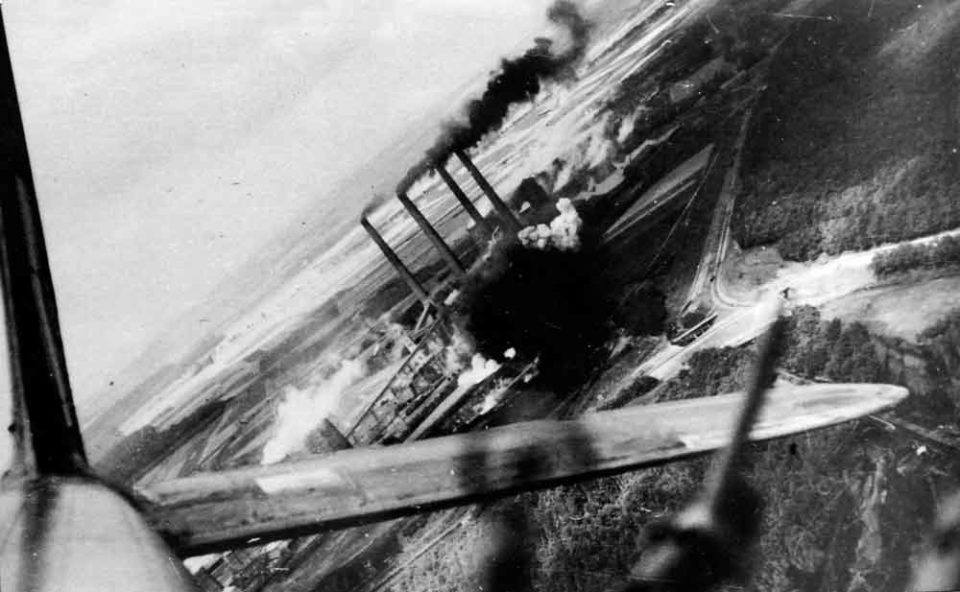
The view from a Blenheim bomber as it finishes its bomb run over the other Cologne power station with bombs exploding on target.
The action against Cologne power stations on 12th August 1941 was described by the Daily Telegraph in 2006 as the “RAF’s most audacious and dangerous low-level bombing raid, a large-scale attack against power stations near Cologne.” The raid was a low-level daylight raid by 54 Blenheims under the command of Wing Commander Nichol of No. 114 Squadron RAF. The Blenheims hit their targets (Fortuna Power Station in Oberaußem-Fortuna and the Goldenberg Power Station in Hürth-Knapsack) but 12 of the Blenheims were lost during the raid, 22% of those that took part, which was far above the sustainable loss rate of less than 5%. The England cricketer Sqn Ldr Bill Edrich was awarded the DFC for his part in the raid.
The Bristol Blenheim was used by both Bomber and Fighter Commands. Some 200 Mk I bombers were modified into Mk IF long-range fighters with 600 (Auxiliary Air Force) Squadron based at Hendon, the first squadron to take delivery of these variants in September 1938. By 1939, at least seven squadrons were operating these twin-engined fighters and within a few months, some 60 squadrons had experience of the type. The Mk IF proved to be slower and less nimble than expected, and by June 1940, daylight Blenheim losses were to cause concern for Fighter Command. It was then decided that the Mk IF would be relegated mainly to night fighter duties where No. 23 Squadron RAF, which had already operated the type under night time conditions, had better success.

Bristol Blenheim MkIVF Night Fighter
In the German night-bombing raid on London on 18th June 1940, Blenheims accounted for five German bombers, thus proving that they were better-suited for night fighting. In July, No. 600 Squadron, by then based at RAF Manston, had some of its Mk IFs equipped with AI Mk III radar. With this radar equipment, a Blenheim from the Fighter Interception Unit (FIU) at RAF Ford achieved the first success on the night of 2nd–3rd July 1940, accounting for a Dornier Do 17 bomber. More successes came, and before long the Blenheim proved itself invaluable as a night fighter. Gradually, with the introduction of the Bristol Beaufighter in 1940–1941, the Blenheim was supplanted by its faster, better-armed descendant.
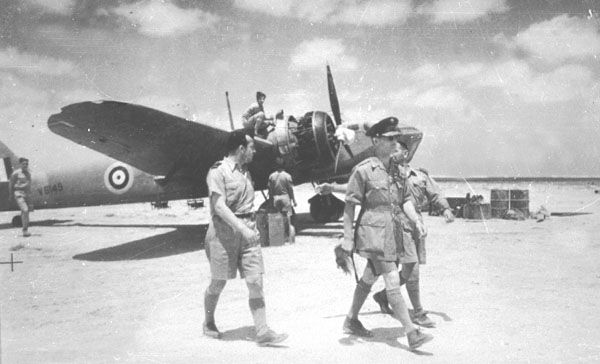
Bristol Blenheim Mk.IV, V6149, 13th Hellenic Squadron, Egypt
Blenheims continued to operate widely in many combat roles until about 1943, equipping RAF squadrons in the UK and on British bases in Egypt, Iraq, Aden, India, British Malaya, Singapore, and the Dutch East Indies. Many Blenheims were lost to Japanese fighters during the Malayan Campaign, battles for Singapore, and Sumatra. By that point, the traditional daylight light bomber role was more effectively carried out by suitable fighter-bombers, and the surviving examples were relegated to training duties. Nonetheless, the Blenheim played a role in preventing India from falling and recapturing Burma, destroying over 60 aircraft on the ground in raids on Bangkok early in the campaign.
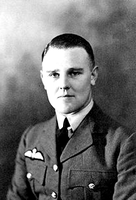
Arthur Scarf VC
One Blenheim pilot, Squadron Leader Arthur Scarf, was posthumously awarded the Victoria Cross for an attack on Singora, Thailand, on 9th December 1941. Another bomber of No. 60 Squadron RAF was credited with shooting down Lt Col Tateo Katō’s Nakajima Ki-43 fighter and badly damaging two others in a single engagement on 22nd May 1942, over the Bay of Bengal. Katō’s death was a severe blow to the Imperial Japanese Army Air Force.
The Air Ministry’s replacement for the Blenheim as a daylight bomber, another Bristol design, the Buckingham, was overtaken by events and changes in requirements and considered inferior to the de Havilland Mosquito, and as such did not see combat. The final ground-attack version – the Blenheim Mk V – first equipped 139 Squadron in June 1942. Eventually 13 squadrons – mainly in the Middle East and Far East – received this variant but operated them generally only for a few months.

Bristol Blenheim Mk I Finnish Air Force
In 1936, the Finnish Air Force ordered 18 Blenheim Mk Is from Britain and two years later, they obtained a manufacturing license for the aircraft. Before any aircraft could be manufactured at the Valtion lentokonetehdas (State Aeroplane Factory) in Finland, the Winter War broke out, forcing the Finns to order more aircraft from the UK. A further 24 British-manufactured Blenheims were ordered during the Winter War. After the Winter War, 55 Blenheims were constructed in Finland, bringing the total number to 97 aircraft (75 Mk Is and 22 Mk IVs)
The Finns also received 20 half-completed ex-Yugoslavian Mk IV Blenheims captured by Germany, together with manufacturing tools and production equipment, as well as a huge variety of spare parts. Yugoslavia had ceased production of the Mk I and commenced a production run of Mk IVs just prior to the April 1941 invasion.

Bristol Blenheim Mk I Finnish Air Force
The Finnish Blenheims flew 423 missions during the Winter War, and close to 3,000 missions during the Continuation War and Lapland War. Blenheim machine-gunners also shot down eight Soviet aircraft. Thirty-seven Blenheims were lost in combat during the wars.
After the war, Finland was prohibited from flying bomber aircraft by the Paris Peace Treaty, with Finland’s Blenheims being placed into storage in 1948. However, in 1951, five Blenheims were re-activated for use as target tugs, with the last flight of a Finnish Blenheim taking place on 20 May 1958.
Bristol Blenheim/ Bolingbroke Survivors.
An airworthy Blenheim had been rebuilt from a scrapped Bolingbroke over a 12-year period, only to crash at an air show at Denham within a month of completion in 1987.
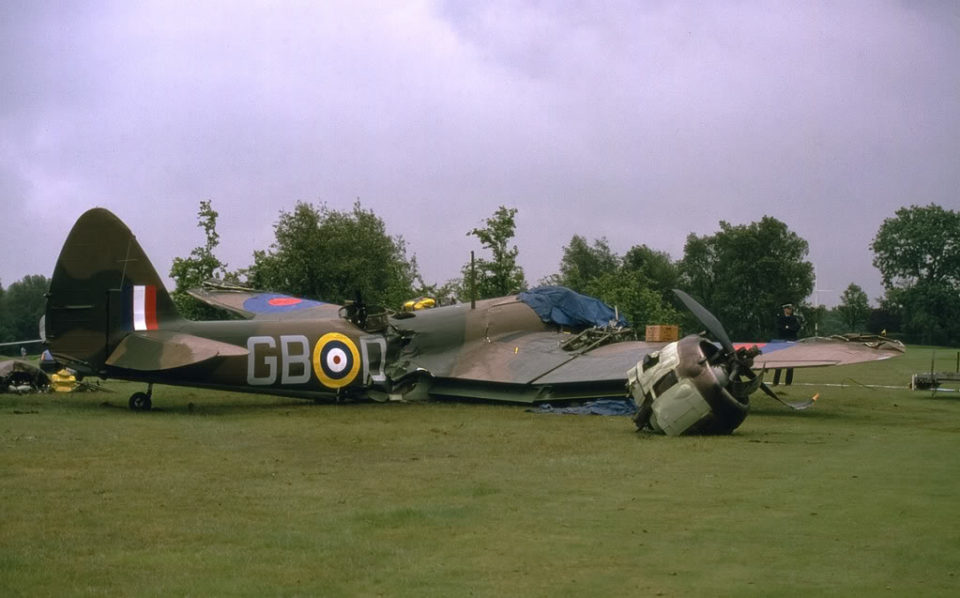
Bristol Blenheim crash at Denham 1987
A replacement Bolingbroke Mk IVT was rebuilt to flying status in just five years and painted to represent a Blenheim Mk IV in RAF wartime service. It began appearing at air shows and exhibitions in the UK, flying since May 1993 and was used in the 1995 film version of Shakespeare’s Richard III. This aircraft crashed on landing at Duxford on 19th August 2003; the crash was feared to have made it a write-off, but after extensive repair and conversion to the Mark I “Short nose” version by The Aircraft Restoration Company (ARC or ARCo) at Duxford, was displayed to the public on 30th May 2014, and first flew for 29 minutes on 20th November 2014, following restoration at the Imperial War Museum Duxford, Cambridgeshire, England.

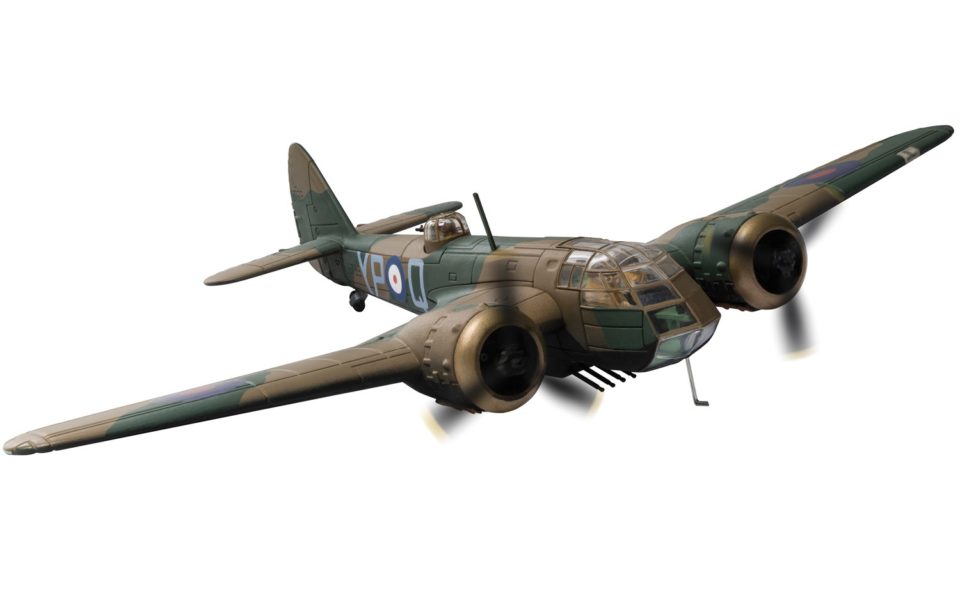
The only flying Blenheim (Mk.1 L6739) displaying at Duxford in 2015.(the subject of Corgi Aviation Archives latest model below).
In Canada, a number of other Bolingbrokes survived the war but were summarily consigned to the scrap heap. Post-war, enterprising farmers often bought surplus aircraft such as these for the scrap metal content, tyres for farm implements, and even for the fuel remaining in the tanks. Some surviving examples in Canada of the Bolingbroke can be traced back to this period. The Canadian Warplane Heritage Museum in Hamilton, Ontario is rebuilding a Bolingbroke to airworthy status. The Commonwealth Air Training Plan Museum in Brandon, Manitoba has restored the exterior of one Bolingbroke, painting it in the Air Training Plan yellow colour. This particular aircraft is on display at a location on the Trans-Canada Highway in Brandon.
A restored Bolingbroke is on static display at the British Columbia Aviation Museum in Victoria, British Columbia. The Canadian Museum of Flight at Langley Airport, Langley, British Columbia has on display the restored nose and cockpit section of a Bolingbroke, and holds the rest of an entire airframe in storage pending future restoration and display.
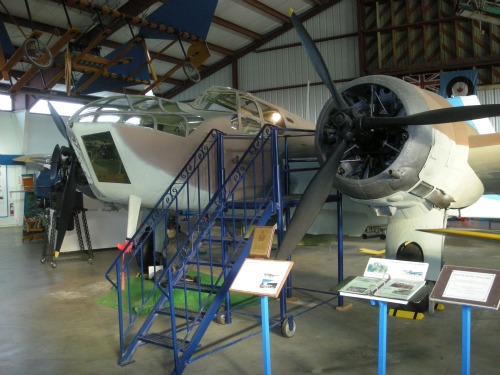
Front view of a Bristol Bolingbroke Mark IV at British Columbia Aviation Musuem,Canada
In Finland, the sole surviving original Blenheim in the world, a Mk IV registered as BL-200 of the Finnish Air Force, has been completely restored and is now on display at the Aviation Museum of Central Finland at Tikkakoski.
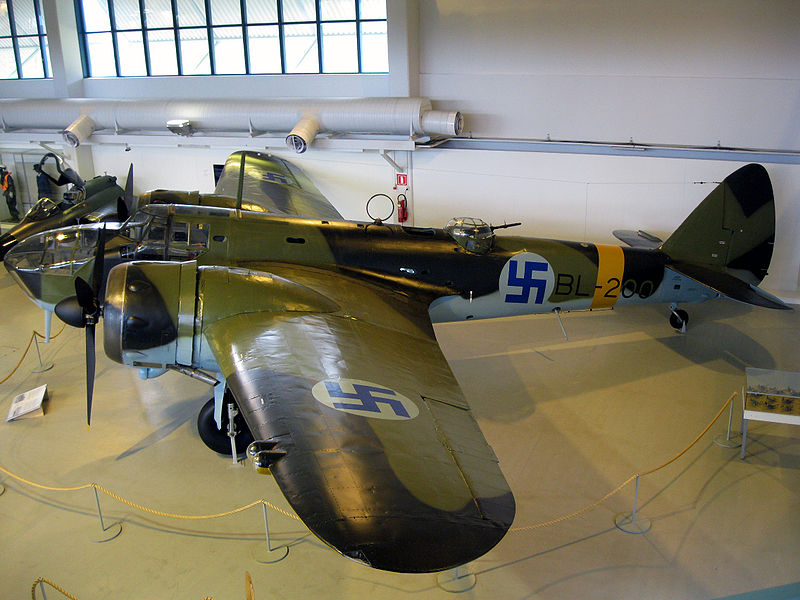
BL-200 (bearing the Hakaristi) at the Aviation Museum of Central Finland.
In the summer of 1996, a Bristol Blenheim Mk IVF was recovered from the sea, a few kilometres off Rethymnon, Crete. The aircraft belonged to No. 203 Squadron RAF and was downed by friendly fire on 28th April 1941. The Blenheim was moved to the Hellenic Air Force Museum for restoration.
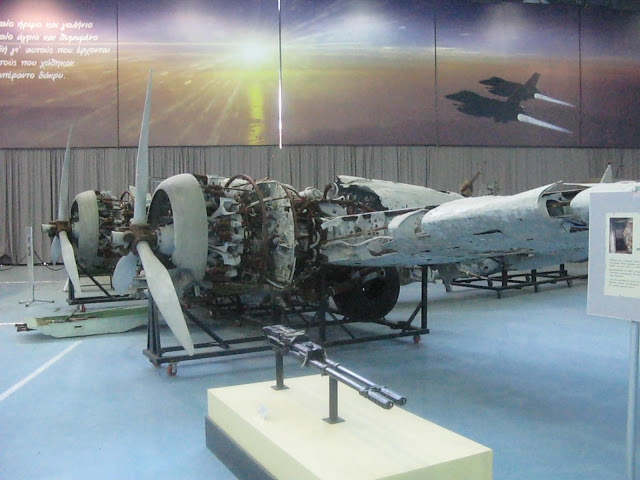
A salvaged Bristol Blenheim Mk IV F Hellenic Air Force Museum.
In Arizona, the Pima Air Museum has a Bristol Bollingbroke IVT (RCAF #10076) on static display.
In Belgium, the Royal Museum of the Armed Forces and Military History has Bristol Fairchild Bolingbroke IV-T (9895) on static display.
New Corgi Aviation Archive Bristol Blenheim.
Corgi’s new model of Imperial War Museum’s Bristol Blenheim Mk.I, L6739 (G-BPIV) is now available to pre-order and is already proving to be a very popular model. Please click on the image or link below to order your now.
Latest Model Arrivals at Sywell
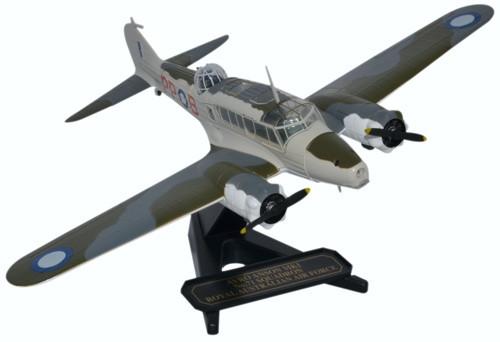
More models have arrived at Sywell this week and are being dispatched to those of you that have already pre-ordered these models. Please click on the images below to go straight to the model of your choice.
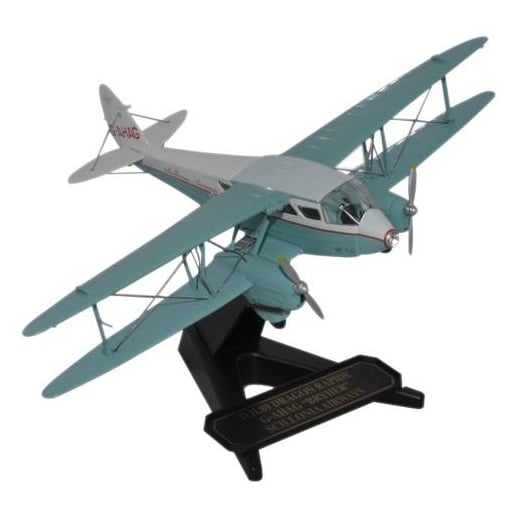
This aircraft recently made a visit to Sywell and I managed to get some great shots of it. It really is a beautifully restored aircraft ! I include a couple of them here…

DH Dragon Rapide G-AHAG Scillonia Airways at Sywell Aerodrome.
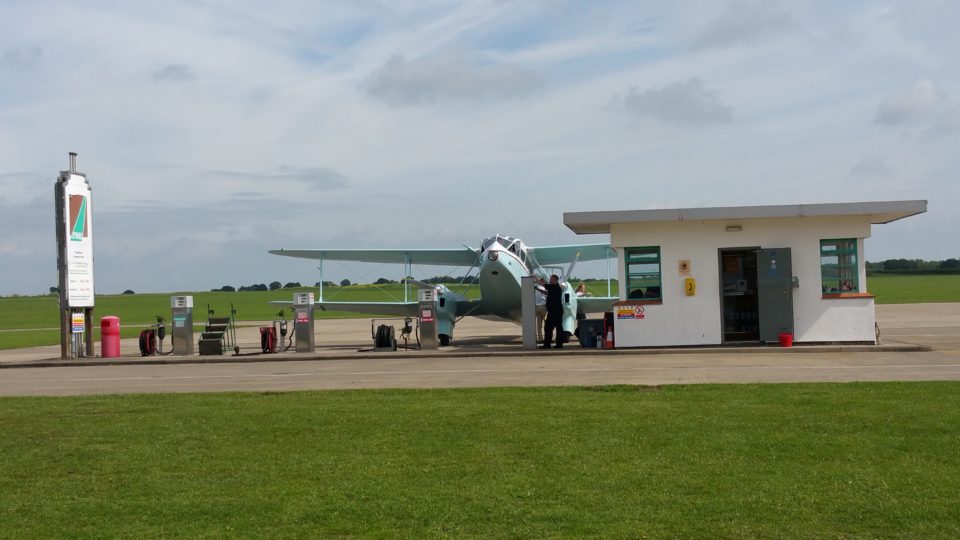
DH Dragon Rapide G-AHAG Scillonia Airways taking on fuel at Sywell Aerodrome
Latest Sale Offers added to “Offers of the Week”
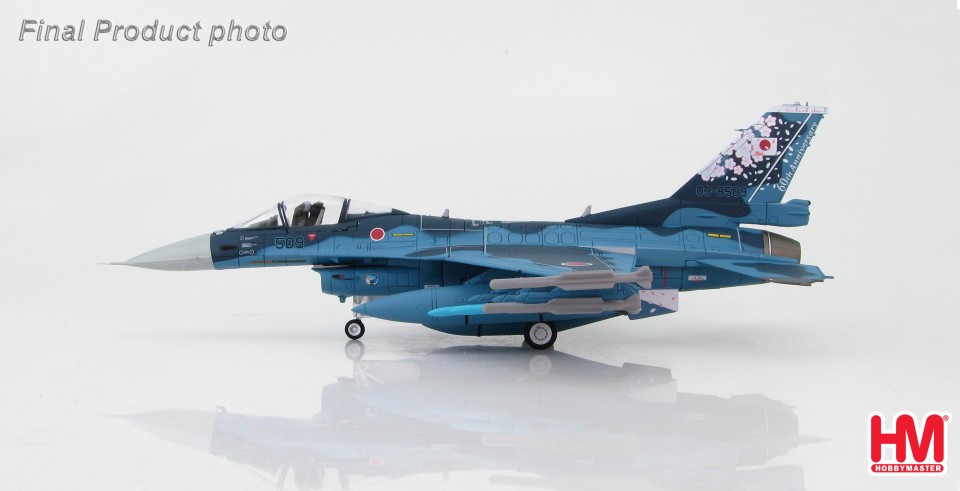
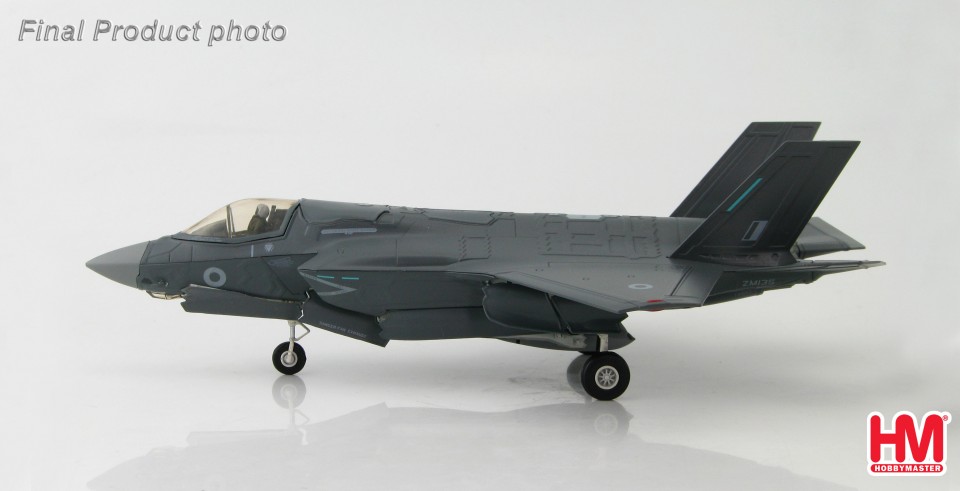
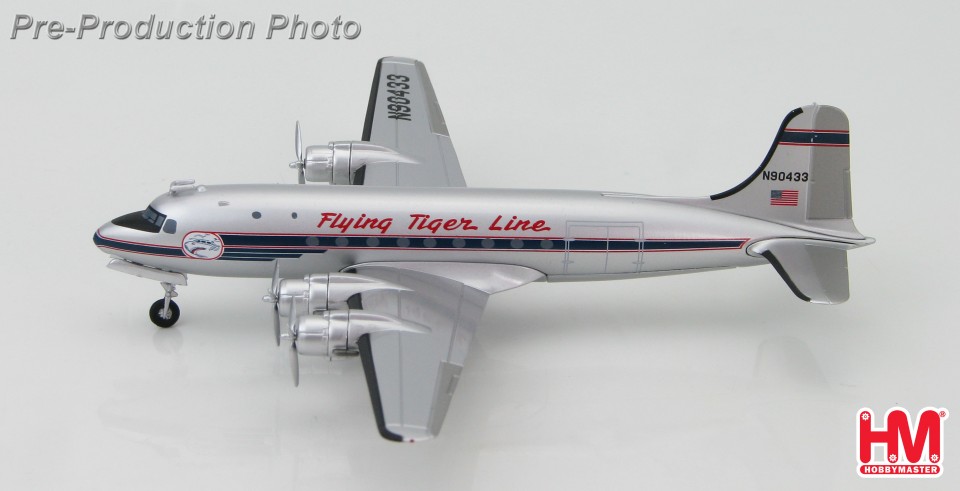
I have added some additional models to the “Offers of the Week” section on the website. Please click on the link HERE to see them all or on any of the images and links below to go straight to the model of your choice.

That’s it for this week. A busy weekend ahead with Flying Legends at Duxford and The Royal International Air Tattoo at Fairford. Let’s hope for some kind weather !
Thank you for taking time to read this week’s Newsletter.
Richard.
Flying Tigers.