Adolf Galland
During the final years of the Weimar Republic, jobs were scarce and life was hard for the Galland family economically. Adolf had some experience of flying gliders so he applied to the Deutsche Verkehrsfliegerschule or DVS (German Commercial Flying School) which was heavily subsidized by Luft Hansa. He was one of 100 successful applicants out of 4,000. After ten days of evaluations, he was among just 18 selected for flight training. Adolf was then assessed on performance. Those that did not reach the standard were sent home.

Adolf Galland’s first flight was in an Albatross L101
Galland’s first flight was in an Albatros L 101. His early career went badly. On one flight, he made a heavy landing and damaged the undercarriage of his aircraft. Later, while leading three aircraft in formation, two of them collided. No one was killed, but Galland was judged to have employed poor formation tactics. These incidents affected him so badly he was convinced he would soon be sent home, and he applied to join the German Army. In the meantime, he carried on with his flight training. Galland did not receive a reply from the Army and settled down to continue his training. Flights in an Albatross L 75 and the award of a B1 certificate allowing him to fly large aircraft over 2,500 kilograms (5,500 lb) in weight helped him regain his confidence. Around the same time, the Army accepted his application, but owing to his successful training and improved flying, the flying school refused to release him. By Christmas 1932, he had logged 150 hours flying and had obtained a B2 certificate.

Albatross L75a
Early in 1933, Galland was sent to the Baltic Sea training base at Warnemuende to train on flying boats. Galland disliked learning what he perceived to be “seamanship”, but logged 25 hours in these aircraft. Soon afterward, along with several other pilots, he was ordered to attend an interview at the Zentrale der Verkehrsflieger Schule (ZVS—Central Airline Pilot School). Here the group were interviewed by military personnel in civilian clothing. After being informed of a secret military training program being built that involved piloting high performance aircraft, all the pilots accepted an invitation to join the organisation.
In May 1933, Galland was ordered to a meeting in Berlin as one of 12 civilian pilots among 70 airmen who came from clandestine programmes, meeting Hermann Göring for the first time. Galland was impressed by and believed Göring to be a competent leader. In July 1933, Galland travelled to Italy to train with the Regia Aeronautica (Italian Air Force). Initially the Germans were treated as inferior by the Italians, but after Galland had flown some daring and impressive low-level manoeuvres, the German contingent won their hosts’ respect.

Junkers G24
In September 1933, Galland returned to Germany and flew in some minor competitions as a glider pilot, winning some prizes. Soon afterwards he returned to the ZVS to learn instrument flying and receive training in piloting heavy transport aircraft logging another 50 hours. As a part of his training, beginning in October 1933, Galland flew Lufthansa airliners, flying the Junkers G24 from Stuttgart to Barcelona in Spain, via Geneva and Marseilles. In December 1933, Galland was recalled to the ZVS headquarters and offered the chance to join the new Luftwaffe. Galland found the choice hard as he wanted the adventure of a military flying career, but as an airline pilot, Galland had enjoyed the life style of flying and visiting exotic places and was reluctant to give it up. Nevertheless, he decided to officially join the Luftwaffe.
After basic training in the Army, he was discharged from his barracks in Dresden in October 1934. In February 1935 Galland was now part of 900 airmen waiting to be inducted to the new ReichsLuftwaffe. In March Galland was ordered to report to Jagdgeschwader 2 (Fighter Wing 2), arriving at its headquarters in Jüterbog-Damm on 1st April 1935. Galland’s performance had not yet been impressive enough for a position as an instructor, so he was evaluated and deemed good enough for an operational posting.

Focke-Wulf Fw 44 Stieglitz
In October 1935, during aerobatic manoeuvre training, he crashed a Focke-Wulf Fw 44 biplane and was in a coma for three days, other injuries were a damaged eye, fractured skull and broken nose. When Galland recovered, he was declared unfit for flying by the doctors. A friend, Major Rheital, kept the doctors report secret to allow Adolf to continue flying. The expansion of the Luftwaffe and his own Geschwader (wing) flooded the administration officers and Galland’s medical report was overlooked. Within a year, Galland showed no signs of injury from his crash.

Arado AR 68
In October 1936 he crashed an Arado Ar 68 and was hospitalized again, aggravating his injured eye. It was at this point his previous medical report came to light again and Galland’s unfit certificate was discovered. Major Rheital was rumoured to have undergone a court-martial, but the investigators dropped the charges. Galland, however, was grounded. He admitted having fragments of glass in his eye, but convinced the doctors he was fit for flying duty. Galland was ordered to undergo eye tests to validate his claims. Before the testing could begin, one of his brothers managed to acquire the charts. Adolf memorized the charts passing the test and was permitted to fly again.
During the Spanish Civil War, Galland was appointed Staffelkapitän of a Condor Legion unit, 3. Staffel Jagdgruppe 88 (J/88—88th Fighter Group), which was sent to support the Nationalist side under Franco at Ferrol from mid-1937. Galland flew ground attack missions in Heinkel He 51s. In Spain, Galland first displayed his unique style: flying in swimming trunks with a cigar between his teeth in an aircraft decorated with a Mickey Mouse figure. When asked why he developed this style, he gave a simple answer:” I like Mickey Mouse. I always have. And I like cigars, but I had to give them up after the war.”

Heinkel He 51s as flown by Adolf Galland in the Spanish Civil War
Galland flew his first of 300 combat mission in Spain with the J/88 commander Gotthard Handrick, on 24th July 1937, near Brunete. During his time in Spain, Galland analysed the engagements, evaluated techniques and devised new ground-attack tactics which were passed on to the Luftwaffe. His experiences in pin-point ground assaults were used by Ernst Udet, a proponent of the dive bomber and leading supporter of the Junkers Ju 87 to push for Stuka wings. Wolfram von Richthofen, an opponent of Udet’s, used them to push for the opposite: Schlachtflieger dual combination fighter-bombers. After trials with Henschel Hs 123s, Bf 109s and Ju 87s, the Junkers was selected to undergo trials for the dive bomber role.

Brillanten Diamonds ceremony for Oberst Adolf Galland
During his time in Spain, he developed early gasoline and oil bombs, he suggested the quartering of personnel on trains to aid in relocation, and following the Nationalist victory was awarded the ‘Spanish Cross in Gold with Swords and Diamonds’ for his contributions. On 24th May 1938 Galland left Spain and was replaced by Werner Mölders. Before leaving he made ten flights in the Bf 109; deeply impressed with the performance of the aircraft, it persuaded him to change from a strike pilot to a fighter pilot. Galland’s fellow student and friend at the Kriegsschule in Dresden, Johannes Janke, later said of him “a very good pilot and excellent shot, but ambitious and he wanted to get noticed. A parvenu he was crazy about hunting anything, from a sparrow to a man”.
From May to August 1938, Galland took leave and visited Spanish Morocco. On his return to Germany, he was ordered to the headquarters of the Reichsluftfahrtministerium (RLM—Ministry of Aviation) where he was tasked with preparing recommendations on the subject of close air support. Galland favoured the virtually simultaneous attack of the air force before the Army advance, leaving their opponents no time to recover. While this reasserted the lessons of World War I, some of the Officer Corps were still pessimistic as to whether that kind of coordination was possible. Galland also adopted the Italian suggestion of heavy armament and criticized the light machine guns in early German fighter aircraft and pointed to the advantages of multi-gun configurations (combining machine guns with cannon). These proved successful in the Bf 109 and Focke-Wulf Fw 190. He also recognized the innovation of drop tanks to extend the range of aircraft as well as the need for specialized tactics for escorting bomber fleets; Galland did not subscribe to the prevailing idea in the Luftwaffe (and RAF) that the bomber “would always get through” (alone). All of Galland’s suggestions were adopted and proved successful in the early campaigns, 1939–41. During his time in the RLM, he instructed, trained and equipped ground-support wings for Fall Grün (Case Green), the invasion of Czechoslovakia in 1938. However, the invasion did not take place.

Henschel Hs 129
Unluckily for Galland, his excellence at evaluation earned him a place at Tutow training facility where he was asked to test fly prototype reconnaissance and strike aircraft. This was not what he wanted, and he hoped to be returned to a fighter unit to fly the Bf 109. During his time there, he gave positive evaluations on types such as the Focke-Wulf Fw 189 and Henschel Hs 129. During his test piloting career at Tutow, Galland received unwelcome news; he was to become Gruppenkommandeur of II. (Schlacht)/Lehrgeschwader 2 (II.(S)/LG 2—2nd battle group of the 2nd Demonstration Wing). It was not a fighter unit, but a special mixed Geschwader of ground attack aircraft.
Just before the outbreak of war, Galland was promoted to Hauptmann. During the Invasion of Poland from 1st September 1939 onward, he flew with 4 Staffel, II./Lehrgeschwader 2. Equipped with the Henschel Hs 123, nicknamed the “biplane Stuka,” supporting the German Tenth Army. On 1 September, Galland flew alone in a Fiesler Fi 156 ‘Storch’ on a reconnaissance mission and was nearly shot down. The next day he flew ground attack missions in support of the 1st Panzer Division advancing to the Warta River. Galland’s Geschwader flew intensive sorties in support of the division and XVI Army Corps at Kraków, Radom, Dęblin and L’vov. The German Army had reached the Vistula near Warsaw by 7th September and the Luftwaffe had been executing the kind of close air support operations Galland had been advocating. Galland participated in the maximum effort by the Luftwaffe during the Battle of Bzura. On 11th September, during one of his visits to the front, Adolf Hitler arrived at LG 2 headquarters for lunch with the staff. Such was the state of the Polish Air Force and Polish Army, that by 19th September 1939 some German air units were withdrawn from the campaign. Galland ceased combat operations on this date, having flown 87 missions. After flying nearly 360 missions in two wars and averaging two missions per day, on 13th September 1939, Galland was awarded the Iron Cross Second Class.

Henschel Hs 123 the “biplane Stuka”
After the Polish Campaign, Galland claimed to be suffering from rheumatism and therefore unfit for flying in open-cockpit aircraft, such as the Hs 123. He tactfully suggested a transfer to a single-engine aircraft type with a closed cockpit would improve his condition. His request was accepted on medical grounds. Galland was removed from his post as a direct ground support pilot. Galland never explained whether open cockpits had caused the complaint or some other cause; given his performance with eye specialists, a certain amount of suspicion is reasonable. He was transferred to Jagdgeschwader 27 (JG 27—Fighter Wing 27) on 10th February 1940 as the adjutant, restricting him from flying.
After his transfer to JG 27, Galland met Mölders again. Due to his injuries, Galland could never match Molders’ sharp eyesight; the shards of glass in his eyes denied him that capacity. However, Mölders, by that time a recognised ace (a pilot with five or more aerial victories, shared what experiences he could with Galland; leadership in the air, tactics and organisation. Mölders was Geschwaderkommodore of Jagdgeschwader 53 at the time of their meeting. In order for Galland to gain experience on the Bf 109E, which Galland lacked, he offered Galland the chance to join his unit which was flying patrols along the French border. During these sorties, Galland copied Mölders’ tactics, such as using spotter aircraft to indicate the position of enemy formation as an early warning system. Galland learned how to allow the Staffel to operate freely in order to seize the initiative and surprise. Taking his findings back to JG 27, its commander Max Ibel, agreed to their implementation. Galland gained further experience as a combat leader acting as the Gruppenkommandeur, when the ‘Gruppenkommandeur went on leave.
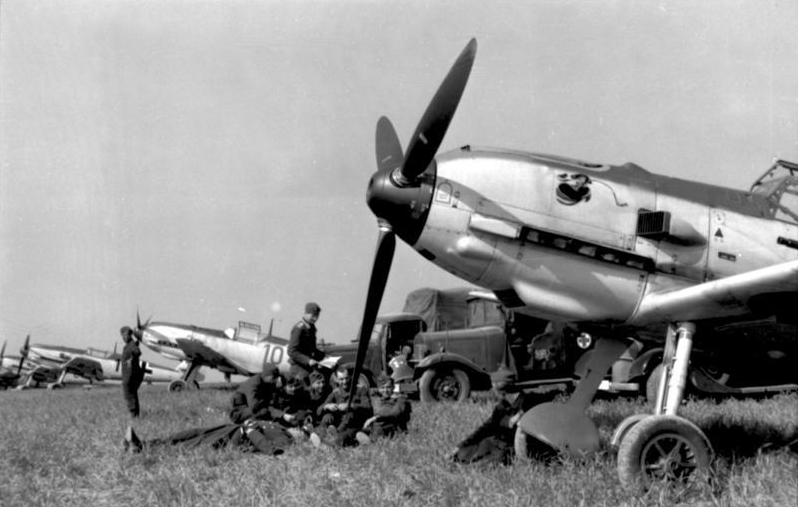
Bf 109Es, 1940. Galland flew the Bf 109 in air-to-air combat for the first time over France and Belgium
On 10th May 1940, the Wehrmacht invaded the Low Countries and France under the codename Fall Gelb. JG 27 supported German forces in the Battle for Belgium. On the third day of the offensive, 12th May 1940, 7 kilometres (4.3 mi) west of Liege, Belgium, at a height of about 4,000 metres (13,000 ft, flying a Messerschmitt Bf 109, Galland, with Gustav Rödel as his wingman, claimed his first aerial victories, over two Royal Air Force (RAF) Hawker Hurricanes. Both aircraft were from No. 87 Squadron. The Hurricanes had been escorting Bristol Blenheim bombers to bomb bridges in the Netherlands. Galland remembered; “My first kill was child’s play. An excellent weapon and luck had been on my side. To be successful, the best fighter pilot needs both”— Galland pursued one of the “scattering” Hurricanes and shot down another at low level. The pilot, a Canadian, Flying Officer Jack Campbell was killed.
Galland claimed his third Hurricane later that same day over Tienen. He had long believed that his opponents had been Belgian, not knowing that all of the Belgian Air Force’s Hurricanes had been destroyed on the ground in the first two days, without seeing combat. On 19th May, Galland shot down a French Potez aircraft. During this flight he ran out of fuel short of the runway and landed nearby, at the base of a hill. With the help of soldiers from a German Flak battery, he pushed the Bf 109 up the hill and then half-flew, half-glided down to the Charleville-Mézières airfield in the valley below. He sent back a can of fuel for his wingman, who had also landed short of the runway. He continued flying and the next day, claimed another three more aircraft, making a total of seven. For this he was awarded the Iron Cross First Class from Erhard Milch on 22nd May.
With the effective defeat of Belgium JG 27 was moved into forward airfields to support the invasion of France. During the Battle of Dunkirk, after encountering the Supermarine Spitfire for the first time, Galland was impressed with these aircraft and their pilots. On 29th May, Galland claimed he had shot down a Bristol Blenheim over the sea. On 3rd June during Operation Paula, he claimed another French aircraft, a Morane-Saulnier M.S.406 for his 12th victory.
On 6th June 1940, Galland took over the command of III./Jagdgeschwader 26 “Schlageter” (III./JG 26—3rd group of the 26th Fighter Wing) with the position of Gruppenkommandeur. Under his command were the 7, 8 and 9 Staffels with an establishment of 39 Bf 109Es. His Staffelkapitäns included Joachim Müncheberg and Wilhelm Balthasar. Balthasar, Staffelkapitän of 7 Staffel had mistakenly attacked Galland during Fall Rot (Case Red). Being on the same radio frequency, Galland was able to warn Balthasar before he opened fire. The remainder of the campaign passed without incident and on 26th June, Major Gotthard Handrick took over command of JG 26. Galland was pleased, having served under him during his Condor Legion days.
Battle of Britain
From June 1940 on, Galland flew as the Gruppenkommandeur of III./JG 26 (JG 26), fighting in the Battle of Britain with Messerschmitt Bf 109Es. On 19th July 1940, he was promoted to Major and JG 26 moved to the Pas de Calais, where they were to remain for the next 18 months with III./JG 26 based at Caffiers.
On 24th July 1940, almost 40 Bf 109s of III./JG 26 took off for operations over the English Channel—a phase of the battle known as the Kanalkampf. They were met by twelve 54 Squadron Spitfires. The Spitfires forced the larger number of Bf 109s into a turning battle that ran down the Germans’ fuel. Galland recalled being impressed by the Spitfire’s ability to outmanoeuvre Bf 109s at low speed and to turn into the Bf 109s within little airspace. Only by executing a “Split S” (a half-roll onto his back, followed by pulling into a long, curving dive) that the Spitfire could not follow without exceeding its maximum safe speed and risking structural failure, could his aircraft escape back to France at low altitude. The II./Jagdgeschwader 52 covered their retreat, losing two Bf 109s to Spitfires from No. 610 Squadron. During the action, two Spitfires were shot down for the loss of four Bf 109s. Galland was shocked by the aggression shown by pilots he believed to be relatively inexperienced. Galland later said he realised there would be no quick and easy victory.
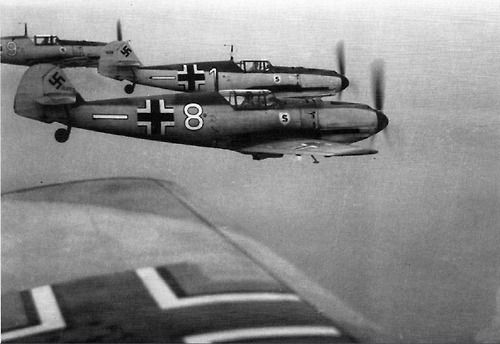
Messerschmitt Bf 109Es of JG 26 in 1940 this Fighter Wing featured prominently in the Battle of Britain that summer its 3rd Staffel Squadron being led by Adolf Galland
As the battles over the Channel continued, Galland shot down Spitfires on 25th and 28th July. On 1st August 1940, Galland was awarded the Knight’s Cross of the Iron Cross (Ritterkreuz des Eisernen Kreuzes) for his 17 victories. Galland continued to make fighter sweeps over southern England before the main assault opened. On 11th August, Galland’s unit engaged 74 Squadron. In a brief dogfight, one Spitfire was shot down. During these battles the RAF seemed to know just where and when to send their aircraft. This made Galland suspect a high level of organisation was at work controlling RAF fighters. The cloudy skies of Britain were a dangerous environment to confront an enemy that had an effective ground control system. Galland resolved to fly higher, where he could see most things and where the Bf 109 performed at its best.
By 15th August, in two weeks’ fighting over Britain, Galland had increased his own score to 22. On this day he claimed three Spitfires. This put him to within three victories of Mölders, who had claimed the highest number of enemy aircraft destroyed and who was wounded and grounded with a damaged knee. One of Galland’s claims was against 54 Squadron RAF that had surprised him with their aggressive attacks three weeks before. JG 26 claimed nine Spitfires in the air battle—Galland himself filing a claim for a Spitfire at 12:55 off Folkestone. Only two 54 Squadron Spitfires were lost in the late-morning early afternoon battle. Galland’s claim matches the loss of a Spitfire piloted by Sergeant N. A. Lawrence who was rescued with severe shock. In the afternoon of that same day, Galland claimed two more Spitfires from 64 Squadron. JG 26 claimed eight of the unit’s Spitfires which were all officially “confirmed” by the Germans. However, only two of the RAF fighters were hit and both were destroyed. Pilot Officer C. J. D Andreae was killed in R6990 and R. Roberts bailed out of K9964.
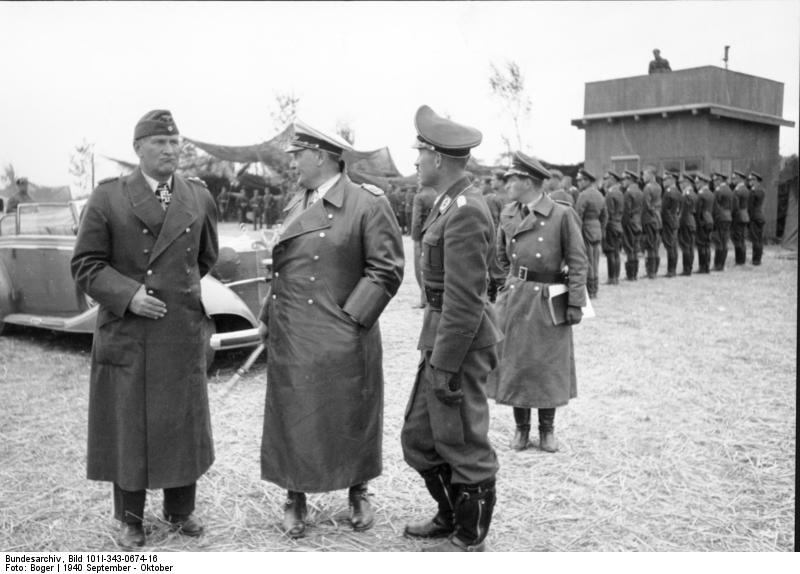
Bruno Loerzer, Hermann Göring,and Adolf Galland
Galland was summoned to Karinhall on 18th August 1940, and missed the intense air battle that day, known as The Hardest Day. During the meeting, Göring insisted that, in combat, Bf 109 fighters escort Bf 110s, which could not survive against single-engine fighters. As high-scoring aces, both Galland and Mölders shared their concerns that close escort of Bf 110s and bombers robbed fighter pilots of their freedom to roam and engage the enemy on their own terms. They also pointed to the fact that German bombers flew at medium altitudes and low speed, the best height area and speed for the manoeuvrability of the Spitfire. Galland resented his pilots having to carry out a task unsuited to their equipment but Göring would not move from his position.
Galland returned to action on 22nd August replacing Gotthard Handrick as Geschwaderkommodore of JG 26. Galland’s appointment made no impact on his successes. From 25th August—14th September 1940, Galland filed claims for victories 23–32. This included three claims on 31 August 1940 for two Spitfires and a Hurricane to take his tally to 27. His 25th victim may have been from 19 Squadron which was claimed 20 kilometers south of Cambridge at 09:42. Klaus Mietusch also accounted for one for his 7th victory. Three 19 Squadron Spitfires were shot down in the morning near North Weald. Pilot Officer R.A.C Aeberhardt was killed in a crash-landing in Spitfire R6912 while Flying Officer T.J.B Coward was wounded in the foot and F.N Brinsden was unhurt. He bailed out of R6958. On 6th September, Galland claimed his 30th victory over a 610 Squadron Hurricane. JG 26 claimed two more of them shot down that morning. 610 lost four Hurricanes; Flying Officer W.H Rhodes-Moorehouse and C.R Davis were killed while Flying Officer J. Toplnicki and Pilot Officer H.T Gilbert were wounded.

Galland with Goering
During the battle, the fighter pilots were criticised by Göring for the growing bomber losses. In a front line General Officer briefing on Luftwaffe tactics, Göring asked what his fighter pilots needed to win the battle. Werner Mölders replied that he would like the Bf 109 to be fitted with more powerful engines. Galland replied: “I should like an outfit of Spitfires for my squadron.” which left Göring speechless with rage. Galland still preferred the Bf 109 for offensive sweeps, but he regarded the Spitfire as a better defensive fighter, owing to its manoeuvrability. Galland said:
“The Bf 109 was superior in the attack and not so suitable for purely defensive purposes as the Spitfire, which, although a little slower, was much more manoeuvrable”.
During the Battle of Britain, the question of killing enemy pilots while in their parachutes was raised. In another conversation with Göring, Galland recalled: Göring wanted to know if we had ever thought about this. “Jawohl, Herr Reichsmarschall!” He looked me straight in the eyes and said, “What would you think of an order to shoot down pilots who were bailing out? ” I should regard it as murder, Herr Reichsmarschall”, I told him, “I should do everything in my power to disobey such an order”. “That is just the reply I had expected from you, Galland”.
Galland later stated that he thought Göring may have been asking him this question so as to have an answer if the question was ever posed to him, as opposed to the implication that Göring would be in favour of such an action.
Galland passed another serious test on 15th September, the date known as Battle of Britain Day. In large scale-clashes Galland claimed his 33rd air victory over a Hurricane while leading JG 26. On 23rd September, Galland became the third member of the Wehrmacht to receive the Knight’s Cross of the Iron Cross with Oak Leaves (Ritterkreuz des Eisernen Kreuzes mit Eichenlaub) for achieving his 39th and 40th aerial victories. On 25th September, he was summoned to Berlin to receive the award from Adolf Hitler. The Battle of Britain continued with large-scale dogfights well past 31st October 1940, considered by some historians as the end of the campaign. A further eight victories—six Spitfires and two Hurricanes—were claimed in October 1940 including three on 30th October which took his tally to 50—the last two victims were claimed at 16:00 CET and were likely from 41 Squadron. Pilot Officer G. G. F. Draper was wounded and Sergeant L. A Garvey was killed. In November, a further six victories including four Hurricanes were accounted for to record victories 51–56 putting him level with the late Helmut Wick who had been shot down and killed on 28th November. On 5th December 1940, Galland recorded his 57th victory. This made him the most successful fighter pilot of the war at that point, putting him ahead of his colleague, friend and rival Werner Mölders.

Adolf Galland & Günther Lützow in southern Italy
Now, promoted to Oberstleutnant, he continued to lead JG 26 in 1941 against the RAF fighter sweeps across northern Europe. In early 1941, most of the Luftwaffe’s fighter units were sent to the Eastern Front, or south to the Mediterranean Theater of Operations (MTO), only leaving JG 26 and Jagdgeschwader 2 (JG 2) as the sole single-engine fighter Geschwader in France. By this time, JG 26 were being re-equipped with the new Bf 109F, normally equipped with a 15 mm (or later a 20 mm) cannon firing through the propeller hub and two cowl-mounted 7.9 mm MG 17. Galland felt the model was grossly under-armed and so tested a series of 109 “specials” – one with a unique armament of an MG 151/20 cannon and two cowl-mounted 13 mm MG 131 machine guns, and another with integral wing-mounted 20 mm MG FF cannons.
On 15th April 1941, Galland took off with lobster and champagne to celebrate General Theo Osterkamp’s birthday at Le Touquet, France. He made a detour with his wingman towards England, looking for RAF aircraft. Off the cliffs of Dover, he spotted a group of Spitfires. Galland attacked and claimed two confirmed and one unconfirmed shot down. The actual result was the destruction of one Spitfire; the other two were damaged in force landings with both pilots wounded. During the combat, Galland’s undercarriage had dropped causing one of the RAF pilots (Flight Lieutenant Paddy Finucane) to claim Galland’s aircraft as destroyed, but Galland landed without incident at Le Touquet and presented Osterkamp with his gifts. Galland’s success that day represented his 60th and 61st aerial victory.
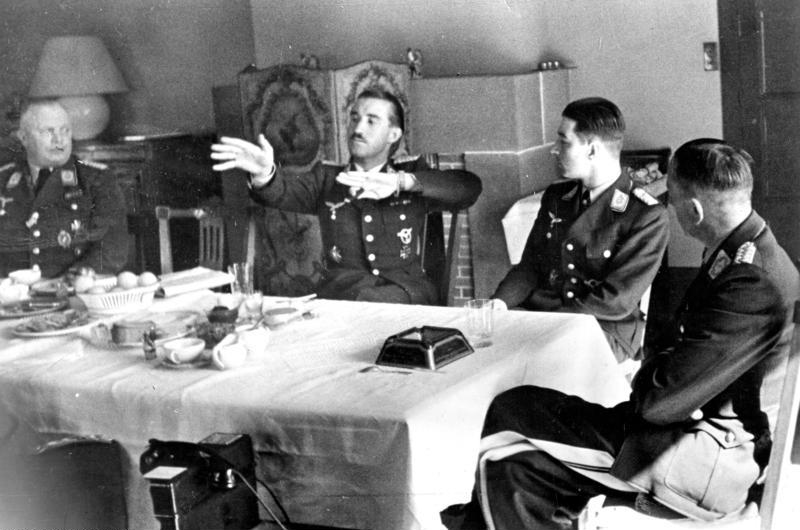
Galland and Werner Mölders attending Theo Osterkamp’s birthday in April 1941
Galland received a telephone from Göring on 10th May 1941, requesting Galland to intercept a Messerschmitt Bf 110 flown by Rudolf Hess heading for Scotland. Galland was unable to launch a full fighter sweep. However, Hess’ flight was far to the north and he reached Scotland crashing his aircraft. Galland sent out fighters to conduct some sweeps so he could honestly claim to have carried out his orders but it was nearly dark and Galland ordered his pilots unused to night flying to stand down.
Galland continued his successes in the summer. On 13th June, he led a small number of Bf 109s on a patrol off the English coast and attacked a pair of No. 258 Squadron RAF Hurricanes claiming both shot down. One can be confirmed through British records as crash landing at RAF Hawkinge. It took his tally to 63. From this point on, the RAF would mount a non-stop offensive with Fighter Command over France. The Germans did not see the point in these operations and soon labelled it the “nonsense offensive.” Galland intended to engage the British and inflict maximum damage while incurring small losses. To do this he only engaged JG 26 in staffel or gruppe strength. The fighters were to scramble quickly gain height and make use of the sun and cloud to attack the enemy formation that was most vulnerable. Under these tactics many JG 26 pilots began to emerge as aces and effective commanders. On 16th June 1941, for example, JG 26 accounted for 15 enemy aircraft. Josef Priller was among those to score bringing his tally to 22. Priller would later rise to command JG 26. Galland claimed a Hurricane this day for victory number 64—though the loss cannot be confirmed in British records. On 17th June, he accounted for two Hurricanes, one from 56 and another from 242 Squadron. The following day he accounted for a No. 145 Squadron Spitfire which inflated his tally to 67—then the highest recorded tally against the Western Allies.
On the morning of 21st June, he accounted for two Bristol Blenheims but was shot down by the Spitfire escorts, crash-landing near Calais. At 16:00 that same afternoon, Galland shot down a No. 611 Squadron Spitfire, but watching his victim for too long, he was himself shot down in Werknummer (Factory number) 6713, code “<- + -“, by a 145 Squadron Spitfire flown by Sergeant R.J.C. Grant. Galland bailed out and tugged at what he thought was his parachute ripcord, but was actually pulling at his parachute release harness. With a “sickening” feeling, he composed himself and pulled the ripcord which opened. Theo Osterkamp drove over to the hospital where Galland was being treated for his wounds and informed him his 69 victories had now earned him the Knight’s Cross of the Iron Cross with Oak Leaves and Swords (Ritterkreuz des Eisernen Kreuzes mit Eichenlaub und Schwertern).

Iron Cross Oberst Adolf Galland Knights Oak Leaves Swords Diamonds
On 2nd July 1941, Galland led JG 26 into combat against a formation of No. 226 Squadron Blenheim bombers. Galland’s fighter was hit by a 20 mm round from one of the bombers escort fighters. The armour plate fitted to the Bf 109 just days earlier saved Galland’s life. Wounded in the head he managed to land and was again hospitalized for the second time in a few days. Just earlier that week, when the armour plate was installed, he severely berated his mechanic, Gerhard Meyer, who welded it in, when he hit his head on the canopy upon entering his aircraft. That same mechanic received “a grateful slap on the back”. Galland had been shot up and shot down twice in the space of four days. The Blenheim brought his tally to 70.

Douglas Bader in a cockpit of a BF109E
On 9th August 1941, RAF ace Douglas Bader bailed out over St Omer, France. Bader was well known to the Luftwaffe and at the time of his capture had been credited with 22 aerial victories. Galland himself claimed two Spitfires on that date. Galland and JG 26 entertained Bader over the next few days. Owing to the significant stature of the prisoner, Galland permitted Bader, under escort, to sit in the cockpit of a Bf 109. Apparently, despite losing one of his tin legs in the aircraft, Bader, in a semi-serious way, asked if they wouldn’t mind if he took it on a test flight around the airfield. Galland replied that he feared Douglas would attempt to escape and they would have to give chase and shoot at each other again, and declined the request.
Throughout the summer, Galland claimed another 14 Spitfires in battles against Fighter Command over France. On 23rd July 1941, he accounted for three Spitfires (Nos. 71–73)—one in the afternoon and two in the evening. JG 26 claimed 13 enemies for three losses under Galland’s command this day. Two on 7th August was sufficient to reach 75 aerial victories. On 19th August, he claimed two Spitfire and one Hurricane to surpass the World War I ace Manfred von Richthofen’s tally of 80. His 80th and 81st victims were from 111 and 71 Squadrons. Galland also flew the Focke-Wulf Fw 190 in the autumn 1941 when the Geschwader converted to the type though he retained and flew Bf 109s himself. On 21 October he repeated his successes with a trio of Spitfires to reach 92. His 96th victim—yet another Spitfire—was claimed on 18th November 1941. It proved to be his last official victory for three years as he was about to be forbidden to fly combat missions. The RAF fighter probably came from 611 Squadron.

Ernst Udet funeral. Adolf Hitler saluting the coffin.(Galland on left)
In November 1941, he was chosen by Göring to command Germany’s fighter force as General der Jagdflieger, succeeding Werner Mölders who had just been killed in an air crash en route to attend the funeral of Ernst Udet. Galland was not enthusiastic about his promotion, seeing himself as a combat leader and not wanting to be “tied to a desk job”.
Soon afterward, on 28th January 1942, Galland was awarded the Knight’s Cross of the Iron Cross with Oak Leaves, Swords and Diamonds (Ritterkreuz des Eisernen Kreuzes mit Eichenlaub, Schwertern und Brillanten) for his service as Geschwaderkommodore of JG 26. Although not keen on a staff position, soon after Galland’s appointment, he planned and executed the German air superiority plan (Operation Donnerkeil) for the Kriegsmarine’s (German navy, or War Marine) Operation Cerberus, from his headquarters at Jever. The German battleships Scharnhorst, Gneisenau and heavy cruiser Prinz Eugen sailed from Brest, France, up the English Channel to Kiel, Germany. The operation caught the British off guard. The RAF attempted to intercept with the forces available, but the German fighter defences were able to shoot down 43 RAF aircraft with 247 British casualties. The Luftwaffe had prevented any damage on the ships by air attack.
A strong proponent of the day fighter force and the defence of Germany, Galland used his position to improve the position of the Jagdwaffe. The need was now pressing, as Germany had declared war on the United States on 11th December 1941, and Galland was keen to build up a force that could withstand the resurgence of the Western Allied Air Forces in preparation for what would become known as the Defence of the Reich campaign. Galland was outspoken, something that was not often tolerated by Göring. Yet, by earning and cultivating the support of other powerful personalities in the Luftwaffe, like Erhard Milch and Günther Korten, and personalities in the industrial sector such as Albert Speer and even Adolf Hitler, Galland was able to survive in his position for three years.
After his appointment, Galland was strictly confined to operational matters and not allowed to fly tactical or combat missions. As the war continued Galland flew missions in violation of these restrictions against the United States Army Air Forces (USAAF) bombing raids during the Defence of the Reich. Galland was keen to familiarise himself with all types of German fighter aircraft and flew the Fw 190 on these interception missions. He would actively engage American bombers on some raids. On at least one mission, he shot down a USAAF heavy bomber. It is possible that as many as three USAAF heavy bombers were shot down by Galland while flying Fw 190s.
Galland’s position as General der Jagdflieger brought him into gradual conflict with Göring as the war continued. In 1942–44, the German fighter forces on all fronts in the European Theatre of Operations (ETO) came under increasing pressure and Galland’s relationship with Göring began to turn sour. The first distinct cracks began to appear in the spring, 1943. Galland suggested that the fighter forces defending Germany should limit the number interceptions flown to allow sufficient time for re-grouping and to conserve air strength. Only by conserving its strength and its precious resources—the fighter pilots—could the Luftwaffe hope to inflict damage on the bombers. Göring refused. He demanded every raid be countered in maximum strength regardless of the size of the Allied fighter escort. According to head of production and procurement Erhard Milch, who was also present at the meeting, “Göring just could not grasp it.”

Focke Wulf Fw-190A6 General der Jagdflieger White 2 Adolf Galland 1943
During the late summer, 1943, the USAAF fighters operated over German air space for the first time. Several aircraft crashed near Aachen on the cusp of Germany’s west border. Galland presented these wrecks as proof that the Luftwaffe was facing an enemy that could soon escort its heavy bombers with fighter aircraft to industrial targets inside Germany. Galland submitted his findings to Göring. Göring was livid with Galland and the fighter force. The Reichsmarschall called the report the “rantings of a worn-out defeatist”, and gave Galland an “order”, that no Allied fighters had crossed into Germany. Göring declared the only possible reason could have been that short range fighters ran out of fuel at high altitude and “they were shot down much further west… and glided quite a distance before they crashed. Galland and Milch denied this. Galland questioned why an Allied pilot would choose to glide east instead of west. Both men and argued that they must increase fighter production to reach a three or fourfold advantage over the attackers immediately to prepare for this new threat. Galland’s efforts to produce a fighter force fit for a war of attrition conflicted with Göring’s bias in favour of bombers, to maintain the offensive on all fronts. It was a policy the Reichsmarschall persisted with until the autumn, 1943.

Focke Wulf Fw-190A6 General der Jagdflieger White 2 Adolf Galland 1943
By October 1943, the fractious relationship came to the surface again. Galland met with Göring at Göring’s estate, Schloss Veldenstein. During the conversation the need for new and improved interceptor aircraft arose. The demands made by Göring, that heavily cannon-armed fighters be used in mass numbers to defeat bomber formations, were unreasonable to Galland. Göring, prompted by the desires of Hitler, wanted cannons of some 2,000 lb in weight which fired at a rate of one shell per second. Galland explained that such a weapon could not be used effectively in an aircraft; the cannon would be prone to jamming and the aircraft would be too difficult to manoeuvre. Galland also asserted the use of inappropriate weaponry such as the Messerschmitt Me 410, a favourite of Hitler’s, had caused heavy losses. Galland argued such measures were deplorable and irresponsible. Göring ignored Galland’s arguments and continued his frequent attacks on the fighter force, accusing them of cowardice. Galland, as he always did, defended them, risking his career, and near the end of the war, his life in doing so. Galland stated that he could not agree to follow Göring’s plans and requested to be dismissed from his post and sent back to his unit. Göring accepted, but two weeks later he apologized to Galland and attributed his behaviour to stress. Galland continued in his post.

Me 262 Jet Fighter
To retrieve the situation for the fighter force, Galland looked to employ new technology in the air war. On 23rd May 1943, Galland flew an early prototype of the Messerschmitt Me 262 jet fighter. After the flight, he described his experience: “For the first time I was flying by Jet propulsion! No engine vibrations. No torque and no lashing sound of the engine propeller. Accompanied by a whistling sound, my jet shot through the air. Later when asked what it felt like, I said, “It was as though angels were pushing.”
Galland became an enthusiastic supporter of the aircraft, realizing its potential as a fighter rather than a bomber. Galland hoped that the Me 262 would compensate for the numerical superiority of the Allies:
“In the last four months [January–April 1944] our day fighters have lost 1,000 pilots…we are numerically inferior and will always remain so…I believe that a great deal can be achieved with a small number of technically and far superior aircraft such as the [Me] 262 and [Me] 163… I would at this moment rather have one Me 262 in action rather than five Bf 109s. I used to say three 109s, but the situation develops and changes.”
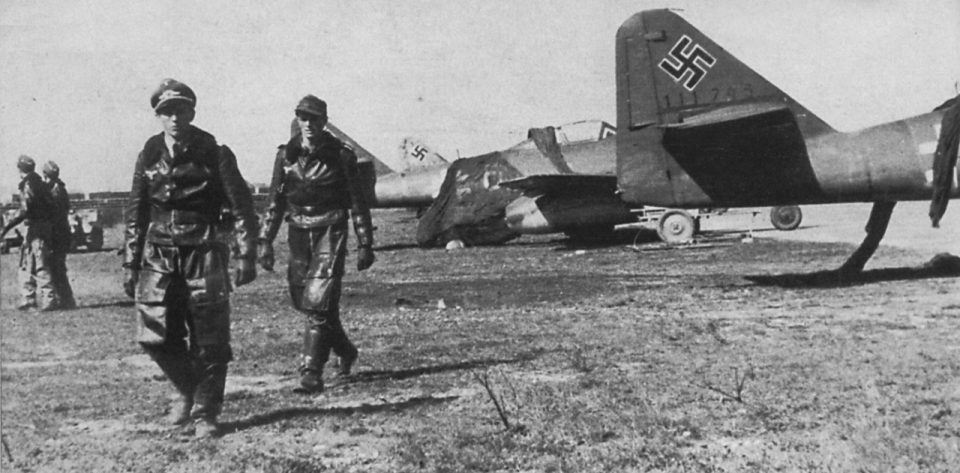
Luftwaffe pilots of Adolf Galland’s legendary Jagdverband 44 JV 44 seen here at Munich-Riem Airport with their Messerschmitt Me 262 March April 1945
Galland succeeded in temporarily persuading Milch to support cancelling the Me 209 program in favour of producing 100 Me 262s by the end of 1943. However, because of persistent problems with its turbojet engines and later, Hitler’s determination to use it as a bomber, the Me 262 was not developed as a fighter until late in the war.
By spring 1944, the Me 262 was sufficiently ready for operational service. By this time , Galland faced rivalries amongst the Luftwaffe command over how best to employ the aircraft. Dietrich Peltz, commander of the IX. Fliegerkorps (9th Air Corps), wanted to use the aircraft as a weapon against a future Allied landing in France. Peltz saw the aircraft as an ideal fast bomber which could evade the overwhelming numbers of Allied piston-engine fighters and attack the landing grounds. Peltz also wished to use highly trained bomber pilots who he felt could better serve as home defence fighter pilots in place of the overextended and overworked Jagdwaffe. Their blind-weather experience and training, and background in multi-engine aircraft made them ideal for these operations in his view. In the first five months of 1944, Peltz’ conventional bomber force had suffered a significant defeat over England in Operation Steinbock but it did not dull his appetite for offensive action or dent his reputation with Göring. Galland argued against his suggestion. Instead, Galland thought the bomber corps should be disbanded and its pilots converted onto fighters. Göring adopted Peltz’ idea to impress Hitler and regain his waning influence.
Galland did not give up. He made repeated appeals for Me 262 fighter aircraft. Göring refused Galland’s requests to have equal numbers of Me 262 fighter and bomber variants built. However, Galland’s close relationship with Albert Speer, the German armaments minister, enabled him to retain a small operational number. Even this was difficult, as Hitler had taken personal control of turbo-jet production and checked where each batch of the aircraft were being deployed. It was not until September 1944 that Hitler rescinded his directive that the Me 262 be used as a fighter-bomber. Galland ignored the order and formed Eprobungskommando 262 to test the Me 262 against high-flying Allied reconnaissance aircraft. He selected the highly decorated pilot Werner Thierfelder as its commander. Hitler heard of the experiment through Milch and ordered Göring to put a stop to it at a meeting on 29th May 1944. Galland persisted with the experiments, and ordered operations to be continued. They achieved isolated successes until Thierfelder was shot down and killed by P-51 Mustangs on 18th July 1944. On 20 August, Hitler finally agreed to allow one in every 20 Me 262 to go into service with the Jagdwaffe which allowed Galland to build all–jet units.
Owing to his keen interest in the type he followed, with interest, the exploits of Kommando Nowotny, the all jet fighter unit. Although it had low serviceability rates, its aircraft achieved considerable success. To see how new aircraft performed in action, Galland often visited the front line airfields close to the scene of the fighting. On 8th November 1944, he was present when ace Walter Nowotny took off with a force of Me 262s in an overcast to engage a USAAF raid. Galland listened to it over the radio waves. Nowotny claimed a bomber but his Me 262 was damaged. He was then jumped by USAAF fighters and crashed close to the airfield. Galland heard the firing but did not see the event. It did not dissuade him from believing in the capabilities of the aircraft as a fighter.
In the meantime, Galland pursued innovations with existing designs. The Focke-Wulf Fw 190 aircraft was formed into several Geschwader with distinctly upgraded firepower. Called the Sturmbock (Battering ram), these machines could inflict heavy damage on unescorted bomber formations. Galland supported the conversion of units such as Jagdgeschwader 300 to the Sturmbock role. The Sturmbock were heavily armed and armoured, which meant they were un-manoeuvrable and vulnerable without protection from escorting Bf 109s. Still, the tactics quickly became widespread and were one of the few Luftwaffe success stories in 1944. Galland said after the war, that had it not been for the Allied landing in Normandy which increased the need for lighter fighter variants, each Geschwader in the Luftwaffe would have contained a Gruppe of Sturmbock aircraft by September 1944.
Galland himself flew on unauthorised interception flights to experience the combat pressures of the pilots, and witnessed USAAF bombers being escorted by large numbers of P-51 Mustangs. Nevertheless, on occasions the Sturmbock tactics worked. For example, on 7th July 1944 Eighth Air Force bombers belonging to the 492nd Bomb Group were intercepted unescorted. The entire squadron of 12 B-24s were shot down. The USAAF 2nd Air Division lost 28 Liberators that day, the majority to a Sturmbock attack.

B24 bomber tail blown off by ME262 firing R4M rocket April 1944
Despite Göring’s apology after their previous dispute, the relationship between the two men did not improve. Göring’s influence was in decline by late 1944 and he had fallen out of favour with Hitler. Göring became increasingly hostile to Galland, blaming him and the fighter pilots for the situation. In 1944, the situation worsened. A series of USAAF raids termed Big Week won air superiority for the Allies in February. By the spring 1944, the Luftwaffe could not effectively challenge the Allies over France or the Low Countries. Operation Overlord, the Allied invasion of German-occupied Europe took place in June 1944. According to a report made by Galland, in the previous four months 1,000 pilots had been killed. Galland reported that the enemy outnumbered his fighters between 6:1 and 8:1 and the standard of Allied fighter pilot training was “astonishingly high”.
To win back some breathing space for his force and German industrial targets, Galland formulated a plan which he called the “Big Blow” (German: Großer Schlag. It called for the mass interception of USAAF bomber formations by approximately 2,000 German fighters. Galland hoped that the German fighters would shoot down some 400–500 bombers. Acceptable losses were to be around 400 fighters and 100–150 pilots. The night fighter force was to assist by employing 100 aircraft in southern and northern Germany, to prevent any crippled bombers making it to Switzerland and Sweden. Over the autumn 1944 Galland carefully husbanded is resources and waited for unusually bad weather to improve.
Hitler proved too impatient. He hoped to improve Germany’s position by winning a decisive victory on the Western Front. Hitler distrusted Galland’s theory and believed him to be afraid and stalling for time. The Führer was also sceptical that the Luftwaffe could stop the American air offensive and was not willing to have German resources sit idle on airfields to wait for an improvement in flying conditions. Admittedly Galland’s efforts had built up a useful reserve, but Hitler was now to use it in support of a land offensive. Göring and Hitler handed over the forces pooled by Galland to Peltz whom they had appointed commander of II. Jagdkorps—responsible for virtually all fighter forces in the west. Peltz appointed Gordon Gollob as Special Fighter Staff Officer for the offensive. Gollob ultimately was a vociferous opponent of Galland and eventually engineered his dismissal. Whether the “Big Blow” operation would have worked is a matter of academic debate. Historians remained divided, with some believing it was a lost opportunity while others think it would have had much less impact than Galland estimated.
The operation never took place. Instead, the fighter force was committed to the disastrous Operation Bodenplatte, designed to support German forces during the Battle of the Bulge. Galland’s influence on matters was now virtually nil. Appalled by the Ardennes losses, he personally confronted Gollob and criticised him severely. Gollob contacted the Reichsführer-SS Heinrich Himmler. Himmler’s reputation as the most powerful man after Hitler at that time may have been a prime motive. Gollob complained about his misuse in the Luftwaffe and Galland’s leadership. The SS had already spread their influence into other areas of military affairs including the V-2 operations. Himmler, whose relationship with Göring was poor, took the opportunity to exploit the dissent in the Luftwaffe and undermine the Reichsmarschall by supporting Gollob. It was also an opportunity for the SS to seize control of the Luftwaffe and for Himmler to oust Göring from power. Göring, for his part offered no support to Galland when Himmler or the SS were mentioned. On 13th January 1945, Galland was finally relieved of his command.
On 17th January, a group of senior pilots took part in a “Fighter Pilots Revolt”. Galland’s high standing with his fighter pilot peers led to a group of the most decorated Luftwaffe combat leaders loyal to Galland (including Johannes Steinhoff and Günther Lützow) confronting Göring with a list of demands for the survival of their service. Göring initially suspected Galland had instigated the unrest. Heinrich Himmler had wanted to put Galland on trial for treason himself; the SS and Gestapo had already begun investigations into whom he was associated. The Oberkommando der Luftwaffe (OKL) appointed the more politically acceptable Gollob, a National Socialist supporter, to succeed him as General der Jagdflieger on 23 January. Although professional contemporaries, Gollob and Galland had a mutual dislike, and after Galland had removed the Austrian from his personal staff in September 1944, Gollob started to gather evidence to use against Galland, detailing false accusations of his gambling, womanising, and alleged private use of Luftwaffe transport aircraft. The official reason for his being relieved of command was his ill health.

Adolf Hitler and Adolf Galland
For his own safety, Galland went to a retreat in the Harz Mountains. He was to keep the RLM informed of his whereabouts, but was effectively under house arrest. Hitler, who liked Galland, had not heard of the events. However, when he learned of them he ordered that “all this nonsense” [the treatment of Galland], was to stop immediately. Hitler had been informed by Albert Speer, who in turn had been informed of events by one of Galland’s close friends. In the end, Göring contacted Galland and invited him to Karinhall. In light of his service to the fighter arm, he promised no further action would be taken against him and offered command of a unit of Me 262 jets. Galland accepted on the understanding that Gollob had no jurisdiction over him or his unit.
Galland was initially assigned to command a Staffel of Jagdgeschwader 54, at that time stranded behind Soviet lines in the Courland Pocket. Galland never took up this command but was given the task of forming Jagdverband 44 (JV 44). On 24th February 1945 the order for formation of Jagdverband 44 read: “JV 44 is established at Brandenburg-Briest with immediate effect. Ground personnel are to be drawn from 16./JG 54, Factory Protection Unit 1 and III./Erg JG 2. The commander of this unit receives the disciplinary powers of a Divisional Commander as laid down in Luftwaffe Order 3/9.17. It is subordinated to Luftflotte Reich and comes under Luftgaukommando III (Berlin). Verband Galland is to have a provisional strength of sixteen operational Me 262s and fifteen pilots. [Signed] Generalleutnant Karl Koller, Chief of Staff of the Luftwaffe.”
Galland was allowed to hand pick a number of experienced fighter pilots and aces for the unit, including Johannes Steinhoff, Erich Hohagen, Heinrich Bär and Gerhard Barkhorn. Erich Hartmann was also asked but would not leave his unit. The unit was officially formed on 22nd February 1945. Galland did everything he could to introduce the Me 262s to the wing as quickly as possible. Göring showed sympathy for Galland’s efforts, which thus far had only 16 operational jets in February. General Josef Kammhuber was asked to assist Galland. Kampfgeschwader 51 (KG 51 or Bomber Wing 51), 6 and 27 were behind their training schedules on jets, and they were to hand over their pilots and Me 262s to Jagdgeschwader 7 and Kampfgeschwader 54. Galland added a suggestion that all experienced fighter pilots flying with Bf 109 or Fw 190 units should be made to join the Me 262 unit. If this could be done Galland believed he could get 150 jets in action against the USAAF fleets. The general chaos and impending collapse prevented his plans from being realised.
On 31st March 1945, Galland flew 12 operational jets to Munich to begin operations. On 5th April, he organised the interception of a USAAF raid. The Me 262s destroyed three B-17s. On 16 April Galland claimed two Martin B-26 Marauder bombers shot down. On 21 April, to his surprise, he was visited by Göring for the final time. Göring officially assigned Günther Lützow to him and confessed to Galland that his assertions about the Me 262 and the use of bomber pilots with experience as jet fighter pilots had been correct. He enquired about the progress of his unit with outspoken civility. As they parted, Göring said, “I envy you Galland, for going into action. I wish I were a few years younger and less bulky. If I were, I would gladly put myself under your command. It would be marvellous to have nothing to worry about but a good fight, like it was in the old days.”

Me 262 8th June 1945
In the space of six days, Galland’s friend, Steinhoff was badly burned in a crash on 18th April, and then, on 24th April, his friend Lützow was posted missing. On 21st April, Galland was credited with his 100th aerial victory. He was the 103rd and last Luftwaffe pilot to achieve the century mark. On 26th April, Galland claimed his 103rd and 104th aerial victories against B-26s, escorted by the 27th Fighter Group and 50th Fighter Group. Galland again made a mistake; he stopped to make sure his second victory was going to crash and he was hit by a USAAF P-47 Thunderbolt piloted by James Finnegan. Galland nursed his crippled Me 262 to the airfield, only to find it was under attack by more P-47s. Galland landed under fire and abandoned his jet on the runway. The battle was his last operational mission. Soon afterward, he was sent to hospital for a knee wound sustained during his last mission. The Americans lost four B-26s and another six damaged. In return two Me 262s were shot down: the other pilot surviving.
In the 1970s, a San Jose State University graduate student came across Galland’s memoirs The First and the Last while researching records of United States Army Air Forces records and matching them to German victory claims. He found that James Finnegan, a P-47 Thunderbolt pilot of the 50th Fighter Group, Ninth Air Force, had made a “probable” claim on 26 April 1945, the day of Galland’s last mission. The details of the engagement matched. Galland and Finnegan met for the first time at an Air Force Association meeting in San Francisco in 1979.
By late April, the war was effectively over. On 1st May 1945, Galland attempted to make contact with United States Army forces to negotiate the surrender of his unit. The act itself was dangerous. SS forces roamed the countryside and towns executing anyone who was considering capitulation. The Americans requested that Galland fly his unit and Me 262s to a USAAF controlled airfield. Galland declined citing poor weather and technical problems. In reality, Galland was not going to hand over Me 262 jets to the Americans. Galland had harboured the belief that the Western Alliance would soon be at war with the Soviet Union, and he wanted to join American forces and to use his unit in the coming war to free Germany from Communist occupation. Galland replied, making his whereabouts known to the Americans, and offering his surrender once they arrived at the Tegernsee hospital where he was being treated. Galland then ordered his unit, which had then moved to Salzburg and Innsbruck, to destroy their Me 262s. At the time of his surrender, Galland had filed claims for 104 Allied aircraft shot down. His claims included seven with the Me 262.
On 14th May 1945, Galland was flown to England and interrogated by RAF personnel about the Luftwaffe, its organisation, his role in it and technical questions. Galland returned to Germany on 24th August and was imprisoned at Hohenpeissenberg. On 7 October, Galland was returned to England for further interrogation. Galland was eventually released on 28th April 1947.

Messerschmitt Bf 109E-3 ,Kommodore Adolf Galland, W.Nr 5398 .(the subject of Hobbymaster’s latest BF109E release)
Hobbymaster 1/48th scale HA8702 Hobbymaster BF 109E-3 Adolf Galland Grp.Kdr. III/JG 26 France, June 1940

Hobbymaster Latest Releases available to Pre-order now.
I have added some great New Releases from Hobbymaster to the website. Please see them below and click on the model image and link to go straight to the model of your choice or CLICK HERE to see them all.


This Week’s “Offer of the Week” !
This week’s offer is aimed at the Diorama and Vehicle collector. Buy any 3 Hobbymaster, Panzerstahl or Blitz Vehicles and Diorama models from the SALE SECTION and you get the third one absolutely FREE ! Free Offer applies to the lowest priced item purchased when three items are bought together. Limited stocks available. First come , first served. Please click on the Link Here to go straight to the Vehicle Sale Section. Offer does NOT apply to Oxford Diecast models. Please place your order as normal and the reduction will be applied when your payment is taken by credit card or refunded to your PayPal account.
This Sale Offer ends at Midnight (BST) Monday 16th May.
That’s it for this week. Thank you for taking time to read this week’s Newsletter.
Richard.
Flying Tigers.