Model Description
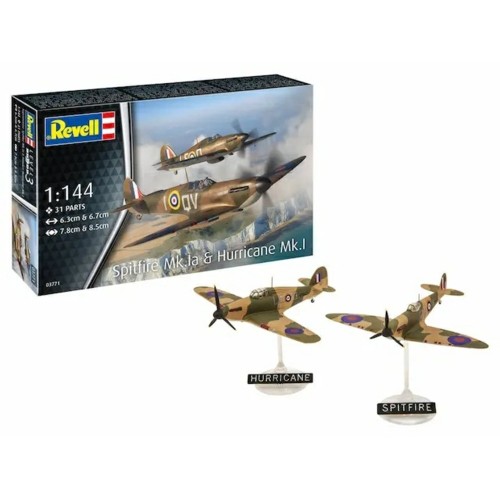
R03771 Revell 1/144th scale model kit Supermarine Spitfire MK.IA and Hawker Hurricane Mk.I. Available to pre-order at Flying Tigers.
The Supermarine Spitfire was a British single-seat fighter aircraft used by the Royal Air Force and other Allied countries before, during, and after World War II. It was the only British fighter produced continuously throughout the war. The Spitfire remains popular among enthusiasts. Around 70 remain airworthy, and many more are static exhibits in aviation museums throughout the world.
The Spitfire was a short-range, high-performance interceptor aircraft designed by R. J. Mitchell, chief designer at Supermarine Aviation Works, which operated as a subsidiary of Vickers-Armstrong from 1928. Mitchell modified the Spitfire’s distinctive elliptical wing (designed by Beverley Shenstone) with innovative sunken rivets to have the thinnest possible cross-section, achieving a potential top speed greater than that of several contemporary fighter aircraft, including the Hawker Hurricane. Mitchell continued to refine the design until his death in 1937, whereupon his colleague Joseph Smith took over as chief designer.
Smith oversaw the Spitfire’s development through many variants, from the Mk 1 to the Rolls-Royce Griffon-engined Mk 24, using several wing configurations and guns. The original airframe was designed to be powered by a Rolls-Royce Merlin engine producing 1,030 hp (768 kW). It was strong enough and adaptable enough to use increasingly powerful Merlins, and in later marks, Rolls-Royce Griffon engines producing up to 2,340 hp (1,745 kW). As a result, the Spitfire’s performance and capabilities improved over the course of its service life.
During the Battle of Britain (July–October 1940), the more numerous Hurricane flew more sorties resisting the Luftwaffe, but the Spitfire captured the public’s imagination as the main RAF fighter, in part because the Spitfire was generally a better fighter aircraft than the Hurricane. Spitfire units had a lower attrition rate and a higher victory-to-loss ratio than Hurricanes, most likely due to the Spitfire’s higher performance. During the battle, Spitfires generally engaged Luftwaffe fighters—mainly Messerschmitt Bf 109E–series aircraft, which were a close match for them.
After the Battle of Britain, the Spitfire superseded the Hurricane as the principal aircraft of RAF Fighter Command, and it was used in the European, Mediterranean, Pacific, and South-East Asian theatres.
Much loved by its pilots, the Spitfire operated in several roles, including interceptor, photo-reconnaissance, fighter-bomber, and trainer, and it continued to do so until the 1950s. The Seafire was an aircraft carrier–based adaptation of the Spitfire, used in the Fleet Air Arm from 1942 until the mid-1950s.
The Hawker Hurricane is a British single-seat fighter aircraft of the 1930s–40s which was designed and predominantly built by Hawker Aircraft Ltd. for service with the Royal Air Force (RAF). It was overshadowed in the public consciousness by the Supermarine Spitfire during the Battle of Britain in 1940, but the Hurricane inflicted 60% of the losses sustained by the Luftwaffe in the campaign, and fought in all the major theatres of the Second World War.
The Hurricane originated from discussions between RAF officials and aircraft designer Sir Sydney Camm about a proposed monoplane derivative of the Hawker Fury biplane in the early 1930s. Despite an institutional preference for biplanes and lack of interest by the Air Ministry, Hawker refined its monoplane proposal, incorporating several innovations which became critical to wartime fighter aircraft, including retractable landing gear and the more powerful Rolls-Royce Merlin engine. The Air Ministry ordered Hawker’s Interceptor Monoplane in late 1934, and the prototype Hurricane K5083 performed its maiden flight on 6 November 1935.
The Hurricane went into production for the Air Ministry In June 1936 and entered squadron service in December 1937. Its manufacture and maintenance were eased by using conventional construction methods so that squadrons could perform many major repairs without external support. The plane was rapidly procured prior to the outbreak of the Second World War; in September 1939, the RAF had 18 Hurricane-equipped squadrons in service. It was relied upon to defend against German aircraft operated by the Luftwaffe, including dogfighting with Messerschmitt Bf 109s in multiple theatres of action.
The Hurricane was developed through several versions: bomber-interceptors, fighter-bombers, and ground support aircraft as well as fighters. Versions designed for the Royal Navy known as the Sea Hurricane had modifications including an arrestor hook near the tail, enabling operation from ships. Some were converted as catapult-launched convoy escorts. By the end of production in July 1944, 14,487 units had been completed in Britain and Canada, with others built in Belgium and Yugoslavia.
RRP £13.00