Model Description
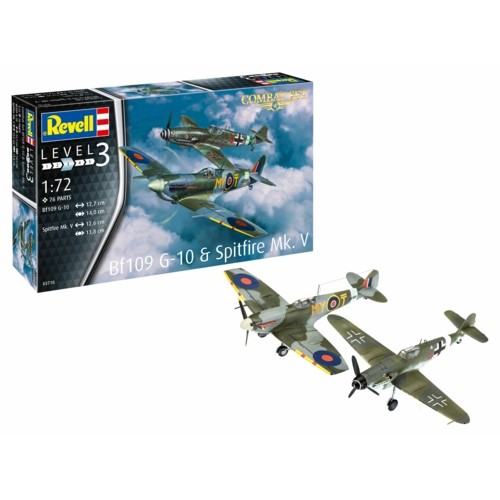
R03710 Revell 1/72nd scale model kit Combat Set Messerschmitt BF109G-10 and Spitfire. Buy now online at Flying Tigers.
The Messerschmitt Bf 109 is a monoplane fighter aircraft that was designed and initially produced by the German aircraft manufacturer Bayerische Flugzeugwerke (BFW). Together with the Focke-Wulf Fw 190, the Bf 109 formed the backbone of the Luftwaffe’s fighter force during the Second World War. It was commonly called the Me 109 by Allied aircrew and some German aces/pilots, even though this was not the official model designation.
The Bf 109 was designed by Willy Messerschmitt and Robert Lusser, who worked at BFW during the early to mid-1930s. It was conceived as an interceptor. However, later models were developed to fulfil multiple tasks, serving as bomber escort, fighter-bomber, day-, night-, all-weather fighter, ground-attack aircraft, and aerial reconnaissance aircraft. It was one of the most advanced fighters when the fighter first appeared, being furnished with an all-metal monocoque construction, a closed canopy, retractable landing gear, and powered by a liquid-cooled, inverted-V12 aero engine. First flown on 29 May 1935, the Bf 109 entered operational service during 1937; it first saw combat during the Spanish Civil War.
During the Second World War, the Bf 109 was supplied to several states and was present in quantity on virtually every front in the western hemisphere; the fighter was still in service at the end of the conflict in 1945. It continued to be operated by several countries for many years after the conflict. The Bf 109 is the most produced fighter aircraft in history, a total of 34,248 airframes having been produced between 1936 and April 1945. Some of the Bf 109 production took place in Nazi concentration camps through slave labour.
The Bf 109 was flown by the three top-scoring fighter aces of all time, who claimed 928 victories among them while flying with Jagdgeschwader 52, mainly on the Eastern Front. The highest-scoring, Erich Hartmann, was credited with 352 victories. The aircraft was also flown by Hans-Joachim Marseille, the highest-scoring ace in the North African campaign, who shot down 158 enemy aircraft (in about a third of the time). It was also flown by many aces from other countries fighting with Germany, notably the Finn Ilmari Juutilainen, the highest-scoring non-German ace. He scored 58 of his 94 confirmed victories with the Bf 109. Pilots from Hungary, Romania, Bulgaria, Croatia, Slovakia and Italy also flew the fighter. Through constant development, the Bf 109 remained competitive with the latest Allied fighter aircraft until the end of the war.
The Supermarine Spitfire is a British single-seat fighter aircraft that was used by the Royal Air Force and other Allied countries before, during, and after World War II. It was the only British fighter produced continuously throughout the war. The Spitfire remains popular among enthusiasts. Around 70 remain airworthy, and many more are static exhibits in aviation museums throughout the world.
The Spitfire was a short-range, high-performance interceptor aircraft designed by R. J. Mitchell, chief designer at Supermarine Aviation Works, which operated as a subsidiary of Vickers-Armstrong from 1928. Mitchell modified the Spitfire’s distinctive elliptical wing (designed by Beverley Shenstone) with innovative sunken rivets to have the thinnest possible cross-section, achieving a potential top speed greater than that of several contemporary fighter aircraft, including the Hawker Hurricane. Mitchell continued to refine the design until his death in 1937, whereupon his colleague Joseph Smith took over as chief designer.
Smith oversaw the Spitfire’s development through many variants, from the Mk 1 to the Rolls-Royce Griffon-engined Mk 24, using several wing configurations and guns. The original airframe was designed to be powered by a Rolls-Royce Merlin engine producing 1,030 hp (768 kW). It was strong enough and adaptable enough to use increasingly powerful Merlins, and in later marks, Rolls-Royce Griffon engines producing up to 2,340 hp (1,745 kW). As a result, the Spitfire’s performance and capabilities improved over the course of its service life.
During the Battle of Britain (July–October 1940), the more numerous Hurricane flew more sorties resisting the Luftwaffe, but the Spitfire captured the public’s imagination as the main RAF fighter, in part because the Spitfire was generally a better fighter aircraft than the Hurricane. Spitfire units had a lower attrition rate and a higher victory-to-loss ratio than Hurricanes, most likely due to the Spitfire’s higher performance. During the battle, Spitfires generally engaged Luftwaffe fighters—mainly Messerschmitt Bf 109E–series aircraft, which were a close match for them.
After the Battle of Britain, the Spitfire superseded the Hurricane as the principal aircraft of RAF Fighter Command, and it was used in the European, Mediterranean, Pacific, and South-East Asian theatres.
Much loved by its pilots, the Spitfire operated in several roles, including interceptor, photo-reconnaissance, fighter-bomber, and trainer, and it continued to do so until the 1950s. The Seafire was an aircraft carrier–based adaptation of the Spitfire, used in the Fleet Air Arm from 1942 until the mid-1950s.
RRP £16.00