Model Description
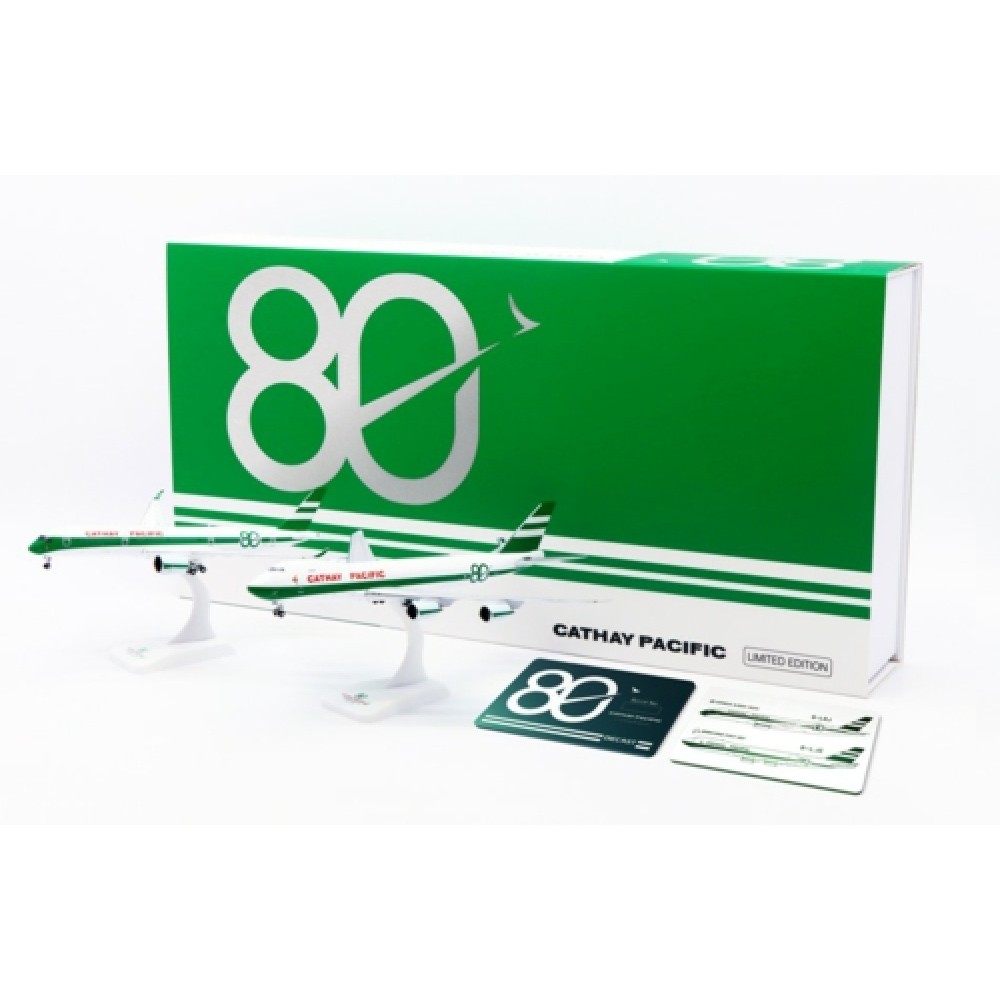
JC Wings 1/400th scale JCSA4124S Misc 80th Anniversary Airbus A350-900XWB and Boeing B747-8F Twin Set REG: B-LRJ, B-LJE with Deluxe Box, Metal Limited Card and stands. Available to pre-order at Flying Tigers.
The Airbus A350 is a long-range, wide-body twin-engine airliner developed and produced by Airbus. The initial A350 design, which was proposed in 2004, in response to the Boeing 787 Dreamliner, would have been a development of the Airbus A330 with composite wings, advanced winglets, and new efficient engines. Due to inadequate market support, Airbus switched in 2006 to a clean-sheet extra wide body (XWB) design, powered by two Rolls-Royce Trent XWB high bypass turbofan engines. The prototype first flew on 14 June 2013 from Toulouse, France. Type certification from the European Aviation Safety Agency (EASA) was obtained in September 2014, followed by certification from the Federal Aviation Administration (FAA) two months later.
The A350 is the first Airbus aircraft largely made of carbon-fibre-reinforced polymers. The fuselage is designed around a 3-3-3 nine-across economy cross-section, an increase from the eight-across A330/A340 2-4-2 configuration. (The A350 has 3-4-3 ten-across economy seating on select aircraft.) It has a common type rating with the A330. The airliner has two variants: the A350-900 typically carries 300 to 350 passengers over a 15,750-kilometre (8,500-nautical-mile) range, and has a 283-tonne (624,000 lb) maximum takeoff weight (MTOW); the longer A350-1000 accommodates 350 to 410 passengers and has a maximum range of 16,700 kilometres (9,000 nmi) and a 322-tonne (710,000 lb) MTOW.
On 15 January 2015, the first A350-900 entered service with Qatar Airways, followed by the A350-1000 on 24 February 2018 with the same launch operator. As of March 2026, Singapore Airlines is the largest operator with 65 aircraft in its fleet, while Turkish Airlines is the largest customer with 110 aircraft on order. A total of 1,564 A350 family aircraft have been ordered and 710 delivered, of which 709 aircraft are in service with 38 operators. The global A350 fleet has completed more than 2 million flights on more than 1,365 routes, transporting more than 530 million passengers with no fatalities and one hull loss in an airport-safety-related incident. It succeeds the A340 and competes against Boeing’s large long-haul twinjets, the Boeing 777, its future successor, the 777X, and the 787 Dreamliner.
The Boeing 747 is a long-range wide-body airliner designed and manufactured by Boeing Commercial Airplanes in the United States between 1968 and 2023. It was conceived in response to the demand of Pan Am for a jet 2+1⁄2 times the size of the 707, which had been introduced in October 1958, to reduce the airline’s seat cost by 30%. The design team was led by Joe Sutter, who left the 737 development program in 1965 to design the 747. In April 1966, Pan Am ordered 25 Boeing 747-100 aircraft, and in late 1966, Pratt & Whitney agreed to develop the JT9D engine, a high-bypass turbofan. On September 30, 1968, the first 747 was rolled out of the custom-built Everett Plant, the world’s largest building by volume. The 747’s first flight took place on February 9, 1969, and the 747 was certified in December 1969. It entered service with Pan Am on January 22, 1970. The 747 was the first airplane called a “Jumbo Jet” as the first wide-body airliner.
The 747 is a four-engined jet aircraft, initially powered by Pratt & Whitney JT9D turbofan engines, then General Electric CF6 and Rolls-Royce RB211 engines for the original variants. With a ten-abreast economy seating, it typically accommodates 366 passengers in three travel classes. It has a pronounced 37.5° wing sweep, allowing a Mach 0.85 (490 kn; 900 km/h) cruise speed, and its heavy weight is supported by four main landing gear legs, each with a four-wheel bogie. The partial double-deck aircraft was designed with a raised cockpit so it could be converted to a freighter airplane by installing a front cargo door, as it was initially thought that it would eventually be superseded by supersonic transports.
Boeing introduced the 747-200 in 1971, with uprated engines for a heavier maximum takeoff weight (MTOW) of 833,000 pounds (378 t) from the initial 735,000 pounds (333 t), increasing the maximum range from 4,620 to 6,560 nautical miles [nmi] (8,560 to 12,150 km; 5,320 to 7,550 mi). It was shortened for the longer-range 747SP in 1976, and the 747-300 followed in 1983 with a stretched upper deck for up to 400 seats in three classes. The heavier 747-400 with improved RB211 and CF6 engines or the new PW4000 engine (the JT9D successor), and a two-crew glass cockpit, was introduced in 1989 and is the most common variant. After several studies, the stretched 747-8 was launched on November 14, 2005, using the General Electric GEnx engine first developed for the 787 Dreamliner (the inspiration for the -8 in the name), and was first delivered in October 2011. The 747 is the basis for several government and military variants, such as the VC-25 (Air Force One), E-4 Emergency Airborne Command Post, Shuttle Carrier Aircraft, and some experimental test aircraft such as the YAL-1 and SOFIA airborne observatory.
Initial competition came from the smaller trijet widebodies: the Lockheed L-1011 (introduced in 1972), McDonnell Douglas DC-10 (1971) and later MD-11 (1990). Airbus competed with later variants with the heaviest versions of the A340 until surpassing the 747 in size with the A380, delivered between 2007 and 2021. Freighter variants of the 747 remain popular with cargo airlines. The final 747 was delivered to Atlas Air in January 2023 after a 54-year production run, with 1,574 aircraft built. As of October 2025, 65 Boeing 747s (4.1%) have been lost in accidents and incidents, in which a total of 3,746 people have died.
RRP £161.00