A U.S. Navy Ling-Temco-Vought A-7E-5-CV Corsair II (BuNo 156863) of Attack Squadron 146 (VA-146) “Blue Diamonds” in flight on 16th November 1974. VA-146 assigned to Attack Carrier Air Wing 9 (CVW-9) aboard the aircraft carrier USS Constellation (CVA-64) for a deployment to the Western Pacific and the Indian Ocean from 21st June to 23rd December 1974.
The LTV A-7 Corsair II is a carrier-capable subsonic light attack aircraft designed and manufactured by American conglomerate Ling-Temco-Vought (LTV).
The A-7 was developed during the early 1960s as replacement for the Douglas A-4 Skyhawk. Its design is derived from the Vought F-8 Crusader; in comparison with the F-8, the A-7 is both smaller and restricted to subsonic speeds, its airframe being simpler and cheaper to produce. Following a competitive bid by Vought in response to the United States Navy’s (USN) VAL (Heavier-than-air, Attack, Light) requirement, an initial contract for the type was issued on 8th February 1964. Development was rapid, first flying on 26th September 1965 and entering squadron service with the USN on 1st February 1967; by the end of that year, A-7s were being deployed overseas for the Vietnam War.
Initially adopted by USN, the A-7 proved attractive to other services, soon being adopted by the United States Air Force (USAF) and the Air National Guard (ANG) to replace their aging Douglas A-1 Skyraider and North American F-100 Super Sabre fleets. Improved models of the A-7 would be developed, typically adopting more powerful engines and increasingly capable avionics. American A-7s would be used in various major conflicts, including the Invasion of Grenada, Operation El Dorado Canyon, and the Gulf War. The type was also used to support the development of the Lockheed F-117 Nighthawk.
The A-7 was also exported to Greece in the 1970s and to Portugal in the late 1980s. The USAF and USN opted to retire their remaining examples of the type in 1991, followed by the ANG in 1993 and the Portuguese Air Force in 1999. The A-7 was largely replaced by newer generation fighters such as the General Dynamics F-16 Fighting Falcon and the McDonnell Douglas F/A-18 Hornet. The final operator, the Hellenic Air Force, withdrew the last A-7s during 2014.

Prototype YA-7Ds 67-14582 and 67-14584, along with 69-6191 and 69-6217 making last flyover retirement formation over Edwards AFB, California, heading to AMARC, August 1992
Design and development
Origins
In 1960, officials within the United States Navy (USN) began to consider the need to replace its existing fleet of Douglas A-4 Skyhawk, a light attack aircraft. At that time, it was not clear that the A-4 would be in production until 1979; furthermore, according to aviation authors Bill Gunston and Peter Gilchrist, some figures believed there to be an unmet requirement for a more capable attack platform that could routinely attain supersonic speeds, carry heavier payloads, and fly further than its predecessors. Proponents of a new attack aircraft included Secretary of Defense Robert McNamara, who urged the Navy’s consideration on the matter.
In December 1962, the Sea-Based Air Strike Forces (SBASF) study group started examining detailed performance and cost evaluations on the topic. The group analysed a total of 144 hypothetical aircraft to support their findings. According to Gunston and Gilchrist, a major finding from these studies was that a subsonic aircraft would achieve superior performance to a supersonic one. By foregoing a supersonic capability, the airframe could be smaller, cheaper, and easier to manufacture; considerably larger quantities of such an attack platform could be procured over a supersonic counterpart. Development speed was also increased by sticking to subsonic speeds, which was a further advantage. A particular emphasis was placed on the accurate delivery of weapons, which would reduce the munitions costs per target.
On 17th May 1963, these criteria were formulated into a draft requirement, known as VAL (Heavier-than-air, Attack, Light). On 29th May 1963, the request for proposals (RFP) associated with the requirement was issued. To minimize costs, all proposals had to be based on existing designs. Accordingly, Vought, Douglas Aircraft, Grumman and North American Aviation chose to respond. The Vought proposal was based on their successful F-8 Crusader fighter and sharing a similar configuration; however, it had a shorter airframe with a rounded nose, giving the aircraft a stubbier appearance.
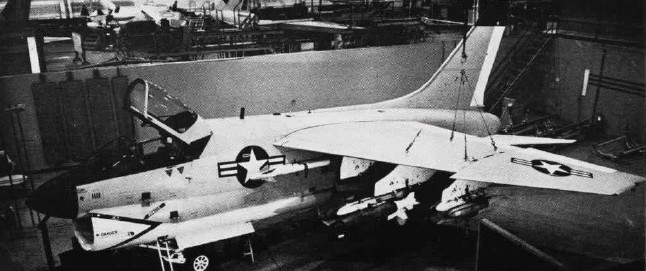
The first A-7 mock-up in 1964
All bids were received by September 1963 and the evaluation process was completed in early November of that year. On 8th February 1964, funding for VAL was approved by Congress, enabling the programme to proceed; three days later, Vought’s submission was selected as the winner. On 19th March 1964, Vought received a contract from the Navy for the manufacture of the initial batch of aircraft, designated A-7. On 22nd June 1964, the mock-up review took place. In 1965, the A-7 received the name Corsair II; Vought had previously produced two aircraft known as “Corsair”. During the 1920s, they had produced the O2U Corsair biplane scout and observation aircraft; during World War II, the firm made the successful F4U Corsair.
Into production
On 27th September 1965, the first A-7A performed the type’s maiden flight. On 2nd November 1965, Vought publicly demonstrated the first pair of A-7As to 1,000 guests; test pilot John Conrad demonstrated the aircraft’s ability to perform rapid rolls even while laden with a payload of six 250 lb and twelve 500 lb bombs. A Navy spokesperson acknowledged the A-7’s ability to carry double the bombload of an A-4E, or the same payload over twice its maximum distance.

A-7P of the Portuguese Air Force
The flight test programme proceeded at a relatively rapid pace, during which no major setbacks were uncovered or meaningful delays were incurred. According to Gunston and Gilchrist, there were some naval officials that sought to slow the programme down so that the A-7’s avionics systems could be revised for greater capabilities, but this preference had been overridden by a perceived urgency to getting the type into service. On 14th October 1966, enough aircraft had been delivered to the Navy that the first squadron could be formed. The first A-7 squadrons attained operational status on 1st February 1967; these were able to commence overseas combat operations in the escalating Vietnam War during December of that year.
The June 1964 contract had ordered the completion of seven development aircraft and 35 production-standard fighter bombers. A follow-up contract, placed during September 1965, ordered 140 more aircraft. A third contract for 17 aircraft led to a total of 199 A-7A aircraft being manufactured. As the original version was found to be underpowered, a large order for 196 aircraft of the improved A-7B variant, equipped with the more powerful Pratt & Whitney TF30-8 engine, was placed. Further variants of the type would be ordered, including the A-7D for the United States Air Force (USAF), during 1966. Partially due to a shortage of engines, the Allison TF41-A-2, a licensed derivative of the Rolls-Royce Spey engine, powered the A-7D. The adoption of a British engine caused some political controversy on both sides of the Atlantic.

VA-147 was the first operational USN A-7 squadron, in 1967.
During 1967, the Navy decided to cancel its order for the A-7B, resulting in 257 aircraft less of this variant being constructed.Taking its place, the A-7E, the definitive model of the aircraft, was specified and placed into production. This variant integrated several of the improvements of the USAF’s A-7D, including the TF41 engine and much of its avionics, however the engine was revised for slightly more thrust and the communications modified for compatibility with naval systems. On 25th November 1968, the first A-7E conducted its first flight; a total of 535 aircraft of this variant would be manufactured. During the 1970s and 1980s, several specialised models, such as the TA-7C for training and EA-7L for electronic warfare, were developed as well. During 1983, the final delivery of a new-build A-7 took place.
Design
The LTV A-7 Corsair II was a carrier-capable subsonic attack fighter. It was a derivative of the Vought F-8 Crusader, an earlier fighter; compared to the Crusader, it had a shorter, broader fuselage, and a longer-span wing but without the Crusader’s variable-incidence feature. The A-7’s wing was not only larger but had reduced sweepback, as well as six pylons with the carriage of up to 15,000 lb (6,800 kg) of bombs or other equipment. According to Gunston and Gilchirst, there were no common structural features shared between the two aircraft despite their visual similarity and shared heritage.

A-7A of VA-203, the “Blue Dolphins”, at NAS Jacksonville Florida in 1976
The A-7 had fully powered flight controls, as did the F-8. However, conventional outboard ailerons were used, along with large slotted flaps on the wing’s inboard area; the wing fold was between the flaps and ailerons. The wing leading edge was fixed and had a dog-tooth discontinuity. A large air brake was fitted on the underside of the aircraft. The three-unit landing gear retracted into the fuselage; the twin-wheel nose gear was steerable and stressed for catapult-assisted take-offs.
VA-147 was the first operational USN A-7 squadron, in 1967.
To achieve the required range, initial versions of the A-7 were powered by a single Pratt & Whitney TF30-P-6 turbofan engine, which produced 11,345 lbf (50.5 kN) of thrust. It had replaced the afterburner-equipped Pratt & Whitney J57-P-20A turbojet engine of the F-8. The same engine had also powered several other combat aircraft of the era, including the General Dynamics F-111 Aardvark and early Grumman F-14 Tomcats. The TF30-P-6 did not need an afterburner for its subsonic role.
Later versions of the A-7 used different engines; according to Gunston and Gilchrist, this was largely due to production difficulties in keeping up with numerous military and civil demands. These new powerplants included the more powerful Pratt & Whitney TF30-8 and the Allison TF41-A-2 engines, a licensed model of the Rolls-Royce Spey engine. The TF41 corrected issues that had troubled initial A-7 operations, such as severe compressor stalls and low thrust. The Air Force A-7D had self-contained starting using internal batteries and a gas turbine starter. The Navy A-7E used an air turbine starter driven by an external air supply.

TA-7C of VA-174 in 1988
Air was fed to the engine through ducting from a simple nose inlet, similar to that on the F-8, despite the potential hazard it posed to flight deck personnel. An aerial refueling probe was mounted on the righthand side of the nose. Two cannon were installed on the underside of the nose. For self-defense against aerial threats, the A-7, in addition to the cannon, had a mounting for AIM-9 Sidewinder air-to-air missiles on either side of the fuselage. Later variants had the two cannon replaced with a single M61A1 Vulcan rotary cannon, along with other improvements. To reduce vulnerability to ground fire the flying control hydraulic systems were triplicated, other systems duplicated and much of the fuselage had armor protection.
The A-7 was fitted with an AN/APQ-116 radar, later followed by the AN/APQ-126, which was integrated into the ILAAS digital navigation system. The radar also fed a digital weapons computer which made possible accurate delivery of bombs from a greater stand-off distance, greatly improving survivability compared with faster aircraft such as the McDonnell Douglas F-4 Phantom II. It was the first U.S. aircraft to have a modern head-up display, (made by Marconi-Elliott), now a standard instrument which displayed information such as dive angle, airspeed, altitude, drift and aiming reticule. The integrated navigation system also had another innovation – the projected map display system (PMDS) which accurately showed aircraft position on two different map scales.
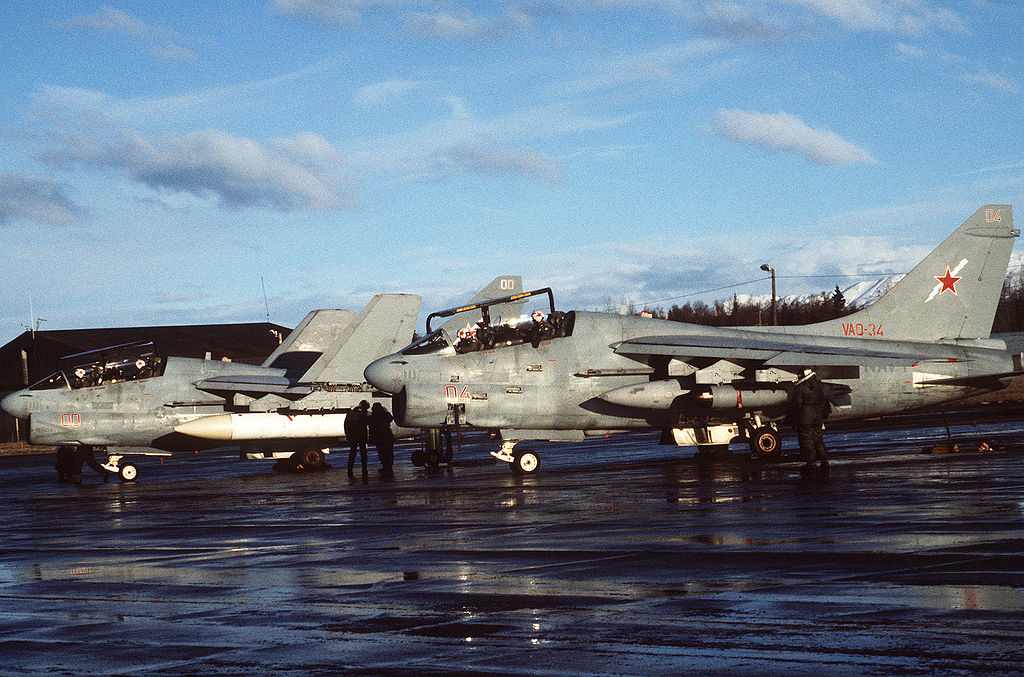
EA-7L of VAQ-34 in 1987
The A-7 had more modern avionics than contemporary aircraft. This included data link capabilities that, among other features, provided fully “hands-off” carrier landing capability when used in conjunction with its approach power compensator (APC) or auto throttle. Other notable and advanced equipment was a projected map display located just below the radar scope. The map display was slaved to the inertial navigation system and provided a high-resolution map image of the aircraft’s position superimposed over TPC/JNC charts. Moreover, when slaved to the all-axis auto pilot, the inertial navigation system could fly the aircraft “hands off” to up to nine individual waypoints. Typical inertial drift was minimal for newly manufactured models and the inertial measurement system accepted fly over, radar, and TACAN updates.
Operational history
Introduction and early operations

Lynn Garrison in a Chance Vought F4U-7 Corsair leads A-7 Corsair IIs of VA-147, over NAS Lemoore, California on 7th July 1967 prior to the A-7’s first deployment to Vietnam on USS Ranger. The A-7A “NE-300” is the aircraft of the Air Group Commander (CAG) of Attack Carrier Air Wing 2 (CVW-2).
Initial operational basing/homeporting for USN A-7 squadrons was at NAS Cecil Field, Florida for Atlantic Fleet units and NAS Lemoore, California for Pacific Fleet units. This was in keeping with the role of these bases in already hosting the A-4 Skyhawk attack squadrons that would eventually transition to the A-7.
From 1967 to 1971, a total of 27 US Navy squadrons took delivery of four different A-7A/B/C/E models. The Vought plant in Dallas, Texas, employed up to 35,000 workers who turned out one aircraft a day for several years to support the navy’s carrier-based needs for Vietnam and SE Asia and commitments to NATO in Europe. In 1974, when USS Midway became the first Forward Deployed Naval Force (FDNF) aircraft carrier to be homeported in Yokosuka, Japan, two A-7A squadrons assigned to Carrier Air Wing Five (CVW-5) were concurrently homeported at NAF Atsugi, Japan. In 1976, these squadrons (VA-93 and VA-56) finally transitioned to the much more advanced A-7E model.[citation needed] Six Naval Reserve attack squadrons would also eventually transition to the A-7, operating from NAS Cecil Field, Florida; NAS Atlanta/Dobbins ARB, Georgia; NAS New Orleans, Louisiana; NAS Alameda, California and NAS Point Mugu, California. An additional active duty squadron stood up in the 1980s, Tactical Electronic Warfare Squadron 34 (VAQ-34) at NAS Point Mugu, operating twin-seat TA-7C and EA-7L aircraft with both a pilot and a naval flight officer in an adversary electronic warfare role.

A Retired A-7E of the Royal Thai Navy in the Royal Thai Air Force Museum
Pilots of the early A-7s lauded the aircraft for general ease of flying (with the exceptions of poor stability on crosswind landings and miserable stopping performance on wet runways with an inoperative anti-skid braking system) and excellent forward visibility but noted a lack of engine thrust. This was addressed with A-7B and more thoroughly with A-7D/E. The turbofan engine provided a dramatic increase in fuel efficiency compared with earlier turbojets – the A-7D was said to have specific fuel consumption one sixth that of an F-100 Super Sabre at equivalent thrust. An A-7D carrying 12 x 500 lb (230 kg) bombs at 480 mph (770 km/h) at 33,000 ft (10,000 m) used only 3,350 lb (1,520 kg) of fuel per hour. Typical fuel consumption at mission retrograde during aircraft carrier recovery was approximately 30 pounds per minute (14 kg/min) compared to over 100 pounds per minute (45 kg/min) for the Phantom F-4J/N series. The A-7 Corsair II was tagged with the nickname “SLUF” (“Short Little Ugly Fucker”) by pilots.
Southeast Asia carrier use
In Vietnam, the hot, humid air robbed even the upgraded A-7D and A-7E of power. Takeoff rolls were lengthy, and fully armed aircraft struggled to reach 500 mph (800 km/h). For A-7A aircraft, high density altitude and maximum weight runway takeoffs often necessitated a “low transition”, where the aircraft was intentionally held in “ground effect” a few feet off the runway during gear retraction, and as much as a 10 mi (16 km) departure at treetop altitude before reaching a safe flap retraction speed. (A-7A wing flap systems were either fully extended or fully retracted. The A-7A flap handle did not have the microswitch feature of later models that permitted the flaps to be slowly raised by several degrees per tap of the flap handle as airspeed slowly increased during max-weight takeoffs.) Carrier catapult launches at maximum weight under these performance-robbing conditions were not significantly better and were characterized by the aircraft decelerating by as much as 20 knots (37 km/h) immediately after launch. As a result, A-7A units operated their aircraft 4,000 pounds (1,800 kg) below the rated maximum takeoff weight for the A-7E.

A-7Bs of CVW-16 on USS Ticonderoga in 1968
In a sortie against the Thanh Hóa Bridge on 6th October 1972, four A-7Cs from VA-82 successfully delivered 8,000 lb of high explosives with two aircraft carrying two 2,000 lb (910 kg) Walleyes, while two others also carried 2,000 lbs in Mk 84 GP bombs. In a simultaneous attack, the center piling on the bridge’s west side was hit and broke the span in half. After this, the Thanh Hoa bridge was considered permanently destroyed and removed from the target list.
A total of 98 USN A-7 Corsairs were lost during the war.
United States Air Force A-7D
The United States Army has not been permitted to operate fixed-wing combat aircraft since the establishment of an independent United States Air Force (USAF) in 1947. To meet its need for close air support of its troops in South Vietnam, the Army pressured the Air Force to procure a specialized subsonic close air support fixed-wing aircraft that would suit its needs better than the general-purpose supersonic aircraft that the USAF preferred.
The Vought A-7 seemed to be a relatively quick and inexpensive way to satisfy this need. However, the USAF was initially reluctant to take on yet another Navy-designed aircraft, but Secretary of Defense Robert McNamara was insistent. On 5th November 1965, Secretary of the Air Force Harold Brown and USAF Chief of Staff General John P. McConnell announced that they had decided to order a version of the Corsair II, designated A-7D, for the Tactical Air Command.
The A-7D differed from the Navy’s Corsair II in several ways. For one, the USAF insisted on significantly more power for its Corsair II version, and it selected the Allison TF41-A-1 turbofan engine, which was a license-built version of the Rolls-Royce Spey. It offered a thrust of 14,500 lbf (64,000 N), over 2,000 lbf (8,900 N) greater than that of the TF30 that powered the Navy’s Corsair IIs. Other changes included a head up display, a new avionics package, and an M61A1 rotary cannon in place of the two single-barreled 20-mm cannon. Also included was a computerized navigation/weapons delivery system with AN/APQ-126 radar and a head-up display.

YA-7D-1-CV AF Serial No. 67-14582, the first USAF YA-7D, 2 May 1968. Note the Navy-style refueling probe and the modified Navy Bureau Number used as its USAF tail number.
Two YA-7D prototypes were completed with TF30-P-6 engines, and the first of these flew on 6th April 1968. The first Spey-powered A-7D (67-14854) flew for the first time on 26th September 1968. The seventeenth production aircraft introduced a provision for boom flight refueling in place of the Navy’s probe/drogue system, with the boom receptacle being on the top of the fuselage behind the cockpit and offset to port.
The A-7D first entered service in 1970 with the 57th Fighter Weapons Wing at Luke AFB Arizona, and the 354th Tactical Fighter Wing at Myrtle Beach AFB, South Carolina was equipped with four squadrons of A-7Ds by 1972; the 355th TFW at Davis-Monthan AFB was equipped with four squadrons in 1972, and in 1973, the 23d TFW at England AFB, Louisiana was fully equipped with A-7Ds.
The 354th TFW first deployed two squadrons of A-7Ds to Korat Royal Thai AFB, Thailand in September 1972 as part of Operation Cornet Dancer, The A-7Ds were quickly assigned the “Sandy mission” of providing air cover for Combat Search and Rescue missions of downed pilots.
Taking over from Douglas A-1 Skyraiders (and adopting their call sign of “Sandy”), the A-7’s higher speed was somewhat detrimental for escorting the helicopters but the aircraft’s high endurance and durability were an asset and it performed admirably.
On 18th November 1972, Major Colin A. Clarke led a successful CSAR mission near Thanh Hoa to rescue a downed Republic F-105 Thunderchief crew. The mission lasted a total of 8.8 hours during which Clarke and his wingman took a number of hits from 0.50 cal (12.7 mm) anti-aircraft fire. For his actions in coordinating the rescue, Clarke was awarded the Air Force Cross, the USAF’s second-highest decoration for valor, and his A-7D (AF Serial No. 70-0970) was eventually placed on display on 31st January 1992 at the National Museum of the United States Air Force at Wright-Patterson AFB, Ohio.

A-7D-7-CV Corsair IIs 70-0976, 70-0989 and 70-0970 of the 354th Tactical Fighter Wing over the skies of Southeast Asia. ‘976 and ‘989 were retired to AMARC in 1992, ‘ 970 is on permanent display at the National Museum of the United States Air Force, Wright-Patterson AFB, Ohio.
With the end of US involvement in South Vietnam, the 354th TFW, deployed at Korat, began flying combat sorties in Cambodia to support the Lon Nol government in support of Khmer National Armed Forces against the Khmer Rouge. Rotational deployments began to Korat from the 355th TFW and 23d TFW, with pilots and support personnel beginning six-months deployment cycles. In March 1973, the 354th transferred a squadron of A-7Ds to the 388th TFW, the host wing at Korat RTAFB at the time, which re-established the 3d Tactical Fighter Squadron and created a permanent USAF A-7D presence in Southeast Asia. A-7Ds from both wings stationed at Korat engaged in combat operations in Cambodia until 15th August 1973 when an A-7D of the deployed 353d TFS/354th TFW carried out the last air support mission. In March 1974, the 354th TFW transferred several more aircraft to the 3d TFS prior to its return to Myrtle Beach AFB.
The USAF A-7D flew a total of 12,928 combat sorties during the war with only six losses – the lowest of any U.S. fighter in the theater. The aircraft was second only to Boeing B-52 Stratofortress in the amount of ordnance dropped on Hanoi and dropped more bombs per sortie with greater accuracy than any other U.S. attack aircraft.
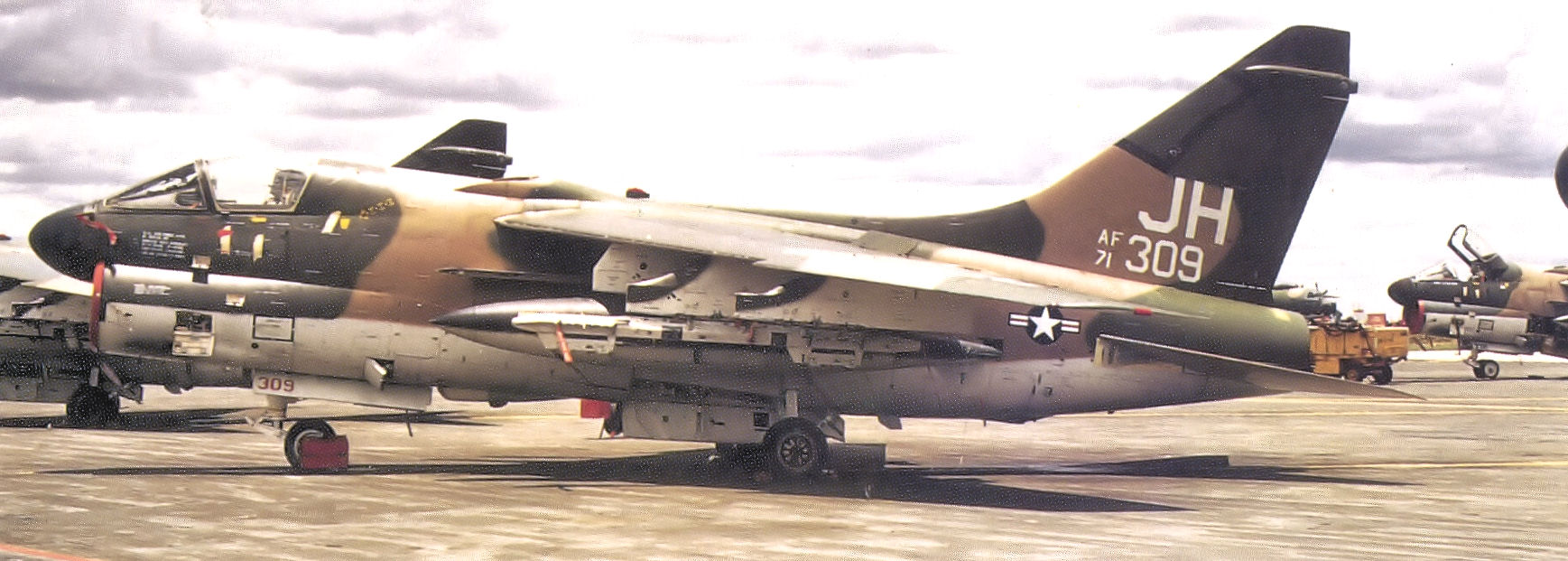
3d TFS A-7D-10-CV Corsair II 71-0309 at Korat Royal Thai Air Force Base, 1973.
Improved A-7E
The Navy was sufficiently impressed with the increased power offered by the A-7D Spey engine used by the Air Force, and decided to use this engine for its own version of the Corsair II. The designation A-7E was assigned, and this version was to succeed the A-7B in production. However, there were delays in the deliveries of the TF41-A-2 engine specified for the A-7E, so the first 67 aircraft of the order were delivered with the TF30-P-8 engine. These aircraft had all of the other improvements planned for the A-7E, including the improved avionics and the M61 rotary cannon, and were re-designated A-7C after delivery.
The first Spey-powered A-7E flew for the first time on 9th March 1969. The A-7E differed from the USAF A-7D in retaining the probe-and-drogue midair refueling system of the earlier A-7A/B. It entered service in Southeast Asia in May 1970 with VA-146 and VA-147 deployed aboard USS America. The A-7E participated in numerous close-air support missions over both North and South Vietnam, the A-7E’s state-of-the-art bombing and navigation system being particularly reliable and accurate. Most air wings operating A-4 Skyhawks and early A-7s were re-equipped with A-7Es. The A-7E participated in the mining of Haiphong harbour in 1972, and played a vital role in Operations.
Linebacker I and Linebacker II that led up to the formal end of US involvement in the Vietnam War on 24th January 1973.
On 15th May 1975, A-7E aircraft operating from USS Coral Sea, in conjunction with A-7D aircraft assigned to the 3d TFS at Korat RTAFB, provided air cover in what is considered the last battle of the Vietnam War, the recovery of SS Mayagüez after it was hijacked by Khmer Rouge gunboats. By the time the Mayaguez incident was over, three USAF Sikorsky CH-53 Sea Stallion helicopters had been shot down, two airmen, 11 Marines and two Navy Corpsmen had been killed in action and a further three Marines were missing in action.

LTV A-7D Corsair II U.S.A.F EL1750 England AFB
Post-Vietnam era
Air National Guard
With the pullout of the USAF from its Thailand bases in late 1975, the A-7Ds stationed at Korat initially went to Clark AB, Philippines. The 3d TFS transitioned from its Corsairs to the F-4E Phantom II and remained at Clark. The A-7Ds were returned to the United States where they were reassigned to several Air National Guard squadrons.
With the end of the Vietnam War, the Air Force began to transfer its active duty A-7D aircraft to Air National Guard units beginning in 1974. The Corsairs had been, in a sense, a forced acquisition by the USAF in the late 1960s, and the inter-service rivalry of flying a Navy aircraft had led, beginning about 1970, to the development of its own Close Air Support aircraft. In 1974, selection of the Fairchild Republic A-10 Thunderbolt II was made as the replacement for the A-7D. The first A-10As were received by the 354th TFW in 1977 at Myrtle Beach AFB; the 355th TFW at Davis-Monthan AFB began replacing its A-7Ds in 1978, and the 23d TFW at England AFB in 1979. As the A-10s were received, the A-7Ds were transferred from the USAF to the National Guard Bureau for subsequent re-allocation. By 1981, when the 23d TFW sent its last A-7Ds to Tonopah Test Range Airport, Nevada for clandestine use in the Lockheed F-117 Nighthawk development program, fifteen ANG squadrons were equipped with the A-7D Corsair II.

A-7 Corsair II aircraft of the Iowa (IA) and South Dakota (SD) Air National Guard flying near RAF Waddington, UK. These aircraft were deployed to the United Kingdom from 21st August through 12th September 1979 for NATO operation CORNET Stallion
However, Congressional decisions added additional funding to the DOD FY 1975 and FY 1976 budgets for the procurement of additional A-7Ds, primarily to keep the LTV production line in Dallas open and the workers employed in the wake of post-Vietnam DOD procurement reductions. As a result of these unplanned acquisitions, the Air Force assigned these new aircraft (all with 1975 tail numbers) to the Arizona Air National Guard 152nd Tactical Fighter Squadron at Tucson, which operated the Air National Guard transition training school for Corsair II pilots. In 1978, a two-seat A-7 trainer was developed by LTV for the Air Force, designated the A-7K. One prototype aircraft was built by modifying an existing A-7D airframe, however production A-7Ks were new builds with 1979 and 1980 tail numbers. The A-7K was a fully combat capable aircraft as well as a dual-control training aircraft. Most of the A-7K trainers went to the transition school at Tucson, with the squadrons’ A-7Ds being re-distributed to other ANG squadrons. However all ANG squadrons were assigned an A-7K trainer as well as their complement of A-7Ds.
During the post-Vietnam era, the Air National Guard frequently deployed its Corsairs on annual operational exercises. Deployments were made to NATO and USAFE bases in West Germany and Denmark as part of training exercises along with the USAREUR Reforger training exercises.

Two USANG Corsairs, a two-seat A-7K and a single-seat A-7D, 1988
Beginning in 1974, active-duty squadrons from Myrtle Beach, England and Davis-Monthan Air Force Bases began deployments of A-7Ds to Howard AFB, Panama to train with Army and Naval forces defending the Panama Canal. These deployments, named “Cornet Cove” generally were of ninety (90) days, and were rotated among squadrons of the three wings in the United States. Beginning in 1977, with the phaseout of the A-7D with active-duty units, the Air National Guard began taking over this mission. In December 1989, the South Dakota 175th Tactical Fighter Squadron and Ohio 112th Tactical Fighter Squadron were at Howard AFB on a Coronet Cove deployment when President George H.W. Bush announced Operation Just Cause, the United States Invasion of Panama. The ANG squadrons participated in the invasion, flying 34 combat missions, completing 34 sorties, expended 71.7 flying hours and expended 2,715 rounds of ordnance. On 12th January 1981, in the 1981 Luis Muñoz Marín International Airport attack, 10 A-7Ds of the 198th Tactical Fighter Squadron, Puerto Rico Air National Guard were destroyed or damaged in a terrorist attack by the Boricua Popular Army at Muniz Air National Guard Base in the largest attack ever on an American military station since the Vietnam War. This terrorist attack was largely unreported due to the Iran hostage crisis at the time.
Grenada and Lebanon
Navy A-7E squadrons VA-15 and VA-87, from USS Independence, provided close air support during the Invasion of Grenada, codenamed Operation Urgent Fury, in October 1983.

A-7Es on USS Independence in 1983
Navy A-7s also provided air support during the U.S. mission in Lebanon in 1983. An A-7 and an A-6 Intruder were shot down by Syrian surface-to-air missiles (SAM) on 4th December 1983. The A-7 pilot, Commander Edward Andrews, managed to guide his failing Corsair over coastal waters before ejecting; he was rescued by a Lebanese fishing boat and safely returned to the U.S. Marines.
Libya
On 24th March 1986, during the Gulf of Sidra dispute with Libya, Libyan air defense operators launched SA-5 missiles at two Fighter Squadron 102 (VF-102) Grumman F-14 Tomcats from USS America that were orbiting in international air space on a Combat Air Patrol (CAP) station. A-7s operating from USS Saratoga responded by launching the first AGM-88 HARM missiles ever used in combat. On the next day, A-6s attacked Libyan warships approaching the US fleet, while A-7s again launched HARM missiles against Libyan SAM sites.
In April 1986, navy Sixth Fleet A-7Es from VA-72 and VA-46 embarked on board USS America also participated in Operation El Dorado Canyon, the retaliatory attack on Libya, using HARM and Shrike anti-radar missiles to protect the naval strike force from SAMs.

A-7E of VA-72 on USS America off Libya in April 1986.
Operations Desert Shield and Desert Storm
While USAF A-7s stayed home in favor of A-10s, the USN deployed two of its last A-7E squadrons to Operation Desert Shield in August 1990 aboard USS John F. Kennedy, the only carrier of six deployed to Desert Storm to operate the A-7. The navy squadrons VA-46 and VA-72 made the last combat sorties of the A-7 in Operation Desert Storm flying from the Red Sea to targets throughout Iraq. The A-7 was used both day and night to attack a wide range of heavily defended deep interdiction targets in Iraq as well as “kill boxes” (geographically defined kill zones) in Kuwait, employing a variety of weapons including precision-guided munitions (PGMs), such as the TV-guided Walleye glide bomb, unguided general-purpose bombs, and High Speed Anti-Radiation missiles (HARM). The A-7 was also used as a tanker in numerous in-flight refueling missions.

A-7E from VA-72 flying over the Saudi desert during Operation Desert Shield
Use in F-117 development
The 4450th Tactical Group stationed at Nellis AFB, Nevada had the distinction of being the last active USAF unit to operate the A-7 Corsair II. The mission of the 4450th TG was the operational development of the F-117, and the unit needed a surrogate aircraft for pilot training and practice. A-7Ds and A-7Ks were obtained from various active duty and air national guard squadrons and were assigned initially to the “(P)” or “Provisional” unit of the 4450th Tactical Group, redesignated the 4451st Tactical Squadron in January 1983. The A-7s were used as a deception and training aircraft by the group between 1981 and 1989. It was selected because it demanded a similar pilot workload expected in the F-117A, was single seat, and many of the F-117A pilots had F-4 or F-111 backgrounds. A-7s were used for pilot training before any F-117As had been delivered, to bring all pilots to a common flight training base line. Later, the A-7s were used as chase planes on F-117A tests and other weapon tests at the Nellis Range.

A-7D-5-CV AF Serial No. 69-6241 of the 4451st Test Squadron / 4450th Tactical Group at Nellis AFB, Nevada in 1984
A-7 flight operations began in June 1981 concurrent with the very first YF-117A flights. The A-7s wore a unique “LV” tailcode (for Las Vegas) and had a dark purple/black paint motif. The A-7s were based officially at Nellis Air Force Base and were maintained by the 4450th Maintenance Squadron. In addition to providing an excuse for the 4450th’s existence and activities, the A-7s were also used to maintain pilot currency, particularly in the early stages when very few production F-117As were available. The pilots learned to fly chase on F-117A test and training flights, perform practice covert deployments, and practice any other purpose that could not be accomplished using F-117As, given the tight restrictions imposed on all F-117A operations.
Some A-7s operated from the Tonopah Test Range Airport, about 30 miles (48 km) southeast of Tonopah, Nevada where the F-117s were being operationally tested. As a deception operation, care was taken to ensure that F-117As were never left parked outside aircraft hangars during daylight hours. However, A-7s were deliberately and routinely left outside hangars for the benefit of any orbiting Soviet spy satellites. Soviet intelligence agencies examining spy satellite imagery of the base would undoubtedly notice the A-7s parked on the Tonopah flight line, and would not be particularly interested. The intention of this deception was to convince the Soviets that Tonopah operated nothing more exciting than some obsolete A-7 Corsairs. The cover story to the public was that the A-7s were flying “radar calibration missions” out of Tonopah. Also, in order to help maintain the deception, about five or six A-7Ds were deployed to South Korea in 1984 and 1988. In South Korea they trained with the Army for about a month in Close Air Support operations. It appeared to the Russians that it was a real squadron with a combat mission because the aircraft could be seen having munitions loaded and performing training missions.
There were approximately 20 A-7D aircraft used in developing the F-117, including several two-seat A-7K trainers. In January 1989, three months after the USAF admitted the F-117A existed, the A-7s were retired to the Aerospace Maintenance and Regeneration Center (AMARC) and were replaced by AT-38B Talons as training aircraft and the 4451st TS was deactivated.

EA-7L pilot LT Lori “Wrench” Melling (left) and ECMO LT Laura “Moose” Mason (right) of VAQ-34 at Elmendorf AFB, 1987
Training retirement and foreign users
Pilots quipped that the Corsair “is not very fast, but it sure is slow.” For dissimilar air combat training (DACT), and aerial demonstrations by the Blue Angels, the Navy would choose the more nimble A-4 Skyhawk as a subsonic maneuvering platform, as some considered the A-7 to be inadequate in air combat, even though it was highly maneuverable. While some questioned its air combat capability it was widely regarded as a highly successful attack aircraft, partly by virtue of being a stable bombing platform. Despite this, the Marine Corps also rejected the Corsair, opting instead for the V/STOL (Vertical/Short Take Off or Landing) AV-8 Harrier as its light attack aircraft to replace its A-4F/M Skyhawks.
Greece’s Hellenic Air Force ordered sixty new A-7H aircraft and five TA-7Hs in 1974. The delivery of the airplanes started in 1975 and equipped the 347, 340, 345 Squadrons. In 1993 Hellenic Air Force received an additional sixty-two A-7Es and nineteen TA-7C surplus USN airplanes who were given to the 335 and 336 Squadrons. The last A-7Es were retired in October 2014 from the 336th Bomber Squadron.

Greek Air Force LTV TA-7C Corsair II departs the Royal International Air Tattoo, UK, 2014
The sale of A-7s to Pakistan was not approved due to US opposition to its nuclear program.
General Dynamics F-16 Fighting Falcons began replacing the Air National Guard Corsairs beginning in the late 1980s and the last were retired in 1993 by the units at Rickenbacker Air National Guard Base, Ohio; Des Moines Air National Guard Base, Iowa; Tulsa Air National Guard Base, Oklahoma; and Springfield Air National Guard Base, Ohio.
USN A-7 Corsairs began being phased out of the fleet during the mid-1980s with the arrival of the McDonnell Douglas F/A-18 Hornet. A-7 squadrons of the United States Navy Reserve transitioned concurrent with (but prior to the completion of) all Regular Navy squadrons. The last Navy A-7s were retired by the last fleet operational squadrons (VA-46 and VA-72) in May 1991 shortly after their return from Operation Desert Storm. By the end of 1998, with the exception of some airframes used as static displays, all US A-7s were disposed of by the AMARC.
Some of these surplus aircraft were passed to Greece, Thailand and Portugal. The last Portuguese Air Force A-7Ps were retired in 2007 after 26 years. The Corsair II served for 49 years.
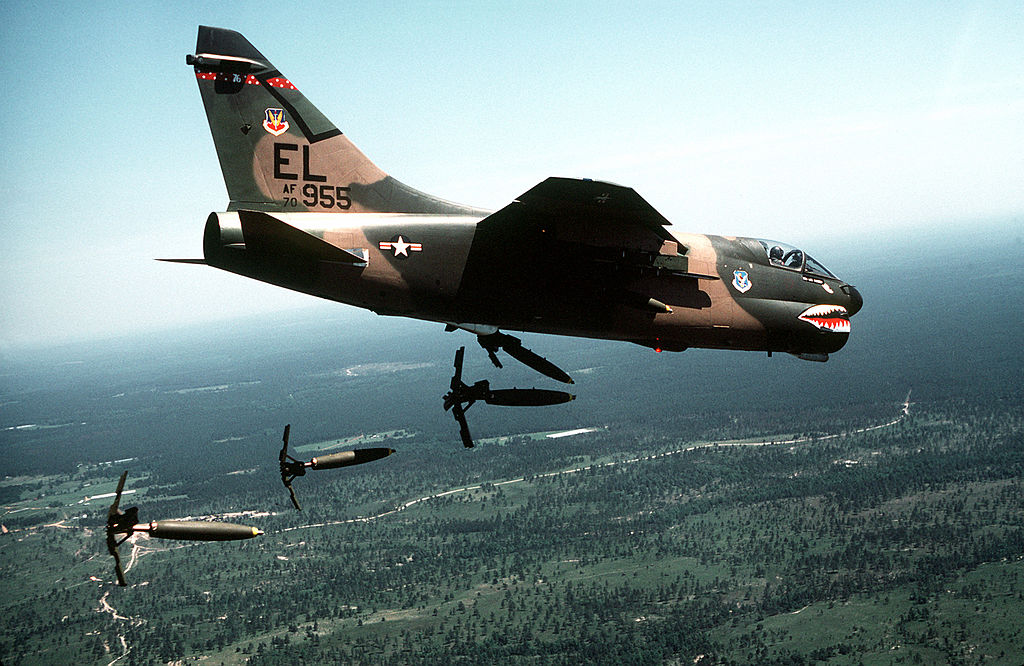
76th Tactical Fighter Squadron A-7D 70-0959 dropping bombs
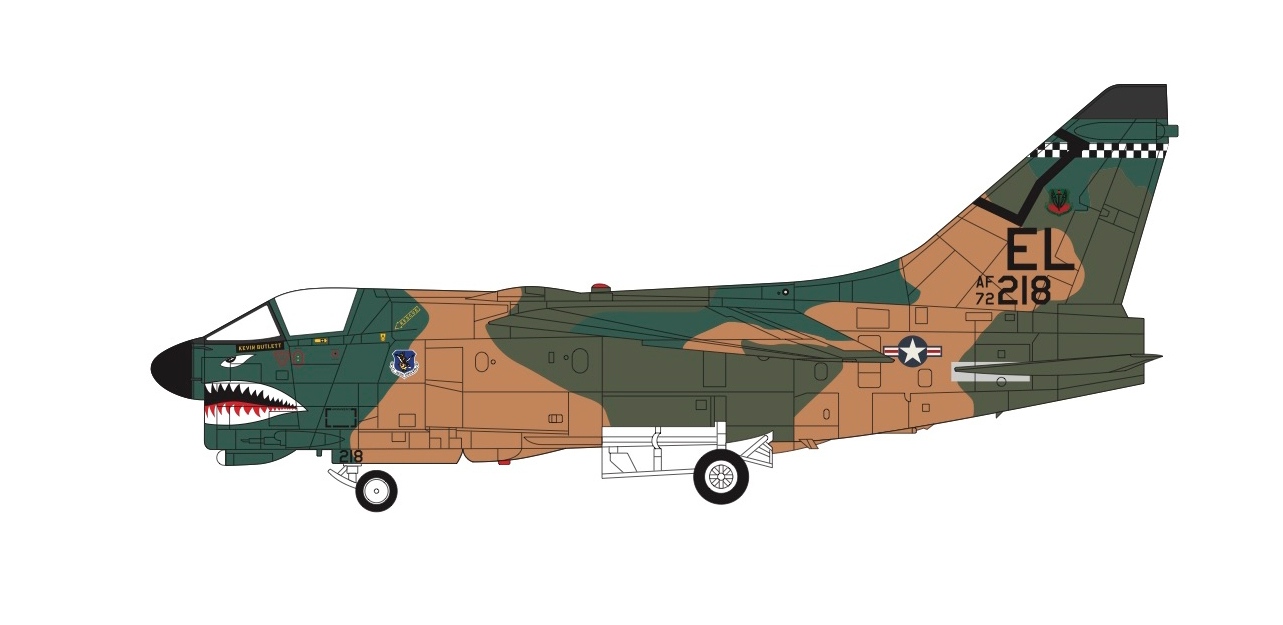
Century Wings New Model Announcement !
Check out the latest Century Wings model announcement which is already selling fast !
On 5th July 1973, the 74 TFS deployed to Korat Royal Thai Air Force Base, Thailand, on temporary duty with the 354th Tactical Fighter Wing (Deployed) from Myrtle Beach Air Force Base, South Carolina. The 74th replaced the 354th Tactical Fighter Squadron from Davis-Monthan Air Force Base, Arizona that had completed its temporary duty. For just over a month, until the cessation of all U.S. bombing on 15th August 1973, the 74 TFS supported the air war activities in Cambodia, accounting for the destruction of 311 enemy structures, 25 ground artillery and missile sites, three bridges and 9,500 cubic meters of supplies. The 74 TFS returned to England on 28th December 1973.
On 18th May 1972, the squadron was redesignated the 75th Tactical Fighter Squadron, and on 1st July 1972 was activated at England Air Force Base, Louisiana. There the squadron began flying the A-7D Corsair II ground attack aircraft.
The 23 TFW took part in a variety of operational exercises both in the United States and overseas, including tactical bombing competitions against the Royal Air Force at RAF Lossiemouth, Scotland, during October 1977 and July 1978. In both events, A-7D teams captured the Sir John Mogg Team Trophy.
Don’t forget NO DEPOSIT necessary with Flying Tigers and if you order with your debit or credit card your payment is not taken until your model is available to dispatch.
Flying Tigers will also consolidate your orders to save on postage costs across all brands !
Please click on the image / links above to go to the model page to order now.
Calibre Wings New Model Announcements !
Calibre Wings have announced some new models to add to their range of Tomcats. Some of these models are now available in “Panel Washed ” finish as well as the normal “clean” versions. I have listed them all below for clarity of calibre wing code numbers.
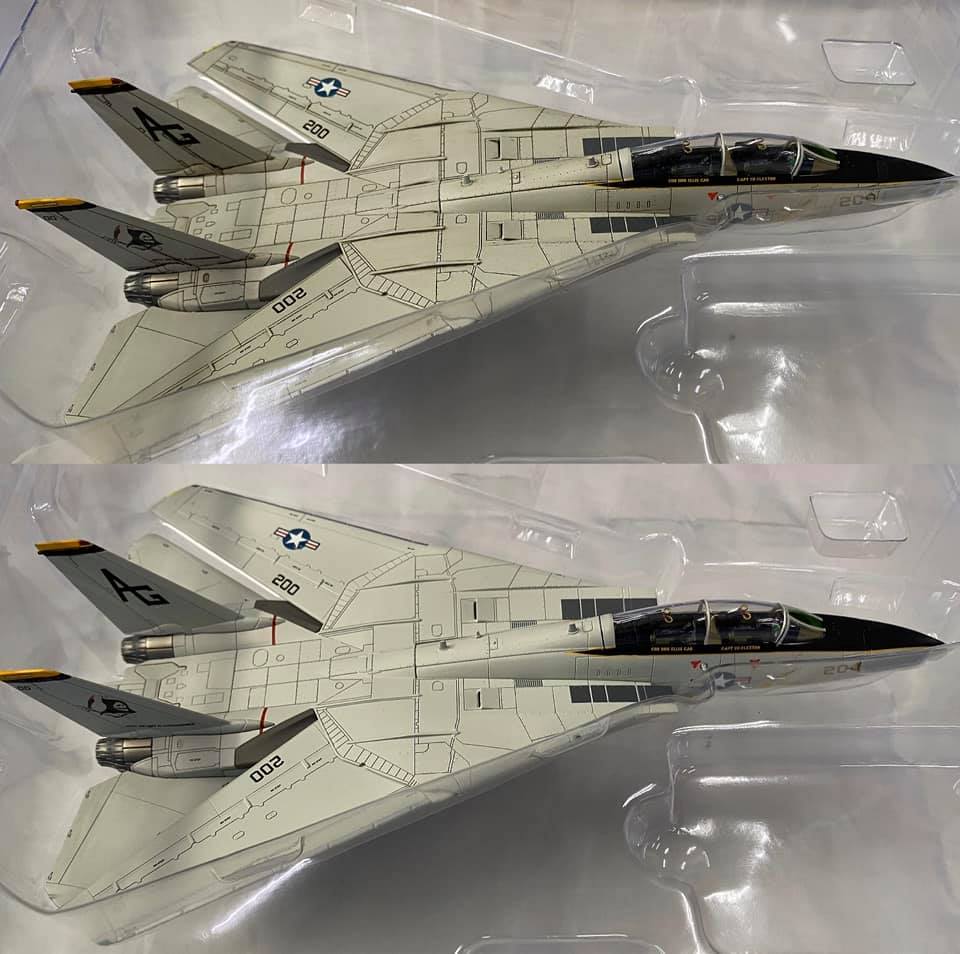
Calibre Wings Grumman F-14A VF-142 Ghostriders (Panel washed version TOP) ( Clean version BOTTOM) for comparison .
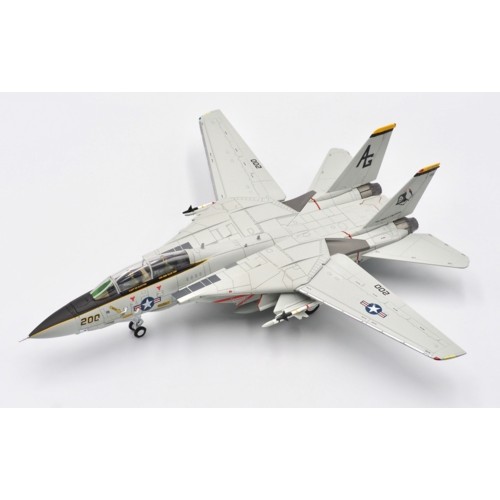
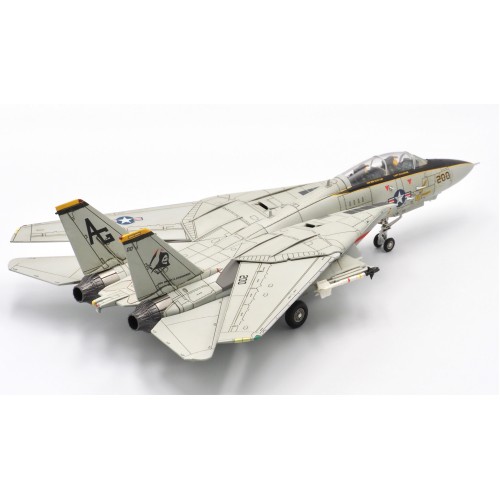

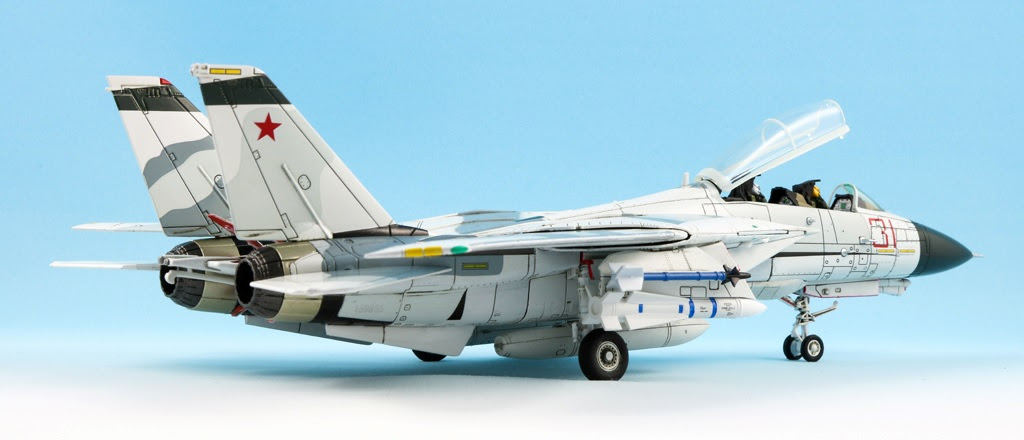
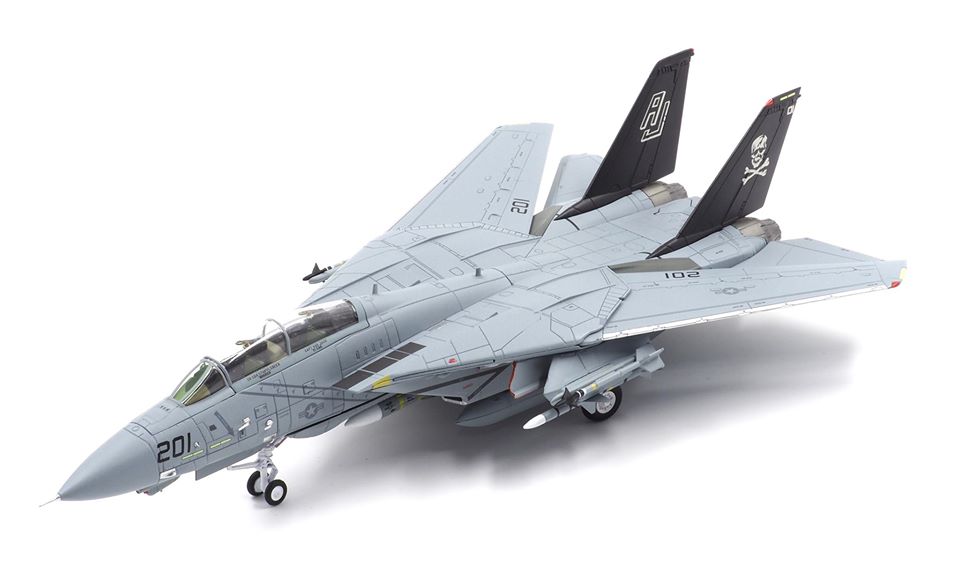
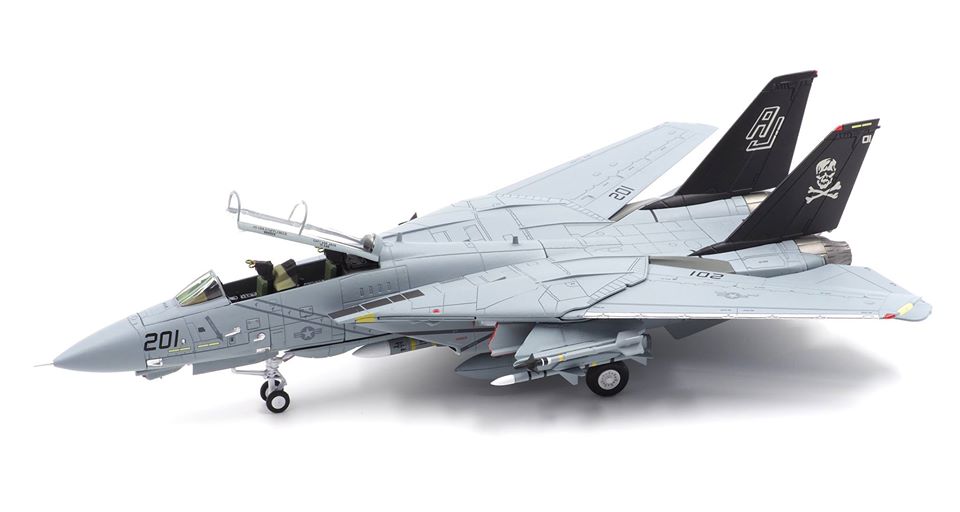


CA72DB01 Calibre Wings 1/72nd scale Ocean Low Pass Diorama Base (Aircraft not included) RRP £40.00 Flying Tigers only £33.99
Coronovirus: Flying Tigers Dispatch Information.
Due to Covid-19 there is now some disruption to service times from Parcelforce and the Royal Mail who have now suspended their service delivery time guarantees. The situation is patchy with some customers getting models next day whilst others are waiting 10 days or so. Please be patient … all carriers and postal services are working round the clock to catch up, and so are Flying Tigers.
At Flying Tigers, family and friends have always been the most important thing to us. During these unprecedented times we want to reassure you that the health and safety of our customers, employees and their families continues to be our number one priority. Now is the time for us to come together and support one another more than ever.
We will continue to follow all World Health Organisation, Government and Public Health England advice and act accordingly. Currently, our small showroom is closed to the public and we will continue to monitor the rapidly changing situation closely and respond as advised by those experts.
Whilst we’ve always been a clean and tidy bunch, we are doing everything to ensure even higher standards of hygiene and cleanliness.
We’d like to say a huge thank you to all our customers, for continuing to support us. It’s not been easy for anyone and we’re lucky to have fellow collectors that understand that in these difficult times, small family businesses such as Flying Tigers need your business and support to stay alive.
If you have supplied Flying Tigers with your mobile number and/ or your email address, Parcelforce will notify you by way of text message or email on anticipated delivery day/time.
For Royal Mail delivered parcels these can be tracked through the Royal Mail parcel tracking service. The tracking number will be emailed to you on the “Your order is completed” notification upon dispatch of your order.
If you had requested a delivery to your place of work or to a neighbour, and you would now like your Parcel delivered to your home/billing address please email us and we will make the change. If we do not receive this instruction we will continue to dispatch to your original delivery address.
We are still working hard processing and despatching orders on a daily basis.
You, our loyal customers will be the first to know in the event of any changes or updates in the coming weeks.
For more information on COVID-19 and current Government stance please follow these links below:
Coronovirus: Royal Mail and Parcelforce Update
Royal Mail have issued an update with regards to the Coronavirus…
Public Health England (PHE) has advised that people receiving parcels are not at risk of contracting the coronavirus. From experience with other coronaviruses, we know that these types of viruses don’t survive long on objects, such as letters or parcels. This complements the highly publicised guidance from PHE for people to wash their hands more often than usual using soap and hot water.
We are actively monitoring this rapidly evolving situation. We take the health and safety of our people very seriously. We have provided guidance to our people, our customers and the communities in which we operate, to help prevent the spread of any infection. We are doing so in line with preventative guidance from Public Health England.
Signing for and receiving items
In order to protect both our people and customers as much as possible, we will not be handing over our hand-held devices to customers to capture signatures. Postmen and women will instead log the name of the person accepting the item. This will apply to all deliveries that require a signature.
Additionally, for all customers (including those who are self-isolating) where we need to deliver any parcel that won’t fit through your letterbox, we will place your item at your door. Having knocked on your door, we will then step aside to a safe distance while you retrieve your item. This will ensure your item is delivered securely rather than being left outside.
In order to protect both our people and customers as much as possible, we will not be handing over our hand-held devices to customers to capture electronic signatures. Our drivers will instead log the first and last name of the person accepting the item then put ‘XP1’ in the signature field, and we will record the geolocation of the delivery. This will apply to all deliveries that normally require a signature.
If you are unable to come to the door at all we will issue a ‘Something for You’ card, advising of other ways you can arrange to get your item. For example, by getting a friend or family member to collect the parcel from our local Customer Service Point on your behalf. In this situation, and to keep your mail as secure as possible, they will need to bring along the card we left you and a form of ID in the name of the person to which the item is addressed.
For full information on our response to this global situation, please visit parcelforce.com/coronavirus
Contingency plans
In the event we need to close one of our units, this decision would be made in line with Public Health England guidance. Royal Mail has many years’ experience of contingency planning for a number of different scenarios. We will follow the Government’s advice and work closely with the relevant authorities.
We have extensive experience in being able to quickly deploy business contingency plans so we continue to provide customers with access to our services and their mail.
Coronovirus International Shipment Updates
As you may know from the media recently, a number of countries are cancelling flights between Europe and themselves, and countries within the EU are shutting borders and some are or have gone on lockdown.
Unfortunately, this means that almost all international mail and parcels will be delayed wherever they go as many pass-through EU countries etc onto other destinations. Some freight also piggybacks onto commercial flights, like Royal Mail use BA to inject into the USA. These flights have recently been cancelled.
We will do our utmost to work with our carrier partners to ensure mail/parcels are stored safely in periods they are held and we will move the freight as quickly, safely and as smooth as possible.
Please note this may cause big breaks within the tracking where parcels haven’t been scanned and we expect we will see delays of up to 4/6 weeks to some destinations. This prediction is based on today’s activities.
Governments are making decisions on a daily basis so it is difficult to pinpoint exactly where or when delays will occur.
I would ask our customers to be mindful of this when contacting our customer services team.
We will try to keep you informed wherever possible.
Service and Parcels to USA
Parcelforce are pleased to tell you that we have been able to secure capacity to allow us to continue to operate the service to USA.
Over the last few days the number of flights to USA has reduced dramatically. This has resulted in a significant reduction in airline capacity for parcels and freight from UK to USA. We have been working very closely with our airline partners to maintain service.
You can continue to receive parcels in these countries via our globalexpress service, however there is a suspension of delivery time guarantee in place.
Services and Parcels to New Zealand and Kuwait
Due to the ongoing situation and attempts to limit the spreading of COVID-19, which has impacted airline capacity into the New Zealand and Kuwait, Parcelforce have suspended our globalpriority service to these countries with immediate effect, until further notice.
You can continue to receive parcels in these countries via our globalexpress service, however there is a suspension of delivery time guarantee in place.
Parcel deliveries in France
Our European parcel delivery partner GLS has informed us that they will not be making deliveries on Fridays in France, until further notice, due to operational issues. The services affected by this are europprioritybusiness and europriorityimport only. GLS hubs, depots and customer services will therefore be closed on Fridays, Saturdays and Sundays in France.
Services and Parcel deliveries to Australia, China and Canada
In the rapidly evolving situation regarding Coronavirus (COVID-19), we are continuing to work very closely with our airline partners to maintain our overseas delivery services.
We are pleased to tell you that we are able to secure capacity to operate the service to Australia, China and Canada. However, as passenger numbers reduce, the number of available flights to these destinations has also reduced significantly, impacting capacity for parcels and freight.
You can continue to receive parcels in these countries via our globalexpress service, however there is a suspension of delivery time guarantee in place.
Thank you for reading this week’s Newsletter.
Stay safe, well, and look after each other.
Richard.
Flying Tigers.