Mikoyan-Gurevich MiG-25 Foxbat
The Mikoyan-Gurevich MiG-25 (NATO reporting name: Foxbat) is a supersonic interceptor and reconnaissance aircraft that was among the fastest military aircraft to enter service. It was designed by the Soviet Union’s Mikoyan-Gurevich bureau primarily using stainless steel; one of the few combat aircraft to do so. It was the last plane designed by Mikhail Gurevich before his retirement. The first prototype flew in 1964, and the aircraft entered service in 1970. It has an operational top speed of Mach 2.83 (Mach 3.2 is possible but at risk of significant damage to the engines), and features a powerful radar and four air-to-air missiles.
When first seen in reconnaissance photography, the large wing suggested an enormous and highly maneuverable fighter, at a time when U.S. design theories were also evolving towards higher maneuverability due to combat performance in the Vietnam War. The appearance of the MiG-25 sparked serious concern in the West and prompted dramatic increases in performance for the McDonnell Douglas F-15 Eagle then under development in the late 1960s.
The capabilities of the MiG-25 were better understood in 1976 when Soviet pilot Viktor Belenko defected in a MiG-25 to the United States via Japan. It turned out that the aircraft’s weight necessitated its large wings.
Production of the MiG-25 series ended in 1984 after completion of 1,190 aircraft. A symbol of the Cold War, the MiG-25 flew with Soviet allies and former Soviet republics, remaining in limited service in Russia and several other nations. It is one of the highest-flying military aircraft, and the second fastest after the SR-71 reconnaissance aircraft.
During the Cold War, Soviet Air Defence Forces, PVO (not to be confused with Soviet Air Force, VVS) was given the task of strategic air defence of the USSR. In the decades after World War II, this meant not only dealing with accidental border violations, but more importantly defending the vast airspace of the USSR against US reconnaissance aircraft and strategic bombers carrying free-fall nuclear bombs. The performance of these types of aircraft was steadily improved. Overflights by the very high altitude American Lockheed U-2 in the late 1950s revealed a need for higher altitude interceptor aircraft than currently available.
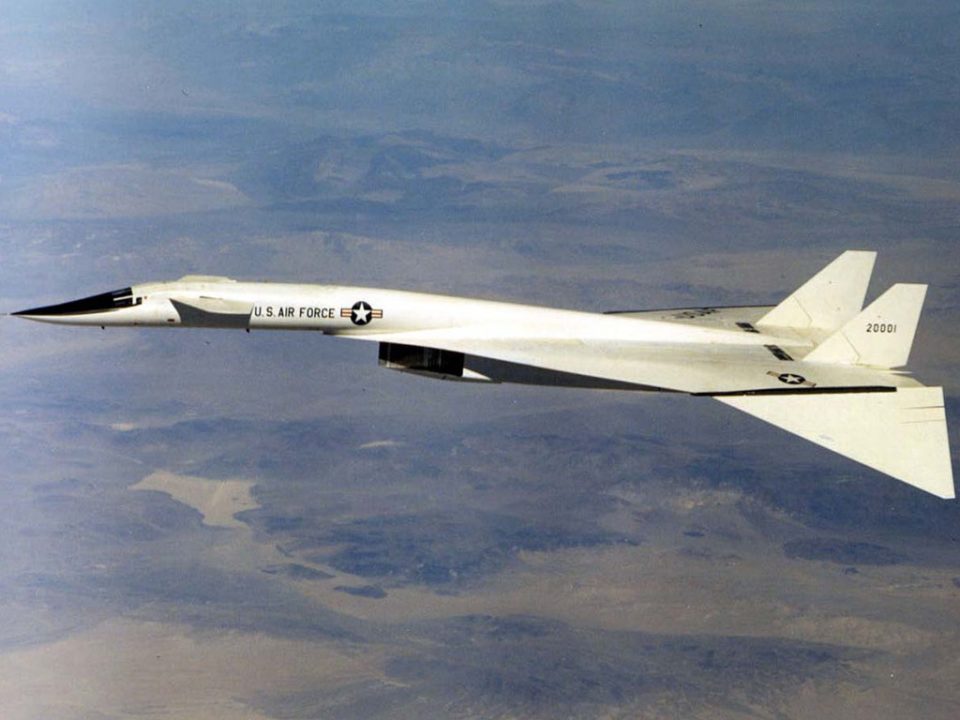
North American XB-70A Valkyrie in flight.
The subsonic Boeing B-47 Stratojet and Boeing B-52 Stratofortress strategic bombers were followed by the Mach 2 Convair B-58 Hustler, with the Mach 3 North American B-70 Valkyrie on the drawing board at that time. A major upgrade in the PVO defence system was required, and at the start of 1958 a requirement was issued for manned interceptors capable of reaching 3,000 km/h (1,864 mph) and heights of up to 27 km (88,583 ft).
Work on the new Soviet interceptor that became the MiG-25 started in mid-1959, a year before Soviet intelligence learned of the American Mach 3 A-12 reconnaissance aircraft. It is not clear if the design was influenced by the American A-5 Vigilante.
The design bureau studied several possible layouts for the new aircraft. One had the engines located side-by-side, as on the MiG-19. The second had a stepped arrangement with one engine amidships, with exhaust under the fuselage, and another in the aft fuselage. The third project had an engine arrangement similar to that of the English Electric Lightning, with two engines stacked vertically. Option two and three were both rejected because the size of the engines meant any of them would result in a very tall aircraft which would complicate maintenance.
The idea of placing the engines in under wing nacelles was also rejected because of the dangers of any thrust asymmetry during flight. Having decided on engine configuration, there was thought of giving the machine variable-sweep wings and a second crew member, a navigator. Variable geometry would improve maneuverability at subsonic speed, but at the cost of decreased fuel tank capacity. Because the reconnaissance aircraft would operate at high speed and high altitude the idea was soon dropped. Another interesting but impractical idea was to improve the field performance using two RD36-35 lift-jets. Vertical takeoff and landing would allow for use of damaged runways during wartime and was studied on both sides of the Iron Curtain. The perennial problem with engines dedicated to vertical lift is they become mere dead weight in horizontal flight, and also occupy space in the airframe needed for fuel. The MiG interceptor would need all the fuel it could get, so the idea was abandoned.

Ye-155R3 Reconnaissance prototype with a 5,280 litre drop tank under the belly, 1964
The first prototype was a reconnaissance variant, designated “Ye-155-R1”, that made its first flight on 6th March 1964. It had some characteristics that were unique to that prototype, and some of these were visually very evident: the wings had fixed wingtip tanks (600 litre capacity) to which small winglets were attached for stability purposes, but when it was found that fuel sloshing around in the tanks caused vibrations they were eliminated. The aircraft also had attachments for moveable fore planes, canards, to help with pitch control at high speed.
The first flight of the interceptor prototype, “Ye-155-P1”, took place on 9th September 1964. Development of the MiG-25, which represented a major step forward in Soviet aerodynamics, engineering and metallurgy, took several more years to complete.

Ye-155R-3 prototype at the 1967 Domodedovo Air Show
On 9th July 1967, the new aircraft was first shown to the public at the Domodedovo air show, with four prototypes (three fighters and a reconnaissance aircraft) making a flypast.
The Mikoyan-Gurevich design bureau soon realized that the performance of the new aircraft gave it great potential to set new flight records. In addition to their normal duties, the prototypes Ye-155-P1, Ye-155-R1, Ye-155-R3 were made lighter by removing some unneeded equipment, and were used for these attempts. Under Federation Aeronautique Internationale (FAI) classification the Ye-155 type belonged to class C1 (III), which specifies jet-powered land planes with unlimited maximum take-off weight.
The first claim was for world speed records with no payload and payloads of 1,000 and 2,000 kilograms. MiG OKB Chief Test Pilot Alexander V. Fedotov reached an average speed of 2,319.12 km/h over a 1,000 km circuit on 16 March 1965.
For pure speed, with no payload, test pilot Mikhail M. Komarov averaged 2,981.5 km/h over a 500 km closed circuit on 5th October 1967. On the same day, Fedotov reached an altitude of 29,977 metres (98,350 ft) with a 1,000 kilogram payload. The MiG eventually became the first aircraft to go higher than 35,000 metres (115,000 ft).
Time to height records were recorded on 4th June 1973 when Boris A. Orlov climbed to 20,000 m in 2 min 49.8 sec. The same day, Pyotr M. Ostapenko reached 25,000 m in 3 min 12.6 sec and 30,000 m in 4 min 3.86 sec.
On 25th July 1973, Fedotov reached 35,230m with 1,000 kg payload, and 36,240 m with no load (an absolute world record). In the thin air, the engines flamed out and the aircraft coasted in a ballistic trajectory by inertia alone. At the apex the speed had dropped to 75 km/h !

The Mikoyan Ye-266M, this prototype MiG-25 is the all-time record holder for the highest altitude achieved by a jet aircraft, at 123,524 ft
On 31st August 1977, “Ye-266M” again flown by Fedotov, set the recognized absolute altitude record for a jet aircraft under its own power. He reached 37,650 metres (123,524 ft) at Podmoskovnoye, USSR in zoom climb (the absolute altitude record is different from the record for sustained altitude in horizontal flight). The aircraft was actually a MiG-25RB re-engined with the powerful R15BF2-300. It had earlier been part of the program to improve the aircraft’s top speed that resulted in the MiG-25M prototype.
In all 29 records were claimed, of which seven were all-time world records for time to height, altitudes of 20,000 m and higher, and speed. Several records still stand today.
Full-scale production of the MiG-25R (‘Foxbat-B’) began in 1969 at the Gorkii aircraft factory (Plant No.21). The MiG-25P (“Foxbat-A”) followed in 1971, and 460 of this variant was built until production ended in 1982. The improved PD variant that replaced it was built from 1978 till 1984 with 104 aircraft completed. But from then on the Gorkii factory switched over production to the new MiG-31.
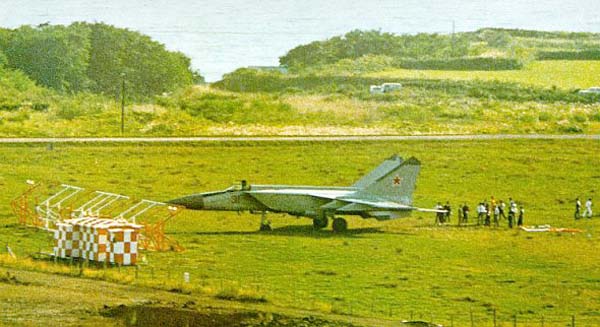
On 6th September 1976 Belenko was performing a conventional flight with a MiG 25. At the very beginning of his flight, he made an unexpected manoeuvre and observers thought that he had crashed. But at low altitude, and out of the range of radar, Belenko headed to sea and to Hokkaido. Another pilot Nikolai Sadovnikov was sent after him to shoot him down, with the more advanced jet fighter “A Sukhoi”.
Inaccurate intelligence analysis caused the West initially to believe the MiG-25 was an agile air-combat fighter rather than an interceptor. In response, the United States started a new program which resulted in the McDonnell Douglas F-15 Eagle. NATO obtained a better understanding of the MiG-25’s capabilities on 6th September 1976, when a Soviet Air Defence Forces pilot, Lt. Viktor Belenko, defected, landing his MiG-25P at Hakodate Airport in Japan. The pilot overshot the runway on landing and damaged the front landing gear. Despite Soviet protests, the Japanese invited U.S. Air Force personnel to investigate the aircraft. On 25 September, it was moved by a C-5A transport to a base in central Japan, where it was carefully dismantled and analyzed. After 67 days, the aircraft was returned by ship to the Soviets, in pieces. The aircraft was reassembled and is now on display at the Sokol plant in Nizhny Novgorod.
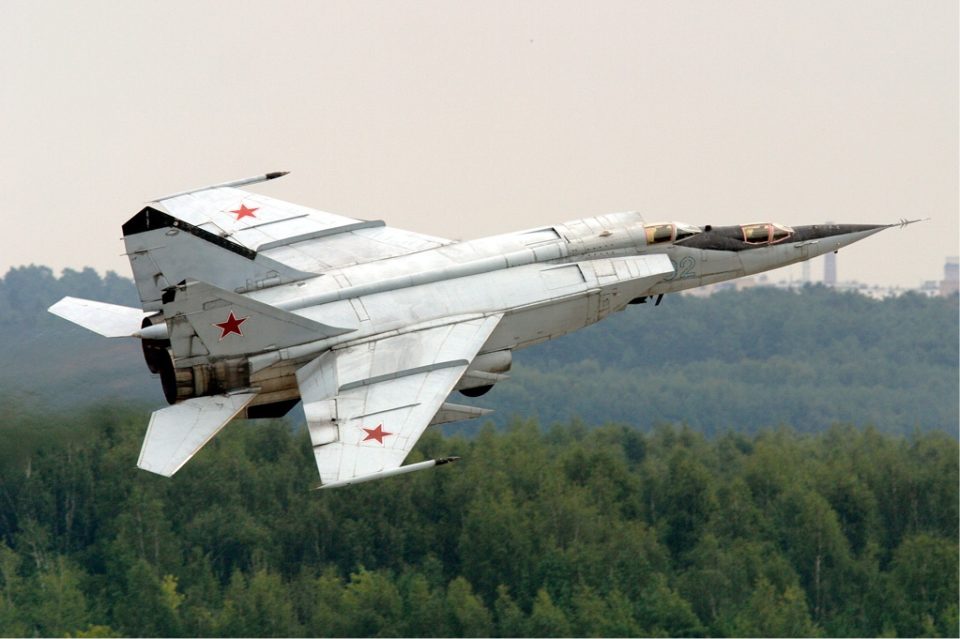
Russian Air Force MiG-25PU two-seat trainer
The unarmed ‘B’ version had greater impact than the interceptor when the USSR sent two MiG-25R, and two MiG-25RB to Egypt in March 1971 and stayed until July 1972. They were operated by the Soviet 63rd Independent Air Detachment (Det 63) set up specially for this mission. Det 63 flew over Israeli held territory in Sinai on reconnaissance missions roughly 20 times. The flights were in pairs at maximum speed and high altitude (between 17,000–23,000 m).
On 6th November 1971, a Soviet MiG-25 operating out of Egypt flying at Mach 2.5 was met by Israeli F-4Es and fired upon unsuccessfully. A MiG-25 was tracked flying over Sinai at Mach 3.2 during this period. The MiG-25 engines went into overspeed, which led to them being scrapped. Unit Det 63 was sent back home in 1972, though reconnaissance Foxbats were sent back to Egypt in 19–20 October 1973 during the Yom Kippur War. Unit Det 154 remained there until late 1974.
During the 1970s, the Soviet air force conducted reconnaissance overflights across Iran using its MiG-25RBSh aircraft in response to joint US-Iran recon operations.
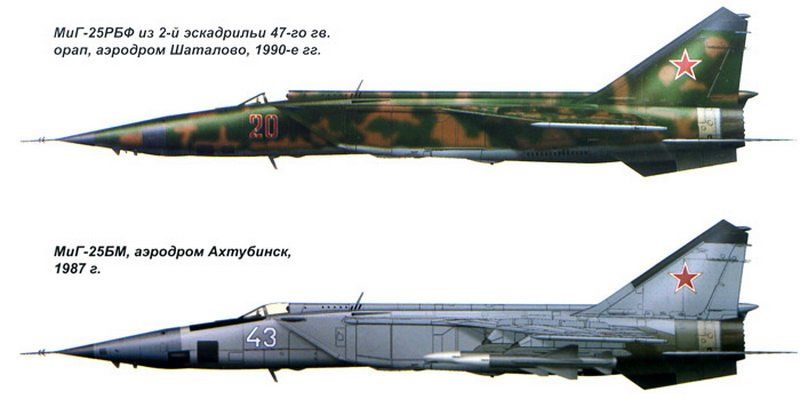
MiG-25 reconnaissance aircraft will be used until 2020
The Swedish Air Force observed via radar a Soviet Air Defence MiG-25 at 63,000 ft trailed 2.9 km behind the Lockheed SR-71 Blackbird at 72,000 ft over the Baltic Sea in the 1980s.
On 13th February 1981, the Israeli Air Force sent two RF-4Es over Lebanon as decoys for Syrian MiG-25 interceptors. As the MiGs scrambled, the RF-4Es turned back delivering chaff and using ECM pods. Two IDF/AF F-15As were waiting for the MiGs and shot one of them down with AIM-7F missiles. The other MiG was able to escape. In a similar engagement, on 29th July 1981, a Syrian MiG-25 was again downed by an Israeli F-15A, after which a second MiG-25 launched its R-40 missiles at the F-15 and its wing man, but they missed. However, other sources state the missiles hit and downed one of the F-15s. On 31st August 1982, a third Syrian MiG-25 was damaged by an Israeli Hawk SAM and then destroyed by an F-15.

MiG 25 Foxbat at Syrian T4 Airbase
The MiG-25 was in service with the Iraqi Air Force during the Iran–Iraq War. On 19th March 1982 an Iranian F-4E was badly damaged by a missile fired by an Iraqi MiG-25. Iraqi MiG-25s made another kill against Iran in February 1983, when an Iraqi MiG-25PD shot down an Iranian C-130. In April 1984, an Iraqi MiG-25PD shot down an Iranian F-5E. On 21st March 1984, an Iraqi MiG-25PD shot down an Iranian F-4E and on 5th June 1985 an Iraqi MiG-25PD shot down a second Iranian F-4E. On 23 February 1986, an Iraqi MiG-25PD shot down an Iranian EC-130E and on 10th June an RF-4E, later in October 1986, an Iraqi MiG-25PDS shot down a second RF-4E.

Once the fastest aircraft in the IrAF, the highly-valued Soviet-supplied MiG 25 Foxbat
The most successful Iraqi MiG-25 pilot of the war was Colonel Mohammed Rayyan, who was credited with 10 kills. Eight of these were while flying the MiG-25P from 1981 to 1986. In 1986, after attaining the rank of Colonel, Rayyan was shot down and killed by Iranian F-14s. For the majority of the air combat Iraqi pilots used R-40 missiles.
On 3rd May 1981, an Iraqi MiG-25PD shot down an Algerian Gulfstream III. On 2nd October 1986, an Iraqi MiG-25PD shot down a Syrian MiG-21RF.
According to research by journalist Tom Cooper, at least 10 MiG-25s (9 reconnaissance and 1 fighter) may have been shot down by Iranian F-14s (one of them shared with an F-5) during the Iran-Iraq war. Only three MiG-25 losses (to ground fire and air combat) were confirmed by Iraq.
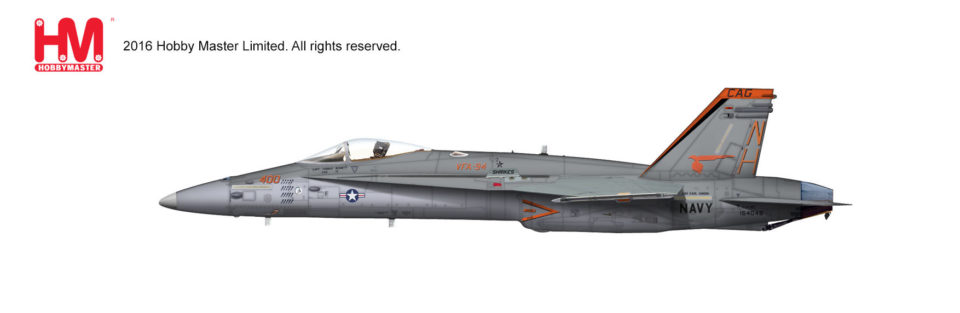
During the Persian Gulf War, a US Navy F/A-18, piloted by Lt Cdr Scott Speicher, was shot down on the first night of the war by a missile fired by a MiG-25. The kill was reportedly made with a Bisnovat R-40TD missile fired from a MiG-25PDS flown by Lt. Zuhair Dawood of the 84th squadron of the IQAF.
Two IQAF MiG-25s were shot down by U.S. Air Force F-15s on January 19th. The MiGs attempted to hide from the F-15s by using chaff and electronic jammers in order to engage the F-15s undetected. However the F-15 pilots were able to reacquire the two Iraqi MiG-25s and shot both down with AIM-7 Sparrow missiles. In another incident, an Iraqi MiG-25PD, after eluding eight USAF F-15s at long range, fired three missiles at General Dynamics EF-111A Raven electronic warfare aircraft, forcing them to abort their mission and leave attacking aircraft without electronic jamming support.
In a different incident, two MiG-25s approached a pair of F-15s, fired missiles at long range which were evaded by the F-15s, and then outran the American fighters. Two more F-15s joined the pursuit, and a total of 10 air-to-air missiles were fired at the MiG-25s, though none reached them. According to the same sources, at least one F-111 was also forced to abort its mission by a MiG-25 on the first 24 hours of hostilities, during an air raid over Tikrit.
After the war, on 27th December 1992, a U.S. F-16D downed a MiG-25 that violated the no-fly zone in southern Iraq with an AIM-120 AMRAAM missile. It was the first USAF F-16 air-to-air victory and the first AMRAAM kill.
On 23rd December 2002, an Iraqi MiG-25 shot down a U.S. Air Force unmanned MQ-1 Predator drone, which was performing armed reconnaissance over Iraq. This was the first time in history that an aircraft and an unmanned drone had engaged in combat. Predators had been armed with AIM-92 Stinger air-to-air missiles, and were being used to “bait” Iraqi fighter aircraft, then run. In this incident, the Predator did not run, but instead fired one of the Stingers, which missed, while the MiG’s missile did not.

Buried MiG-25 Foxbat Jet Uncovered in Iraqi Desert, Now Preserved in US

Mikoyan-Gurevich MiG-25 Foxbat unearthed !
No Iraqi aircraft were deployed in the U.S. invasion of Iraq in 2003, with most Iraqi aircraft being hidden or destroyed on the ground. In August 2003, several dozen Iraqi aircraft were discovered buried in the sand.

Indian Air Force (IAF) Mikoyan MiG-25RB Foxbat-B Reconnaissance
The MiG-25 was kept a guarded secret in India, designated Garuda after the large bird-like creature from Hindu and Buddhist scriptures. It was used extensively in the Kargil War and Operation Parakram, conducting aerial reconnaissance sorties over Pakistan.
In May 1997, an Indian Air Force Mikoyan MiG-25RB reconnaissance aircraft created a furore when the pilot flew faster than Mach 2 over Pakistani territory following a reconnaissance mission into Pakistan airspace. The MiG-25 broke the sound barrier while flying at an altitude of around 65,000 feet (20,000 m), otherwise the mission would have remained covert, at least to the general public. The Pakistani Government contended that the breaking of the sound barrier was a deliberate attempt to make the point that the Pakistan Air Force (PAF) had no aircraft in its inventory that could come close to the MiG-25’s cruising altitude (up to 74,000 feet (23,000 m)). India denied the incident but Pakistan’s Foreign Minister, Gohar Ayub Khan, believed that the Foxbat photographed strategic installations near the capital, Islamabad.
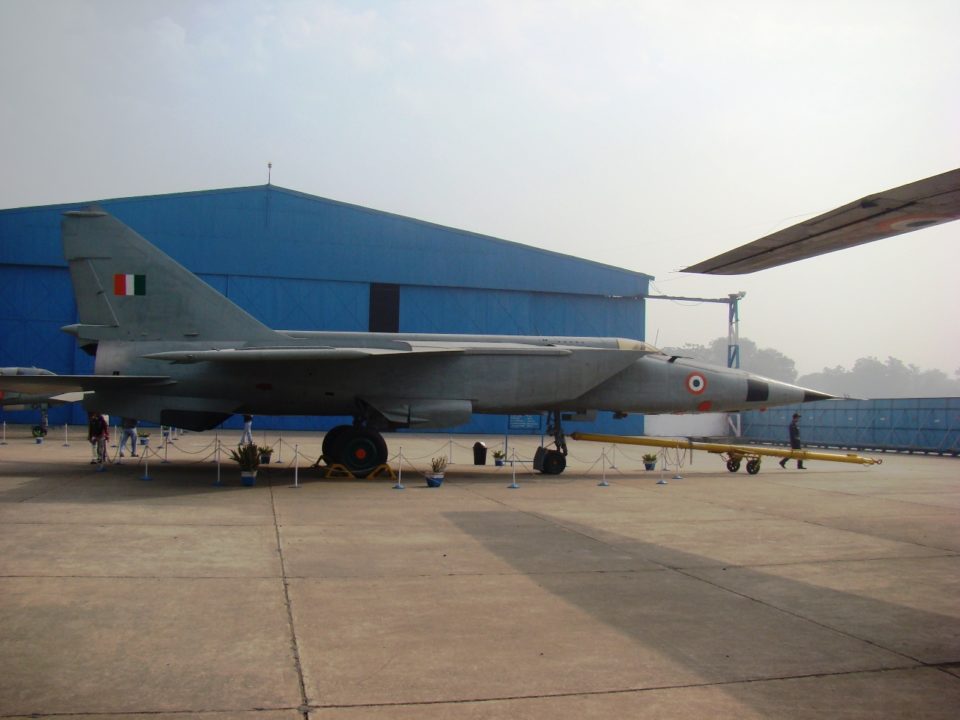
MiG-25R of No. 102 Squadron IAF on display at the Indian Air Force Museum, Palam
Lack of spare parts and India’s acquisition of unmanned aerial vehicles and satellite imagery eventually led to its retirement in 2006.
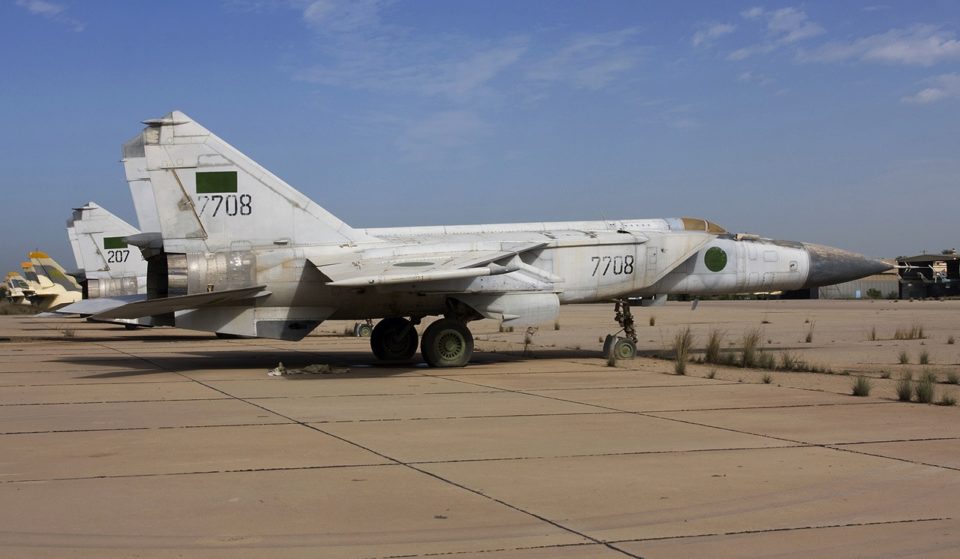
A Libyan MiG-25PD “Foxbat-E
Libya was a major user of the MiG-25 as it imported 96 MiG-25PD interceptor, MiG-25PU trainer and MiG-25RBK reconnaissance aircraft in the late 1970s and early 1980s. During the 1980s, Libya confronted the United States over some claims over the extension of its territorial waters. These incidents prompted a number of encounters between the opposing forces as it happened during the Gulf of Sidra incident (1981) with the Libyan MiG-25s taking part in them.
During the following years, the Libyan MiG-25 fleet was grounded, lacking maintenance. As MiG-25 air-frames were grounded for several years, NATO attacks spared them during the Libyan Civil War (2011).
In 2014 and 2015, the Libyan forces under the New General National Congress controlled a number of former LARAF air-frames, that were retired and stored before the Libyan Civil War in 2011, among them a number of MiG-25s. Technicians started working on some of the air-frames to push them back to service in the fight against the opposing internationally recognized Libyan government forces.

Libyan AF MiG-25RBK
On 6th May 2015, a New General National Congress MiG-25PU crashed near Zintan while attacking the civilian airport controlled by the opposing internationally recognized Libyan government, the pilot ejected and was captured by opposing forces which also claimed they downed the jet. The jet was at one of its first flights after re-entering service.
Latest Hobbymaster Models available to pre-order now.
I have listed below all the latest Hobbymaster models which are available to pre-order now. Please click on the images/links to go straight to the model of your choice or CLICK HERE to see them all.
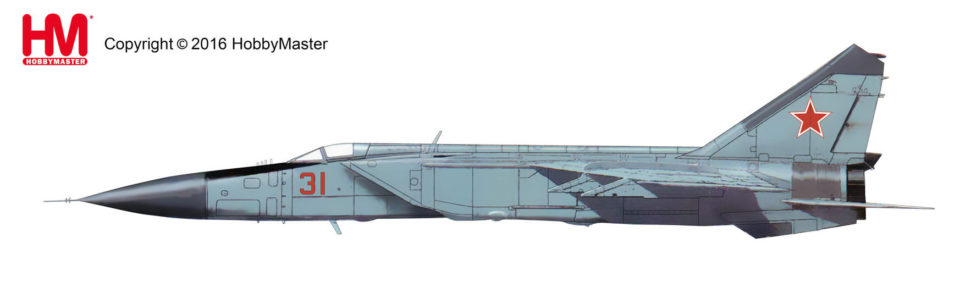
Hobbymaster 1/72nd scale HA5601 MiG-25P Foxbat Red 13, Lt. (Sg.) V. Belenko, Japan 1976 PRICE TBA (see webpage for details)





Hobbymaster 1/72nd scale HA5502 Curtiss P-40N Chiao Wu O, 29th FS/5th FG, Chinese Air Force, China 1944 RRP £TBA ( see webpage for details)

Hobbymaster 1/72nd scale HA5501 Curtiss P-40N Wang Kuang Fu, 7th FS/3rd FG, Chinese Air Force, Laohokow, China, January 1945 RRP £TBA ( see webpage for details)
That’s all for this week.
Thank you for reading this week’s Newsletter.
Richard
Flying Tigers.