Model Description
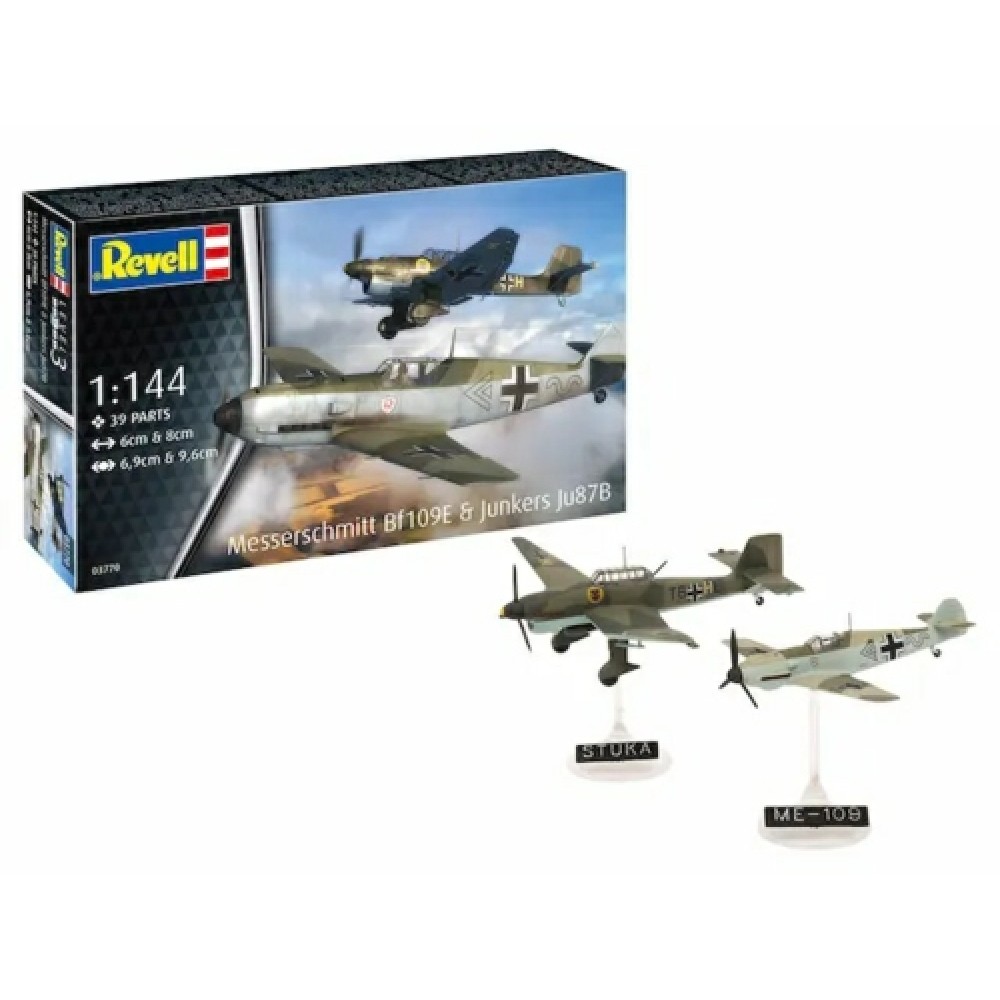
R03770 Revell 1/144th scale model kit Messerschmitt BF109E and Junkers JU87B Stuka. Buy now online at Flying Tigers.
The Messerschmitt Bf 109 is a monoplane fighter aircraft that was designed and initially produced by the German aircraft manufacturer Bayerische Flugzeugwerke (BFW). Together with the Focke-Wulf Fw 190, the Bf 109 formed the backbone of the Luftwaffe’s fighter force during the Second World War. It was commonly called the Me 109 by Allied aircrew and some German aces/pilots, even though this was not the official model designation.
The Bf 109 was designed by Willy Messerschmitt and Robert Lusser, who worked at BFW during the early to mid-1930s. It was conceived as an interceptor. However, later models were developed to fulfil multiple tasks, serving as bomber escort, fighter-bomber, day-, night-, all-weather fighter, ground-attack aircraft, and aerial reconnaissance aircraft. It was one of the most advanced fighters when it first appeared, being furnished with an all-metal monocoque construction, a closed canopy, retractable landing gear, and powered by a liquid-cooled, inverted-V12 aero engine. First flown on 29 May 1935, the Bf 109 entered operational service during 1937; it first saw combat during the Spanish Civil War.
During the Second World War, the Bf 109 was supplied to several states and was present in quantity on virtually every front in the European theatre; the fighter was still in service at the end of the conflict in 1945. It continued to be operated by several countries for many years after the conflict. The Bf 109 is the most produced fighter aircraft in history, a total of 34,248 airframes having been produced between 1936 and April 1945. Some of the Bf 109 production took place in Nazi concentration camps through slave labor.
The Bf 109 was flown by the three top-scoring fighter aces of all time, who claimed 928 victories among them while flying with Jagdgeschwader 52, mainly on the Eastern Front. The highest-scoring, Erich Hartmann, was credited with 352 victories. The aircraft was also flown by Hans-Joachim Marseille, the highest-scoring ace in the North African campaign, who shot down 158 enemy aircraft (in about a third of the time). It was also flown by many aces from other countries fighting with Germany, notably the Finn Ilmari Juutilainen, the highest-scoring non-German ace. He scored 58 of his 94 confirmed victories with the Bf 109. Pilots from Hungary, Romania, Bulgaria, Croatia, Slovakia and Italy also flew the fighter. Through constant development, the Bf 109 remained competitive with the latest Allied fighter aircraft until the end of the war.
The Junkers Ju 87, popularly known as the “Stuka”, is a German dive bomber and ground-attack aircraft. Designed by Hermann Pohlmann, it first flew in 1935. The Ju 87 made its combat debut in 1937 with the Luftwaffe’s Condor Legion during the Spanish Civil War of 1936–1939 and served the Axis in World War II from beginning to end (1939–1945).
The aircraft is easily recognisable by its inverted gull wings and fixed spatted undercarriage. Upon the leading edges of its faired main gear legs were mounted ram-air sirens, officially called “Lärmgerät” (noise device), which became a propaganda symbol of German air power and of the Blitzkrieg victories of 1939–1942, as well as providing Stuka pilots with audible feedback as to speed. The Stuka’s design included several innovations, including automatic pull-up dive brakes under both wings to ensure that the aircraft recovered from its attack dive even if the pilot blacked out from the high g-forces, or suffered from target fixation.
The Ju 87 operated with considerable success in close air support and anti-shipping roles at the outbreak of World War II. It led air assaults during the Invasion of Poland in September 1939. Stukas proved critical to the rapid conquest of Norway, the Netherlands, Belgium, and France in 1940. Though sturdy, accurate, and very effective against ground targets, the Stuka was, like many other dive bombers of the period, vulnerable to fighter aircraft. During the Battle of Britain of 1940–1941, its lack of manoeuvrability, speed, or defensive armament meant that it required a heavy fighter escort to operate effectively.
After the Battle of Britain, the Luftwaffe deployed Stuka units in the Balkans Campaign, the African and the Mediterranean theatres and in the early stages of the Eastern Front war, where it was used for general ground support, as an effective specialised anti-tank aircraft and in an anti-shipping role. Once the Luftwaffe lost air superiority, the Stuka became an easy target for enemy fighters, but it continued being produced until 1944 for lack of a better replacement. By 1945 ground-attack versions of the Focke-Wulf Fw 190 had largely replaced the Ju 87, but it remained in service until the end of the war in 1945.
Germany built an estimated 6,000 Ju 87s of all versions between 1936 and August 1944.
Oberst Hans-Ulrich Rudel became the most successful Stuka pilot and the most highly decorated German pilot of the war.
RRP £13.00