Model Description
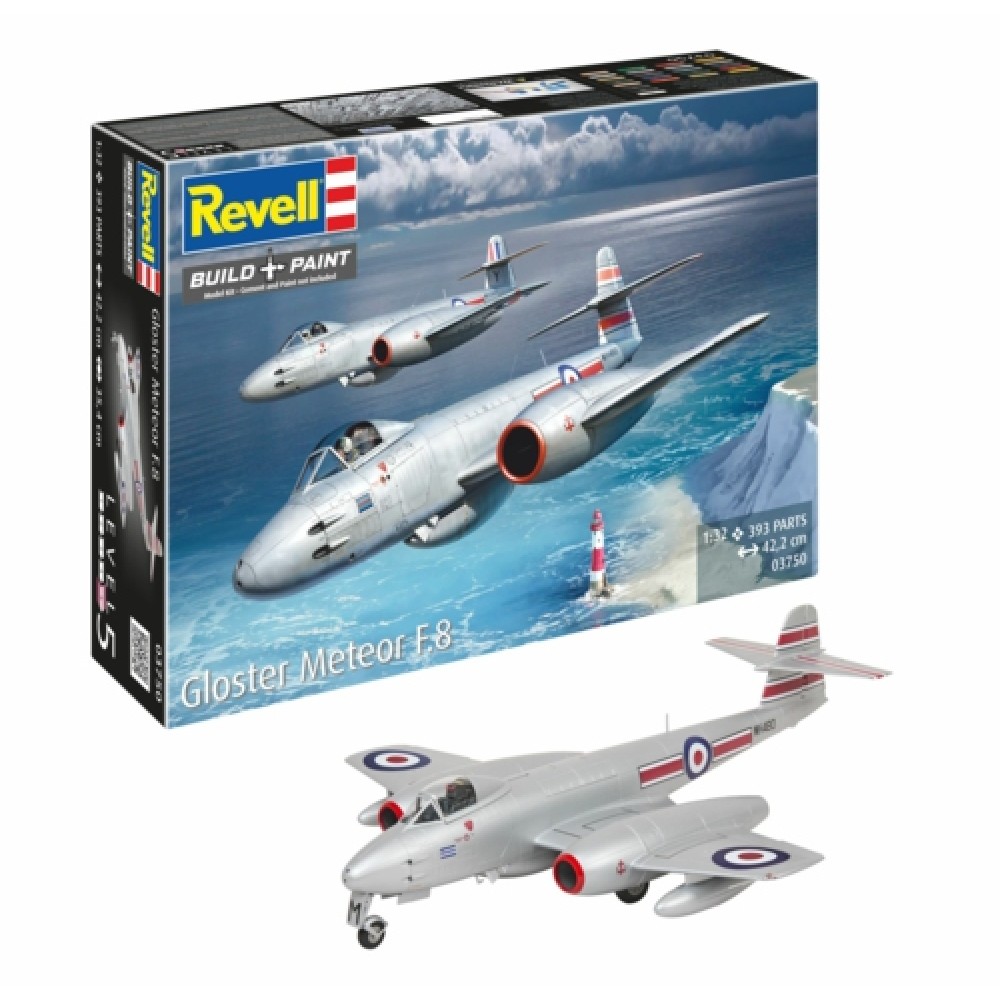
R03750 Revell 1/32nd scale model kit Gloster Meteor F.8 new tooling. Available to pre-order at Flying Tigers.
The Gloster Meteor was the first British jet fighter and the Allies’ only jet aircraft to engage in combat operations during the Second World War. It was designed and primarily produced by the Gloster Aircraft Company, although its development was heavily reliant on its ground-breaking turbojet engines, pioneered by Frank Whittle and his company, Power Jets Ltd.
Development of the Meteor began in 1940, while work on its engines had been under way as early as 1936. It made its maiden flight in 1943 and commenced operations on 27 July 1944 with No. 616 Squadron RAF. The Meteor was not a sophisticated aircraft in its aerodynamics, but proved to be a successful combat fighter. Gloster’s 1946 civil Meteor F.4 demonstrator G-AIDC was the first civilian-registered jet aircraft in the world. Several major variants of the Meteor incorporated technological advances during the 1940s and 1950s. Thousands of Meteors were built to fly with the RAF and other air forces and remained in use for several decades. Slower and less heavily armed than its German counterpart, the jet-powered Messerschmitt Me 262, the Meteor saw limited action in the Second World War. Meteors of the Royal Australian Air Force (RAAF) fought in the Korean War. Several other operators such as Argentina, Egypt and Israel flew Meteors in later regional conflicts. Specialised variants of the Meteor were developed for use in photographic aerial reconnaissance and as night fighters.
The Meteor was also used for research and development purposes and to break several aviation records. On 7 November 1945, the first official airspeed record by a jet aircraft was set by a Meteor F.3 at 606 miles per hour (975 km/h). In 1946, this record was broken when a Meteor F.4 reached a speed of 616 miles per hour (991 km/h). Other performance-related records were broken in categories including flight time endurance, rate of climb, and speed. On 20 September 1945, a heavily modified Meteor I, powered by two Rolls-Royce Trent turbine engines driving propellers, became the first turboprop aircraft to fly. On 10 February 1954, a specially adapted Meteor F.8, the “Meteor Prone Pilot”, which placed the pilot into a prone position to counteract inertial forces, took its first flight.
In the 1950s, the Meteor became increasingly obsolete as more nations developed jet fighters, many of these newcomers having adopted a swept wing instead of the Meteor’s conventional straight wing; in RAF service, the Meteor was replaced by newer types such as the Hawker Hunter and Gloster Javelin. As of 2023, two Meteors, G-JSMA and G-JWMA, remain in active service with the Martin-Baker company as ejection seat testbeds.[5] One further aircraft in the USA remains airworthy, as does another in Australia.
RRP £75.00