A close up view of the Sukhoi Su-22 landing at Fairford in 1995 .This Aircraft looking very much a part of the cold war period
The Sukhoi Su-17 (izdeliye S-32) is a variable-sweep wing fighter-bomber developed for the Soviet military. Its NATO reporting name is “Fitter”. Developed from the Sukhoi Su-7, the Su-17 was the first variable-sweep wing aircraft to enter Soviet service. Two subsequent Sukhoi aircraft, the Su-20 and Su-22, have usually been regarded as variants of the Su-17. The Su-17/20/22 series has had a long career and has been operated by many other air forces of including the Russian Federation, other former Soviet republics, the former Warsaw Pact, countries in the Arab world, Angola and Peru.
Development
Shortly after the Su-7 fighter-bomber was put into service, the Sukhoi Design Bureau was ordered to develop a deep modernization program for the aircraft in the early 1960s. The program would be aimed primarily at updating on-board avionics and the takeoff/landing performance characteristics. The concept of variable-geometry wings – something gaining wider attention at that time – was adopted as well. The program was to be led by Sukhoi’s head designer, Nikolay Zyrin.
Seeking to improve low-speed and take-off/landing performance of the Su-7B fighter-bomber, in 1963 the Sukhoi OKB with input from TsAGI created a variable-sweep wing technology demonstrator. The S-22I (also known as the Su-7IG, NATO designation “Fitter-B”), converted from a production Su-7BM, had fixed inner portions of the wing with movable outer segments which could be swept to 28°, 45°, or 62°. The S-22I first took off, with Vladimir Ilyushin at the controls on 2nd August 1966. It was later publicly demonstrated to the public at the air parade in Domodedovo in July 1967. Flight testing revealed that the new configuration improved both the take-off/landing characteristics and the range and endurance of the aircraft. Handling was also generally better than the fixed wing Su-7, with the exception that there was no longer any buffeting at high angles of attack to warn of imminent stall. The aircraft was ordered into serial production in 1969 by a joint resolution of the Central Committee of the Communist Party of the Soviet Union and the Council of Ministers. The design of the Su-7IG was modified further, eventually with enough difference to justify the S-32 internal designation. The S-32 first took off on July 1st, 1969, with Yevgeny Kukushev at the controls.
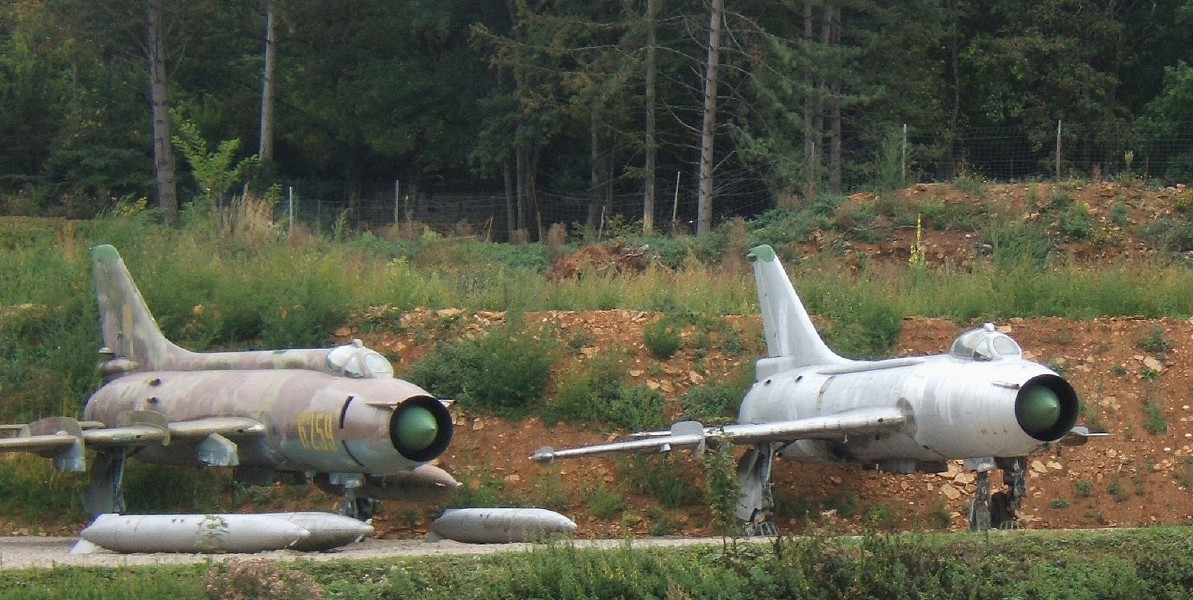
Sukhoi Su-17 (left) and Su-7 (right) side by side at the Chateau de Savigny les Beaune museum (in France)
Serial production of the Su-17 started at the Yuri Gagarin Aviation Factory (now KnAAPO) in 1969. The 523rd Aviation Regiment, of the Far East Military Okrug, was the first unit to receive the Su-17. The Su-17 was produced until 1990, at a total of 2867 units produced.
The Su-17 largely resembles its predecessor, the Su-7, with weight-saving measures added at the cost of combat survivability, an example of which is the removal of armored protection for the pilot.
The prototype S-22I differed little from the Su-7 except for the wing, being essentially a technology demonstrator for the variable-geometry wing. It was later lost in an accident.
Following the S-22I, two pre-production prototypes were constructed, designated the S32-1 and the S32-2, respectively. The two aircraft mounted updated avionics, and replaced the older AP-28I-2 autopilot with the newer SAU-22 automatic control system.
The next series of prototypes were the Su-7-85, with 85 indicating the batch number, continued from that of the Su-7. The batch of ten aircraft incorporated a completely redesigned fuselage, a streamlined cockpit (similar to that of the Su-7U), extra and more accessible maintenance hatches, and an upwards-opening canopy. The front of the cockpit was protected with a windshield and two electrically heated side windows. The first three aircraft of the 86th batch that followed further incorporated clear windshields with warm air blown at it, taken from the 9th stage of the engine compressor. However, this new windshield was dropped in favor of the more traditional glazed windshield following tests by the 4th Combat Use and Retraining of Air Force Personnel Center in Lipetsk.
The Su-7-85 was equipped with a modified KS4-S32 ejection seat, capable of safely ejecting the pilot at speeds above 140–170 km/h in the event of an accident.
The fuel system of the Su-17 was modified from that of the Su-7 as well – fuel was now stored in three lightweight tanks, with provisions for up to four disposable auxiliary tanks each with 600 litres of capacity (itself used on the Su-7B), or two PTB-1150 tanks with 1150 litres each, mounted on “wet” pylons underneath the fuselage.
The wing was largely unmodified from that mounted on the S-22I prototype. The stationary part of the wing being half as long as the rotating part. With wings at maximum sweep, the Su-17 would look virtually identical to the Su-7. A slide-out flap was installed on the stationary part of the wing, while a slat, a rotating flap and aileron are mounted on the rotating part. The sweep angle of the wing could be configured between 30° and 63°. The horizontal and vertical tails are swept at 55°.
Flight control was assisted by non-reversing hydraulic boosters, the BU-220DL2 and -220DP2 for the left and right ailerons, the BU-250L and -250P for the stabilizers and the BU-250DRP for the rudder. The flight control systems are spring loaded to provide a feedback force on the stick and the rudder pedals.
There are three independent hydraulic systems installed on the Su-17 – an actuating system and two booster systems, each with its own hydraulic pump. The actuating hydraulic system was responsible for adjusting the sweep angle of the wing, deploying/retracting the landing gear, the flaps and slats, adjusting the intake ramps, the flight control mechanisms used by the SAU-22 autopilot, and the steering front wheel. The booster systems are responsible for controlling the flight surfaces. Both systems operate in parallel to ensure safe operation in the event of one of them failing. The remaining operational system would still provide power to all the flight surfaces, albeit at half the power. The Nr 1 booster system also feeds the GM-40 hydraulic motor driving the rotary parts of the wing. All hydraulic systems are fed with the AMG-10 hydraulic fluid, with a standard operating pressure of 215 kgf/cm2 for the booster systems and 210 for the actuating system.
A pneumatic system with a 150kgf/cm2 pressure operates the normal and emergency brakes on the landing gear as well as the emergency landing gear/flaps deployment system, and was responsible for charging the two NR-30 cannons mounted on the aircraft, pressurizing the cockpit, opening/closing the canopy and pressurizing the hydraulic fluid tanks.
The Su-17 was powered by a modified Lyulka AL-7F1-250 with a slightly uprated thrust of 9600 kgf on afterburners. It was equipped with a compressor actuator with redundancy, and a system for intake adjustment. The aircraft would need to be disassembled into two halves to replace its engine. Jettisonable SPRD-110 RATO boosters are available to facilitate take-off on short runways, providing a momentary thrust of up to 3000 kgf.
On-board electronics are fed by a 28V DC circuit and a 115V, 400 Hz single-phase AC circuit, fed by two GS-12T DC generators, an SGO-8TF AC generator and a 20NKBN25 nickel–cadmium battery.
The Su-17 has the ability to carry free-fall nuclear bombs with a BDZ-56FNM bomb rack. A special code device would also be installed in the cockpit, mandating a correct code input before the bomb could be armed and released, to prevent unauthorized uses of nuclear weaponry. The aircraft also has a toss bombing capability for nuclear weapon delivery, with which it could approach the target, initiate a steep climb and release the bomb when pointing almost upright, and then activate afterburners to escape the blast radius. A special IAB-500 bomb was made specifically for practicing such a bombing technique.
Operational history
Soviet Union/Russia
The Su-17M3/4 were used during the First Chechen War alongside Sukhoi Su-24s and Sukhoi Su-25s in ground attack and reconnaissance missions.
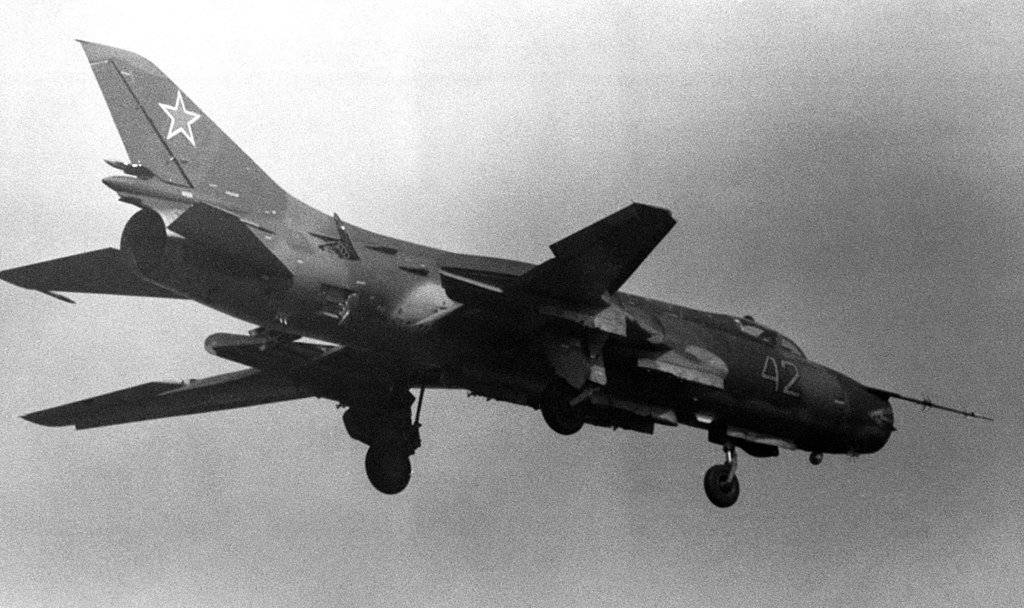
Right rear view of a Soviet Su-17 Fitter C aircraft preparing to land.
In a move to eliminate single-engine strike aircraft from its inventory, the Russian Air Force retired its last Su-17M4 along with its fleet of MiG-23/27s in 1998.
Angola
The Soviets supplied the communist government of Angola with 12 Su-20Ms in 1982 or 1983, which formed the basis of the 15th FS. The squadron suffered a swift loss of at least six aircraft – most in mishaps – by 1985, and three more by 1988, and had only two aircraft left when it was reinforced with another Soviet batch of 14 Su-22M-4Ks and two Su-22UM-3Ks in 1989–90 (incorporated into the 26th Air Regiment, based in Moçâmedes). A second shipment from Belarus in 1999 consisted of two Su-22UBs and four Su-22Ms, and a third one from Slovakia in 1999–2001 consisted of 10 Su-22M-4s and one Su-22UM-3K.
These aircraft saw heavy use in the war against UNITA. From the aforementioned losses, which can not be classified as mishaps or combat attrition, only an Su-20M, serialled C510 was reportedly downed in 1987 and a better-documented case occurred on 6th November 1994 when an Su-22 based at Catumbela was shot down by a surface-to-air missile launched by UNITA during a raid against Huambo. The pilot managed to eject and flee naked after stripping off his flight suit.
Iraq
From 22nd September 1980 to 20th August 1988, during the Iran–Iraq War, Iraq used Su-17 export versions (Su-20 and Su-22) alongside older Su-7s. They were mostly used in ground-attack and close air support roles. Iranian Grumman F-14 Tomcats shot down 21 Su-20/-22s, that have been confirmed by western sources. Eighteen Su-20/-22s were also shot down by Iranian McDonnell Douglas F-4 Phantom IIs. and three by Iranian Northrop F-5s. On 20th October 1980 an Iraqi Su-20 shot down an Iranian F-4E with its 30 mm cannons.
Official Iraqi accounts show no loss of Su-20 aircraft throughout the war against the Kurds and Iran. Twenty Su-22M2s, two Su-22M3s and seven Su-22M4s were lost during the war with Iran, the majority to anti-aircraft fire sustained during low level bombing raids against the Iranian front lines.
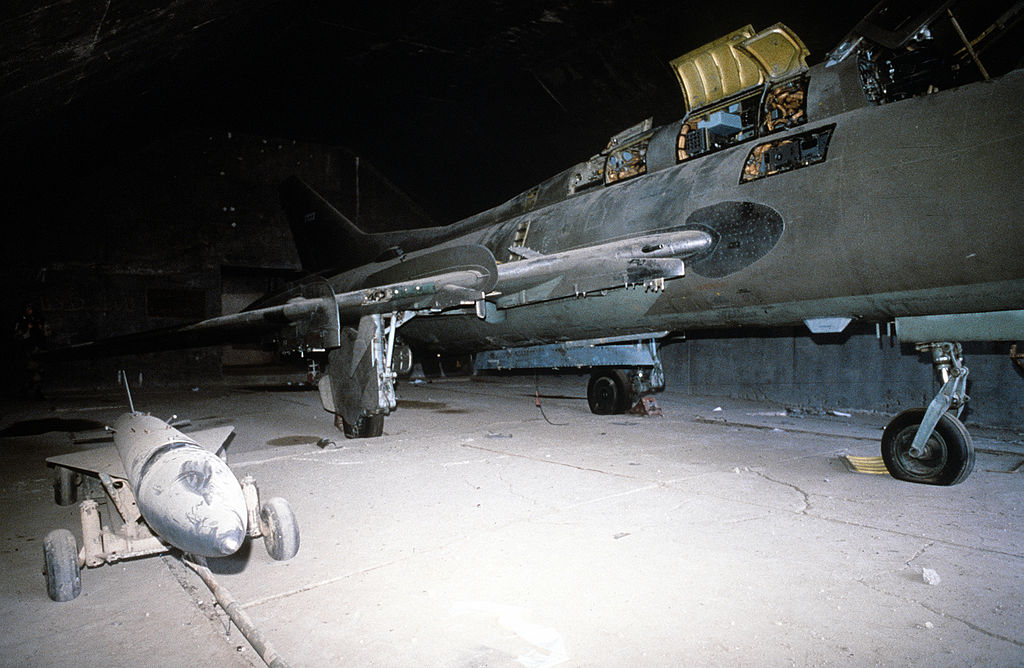
Iraqi Su-22M aircraft in a hangar damaged by Coalition air strikes during Operation Desert Storm.
In 1991, during the Gulf War, Iraqi Su-22s saw limited active service because the Iraqi regime distrusted the Iraqi Air Force (IQAF). On 7th February 1991, two Su-20/22s and one Su-7 were shot down by United States Air Force McDonnell Douglas F-15 Eagles using AIM-7 air-to-air missiles when the IQAF was moving its aircraft to Iran. Many more were destroyed on the ground by coalition air forces or evacuated to Iran and were never returned.
On 20th and 22nd March 1991, two other Su-20/22s were downed by a USAF F-15C during Operation Provide Comfort that started soon after the war.
Libya
Two Libyan Su-22s were shot down in the Gulf of Sidra incident by United States Navy Grumman F-14 Tomcats on 19th August 1981. One Su-22 launched a K-13 missile head-on at one of the F-14s from an estimated 300-meter (984-foot) closing distance, however the missile was evaded. Both were then downed by AIM-9 Sidewinder missiles.
On 8th October 1987, in the aftermath of the Chadian–Libyan conflict, an Su-22 was shot down by a FIM-92A launched by Chadian forces. The pilot, Capt. Diya al-Din, ejected and was captured. He was later granted political asylum by the French government. During the recovery operation, a Libyan Mikoyan-Gurevich MiG-23MS was shot down by a FIM-92A.
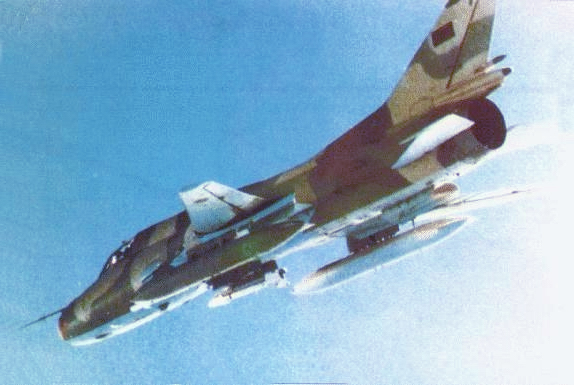
Libyan Su-22M.
A Libyan Su-22 crashed near Benghazi on 23rd February 2011. The crew members, Captain Attia Abdel Salem al Abdali and his copilot, Ali Omar Gaddafi, were ordered to bomb the city in response to the Libyan Civil War. They refused, bailing out of the aircraft and parachuting to the ground. Su-22s were heavily used by the Libyan loyalist forces against the insurgent forces from mid February up to mid March 2011, when the international mission started and the no fly zone was imposed. Among other missions, Su-22s also attacked Anti-Gaddafi positions in Bin Jawad in early March 2011 as government forces retook the town.
One Libyan Air Force Su-22 was destroyed on the ground by a Belgian Air Force F-16AM on 27th March.
Peru
Peru was the only export customer of the type in the Americas. In 1980 a Peruvian Su-22 intercepted an alleged UFO over Arequipa.
On 24th April 1992, Peruvian Su-22s attacked a Lockheed C-130H Hercules of the United States Air Force’s 310th Airlift Squadron which was intercepted at sea, west of Lima, injuring six of the 14 crew members. Crew member Joseph C. Beard Jr., was killed, when he was blown from the cabin at 18,500 feet, and crew member Ronald Hetzel sustained severe injuries, with his chest blown open and his jugular vein severed. The incident caused an almost year-long interruption to the US anti-drug Air Bridge Denial Program and the establishment of a Joint Air Operation Center at Howard Air Force Base in Panama.
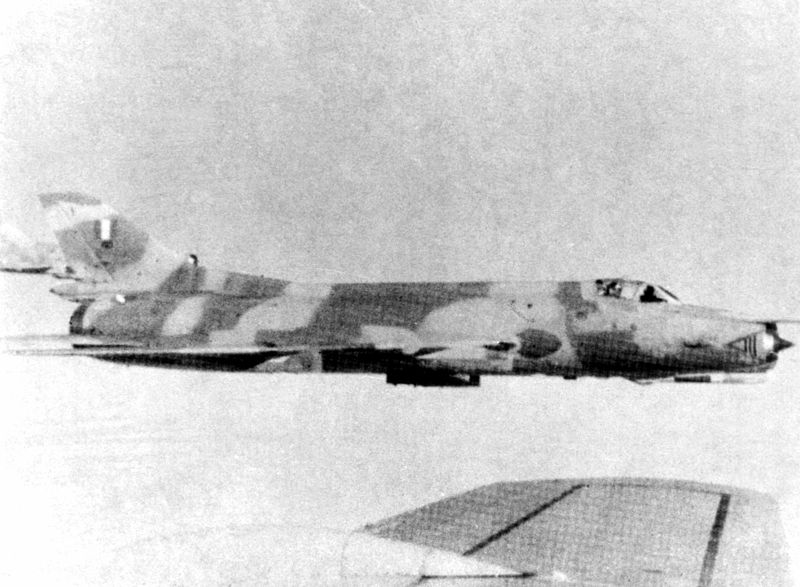
Sukhoi Su-22 aircraft of the Peruvian Air Force.
During the 1995 Cenepa War between Peru and Ecuador, two Peruvian Sukhoi Su-22s were lost, when on 10th February, two Ecuadorian Air Force Mirage F1JAs, piloted by Maj. R. Banderas and Capt. C. Uzcátegui, were directed over five targets approaching the disputed Cenepa valley. After making visual contact, the Mirages launched their missiles, claiming two Peruvian Su-22As shot down, while a Kfir claimed a further Cessna A-37 Dragonfly. Peru, however, denied that the two Su-22As were shot down by Mirages, stating that one was struck by Ecuadorian anti-aircraft artillery during a low flying ground-attack mission and the second crashed because of an engine fire.
The Su-22s flew 45 sorties into the combat zone. A 20-strong force of Su-22s was also set up at El Pato as a retaliatory force should Ecuador decide to attack the coastal port.
Poland
On 19th August 2003, a Polish Air Force Su-22M4K was accidentally shot down by friendly fire during an exercise by a Polish 2K12 Kub missile battery. The aircraft was flying 21 km from the coast over the Baltic Sea near Ustka. The pilot ejected and was rescued after two hours in the water. In 2012, Poland was investigating the replacement of its Su-22s with three squadrons of unmanned aerial vehicles.
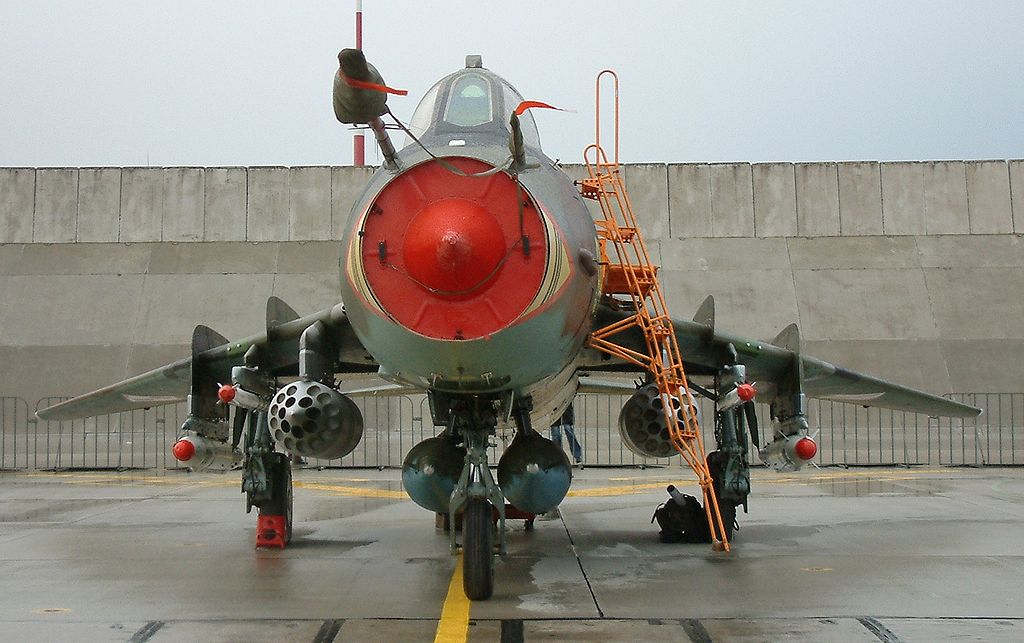
Polish Su-22M4 in the markings of 7th Tactical Sqn.
As of 2014 the Polish Air Force was planning to retain the Su-22s in service. The decision was hoped to have a positive impact on Polish industry, as the WZL nr 2 repair facility in Bydgoszcz would maintain the remaining aircraft under contract to the Air Force. The decision would also allow the Air Force to retain the well-trained ground crews and pilots operating the aircraft. The Poles consider the Su-22 easier to maintain and repair than the other main combat aircraft types currently in Polish service (mainly the MiG-29 and the F-16). They also suffer from fewer malfunctions and other problems (high, 70–75% non-error index). It is also the only aircraft in Polish inventory equipped for electronic intelligence, warfare, and support of ground systems. The Polish Air Force had retained a large stockpile of air-to-ground weapons for use with the Su-22. By some estimates, the cost of destroying these resources would be higher than the projected cost of continuing Su-22 operations. It was decided that starting from 2015, only 12 Su-22M4s and 4-6 Su-22UM3Ks out of 32 remaining would undergo a refit, increasing their lifespan for another ten years. For economical reasons the aircraft are not modernized, apart from fitting an additional RS-6113-2 C2M radio with a blade antenna on the top, but they receive a new grey multishade camouflage, similar to other Polish aircraft.
Several Polish Su-20s and Su-22s have since been donated to various museums, including the Polish Army Museum in Warsaw, the Armament Museum in Poznań, the Museum of Polish Arms in Kołobrzeg and the Polish Aviation Museum in Kraków. Other were placed on monuments or donated to schools as technical aids.
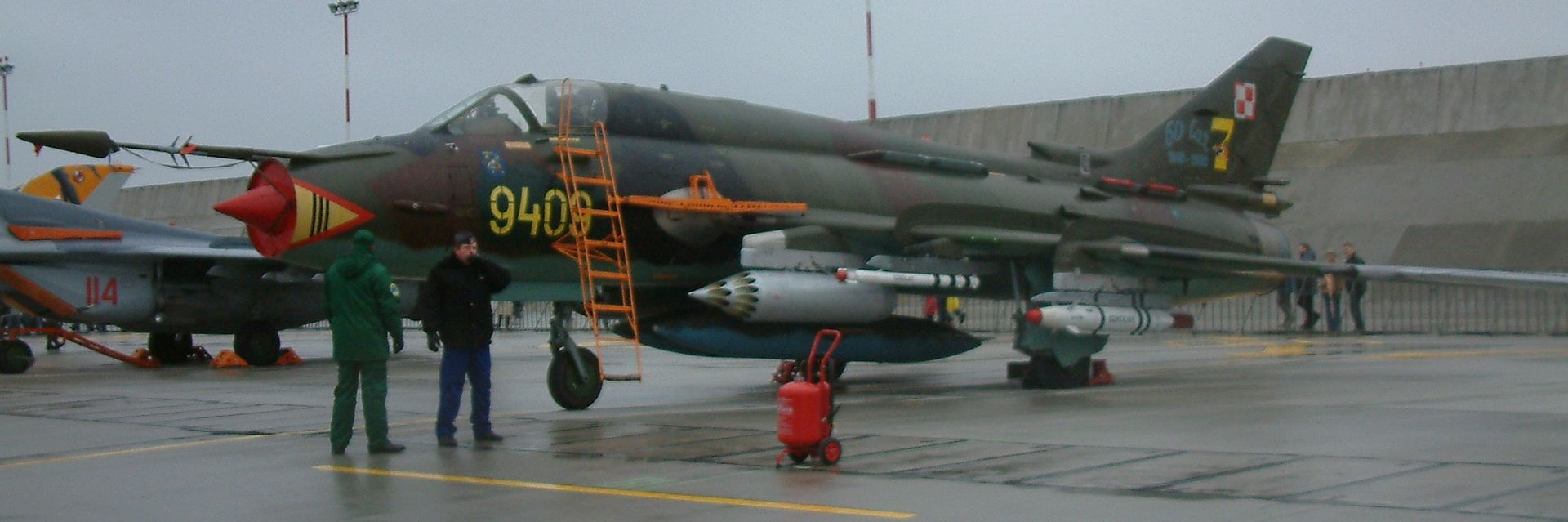
Polish Su-22M4 in markings of 7th Tactical Sqn.
Syria
The Syrian Air Force (SyAAF) used Su-20/-22s to attack Israeli forces in the Yom Kippur War and 1982 Lebanon War. Several Su-20/-22s were shot down by the Israeli Air Force. From mid-2012, in the Syrian Civil War, Syrian Air Force Su-22s were involved in combat operations against Syrian insurgents. Videos showed Su-22s using unguided munitions like other SyAAF fixed wing aircraft; mostly general-purpose bombs, cluster bombs and incendiary bombs and unguided rockets. Attack tactics were low to medium-altitude flat bombing runs with pull up after rocketing or bombing, with decoy flares deployed for self-defense. As of the end of 2015, the SyAAF Su-22s suffered a limited number of losses compared to the SyAAF MiG-21 and MiG-23 during the same period. The first confirmed loss of an SyAAF Su-22 was recorded on 14th February 2013, when rebel forces shot it down using a MANPADS. On 18th June 2017, a US F/A-18E Super Hornet engaged and shot down an SyAAF Su-22 for dropping munitions on US-backed forces. According to the wingman of the Super Hornet that made the kill, the Syrian pilot was able to eject and was later returned to the Syrian government. On 24th July 2018, an SyAAF Su-22 which entered Israeli air space was shot down by two Israeli Patriot missiles. Other Syrian Su-22 jets were downed during the ongoing civil war.
Yemen
On 11th August 2009, Yemeni armed forces started Operation Scorched Earth in northern Yemen to fight the Houthis. The Yemeni Air Force backed the army with air raids on rebel-held positions. On 5th October 2009, a Yemeni Su-22 crashed, with the rebels claiming to have shot it down. Earlier on 2nd October, the Yemeni revolutionaries said they shot down a “MiG-21” while again the military insisted technical problems caused the crash. On 8th November, a third Yemeni fighter aircraft, reported to be a Sukhoi, was destroyed. Again the military claimed it crashed due to technical problems, while the Yemeni rebels claimed they shot it down. The pilot ejected and was recovered by friendly forces. The Yemeni Air force once again used Sukhoi aircraft during the Arab Spring uprising. On 28th September 2011, a Yemeni Air Force Su-22 was shot down by tribesmen opposed to the rule of President Saleh. The government confirmed that rebels were responsible for the shoot-down, and that the pilot had been captured. On February 19th, 2013, a Yemeni Su-22 on a training mission crashed for unknown reasons into Sana’a, killing 12 civilians. On May 13th, 2013, another Yemen Su-22 on a training mission crashed in Sana’a, killing the pilot.
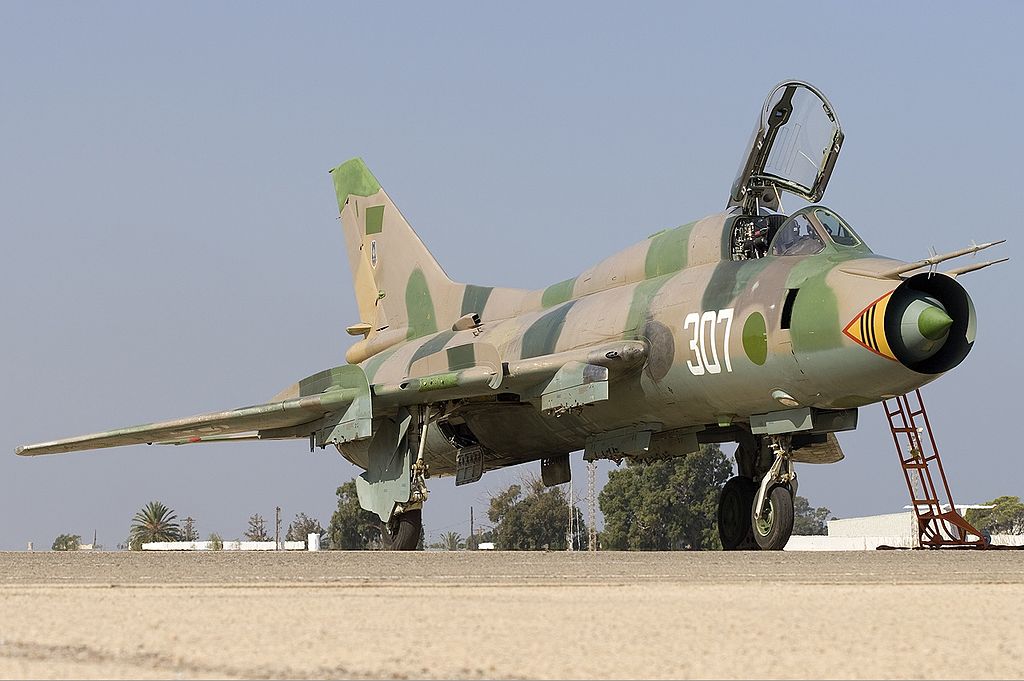
Former Libyan Arab Republic Air Force Sukhoi Su-22M
|
|

|
|

|
|

|
|

|
|

|
|

|
|

|
|

|
|

|
|
|

|
|

|
|
|
|

|
|

|
|
|
|

|
|
|
|
|
|
|
|

|
|
|
|
|
|
|
|
|
|
|
|

|
|

|
|

|
|

|
|

|
|
|
|
|
Thank you for reading this week’s Newsletter.
Richard
Flying Tigers.