Model Description
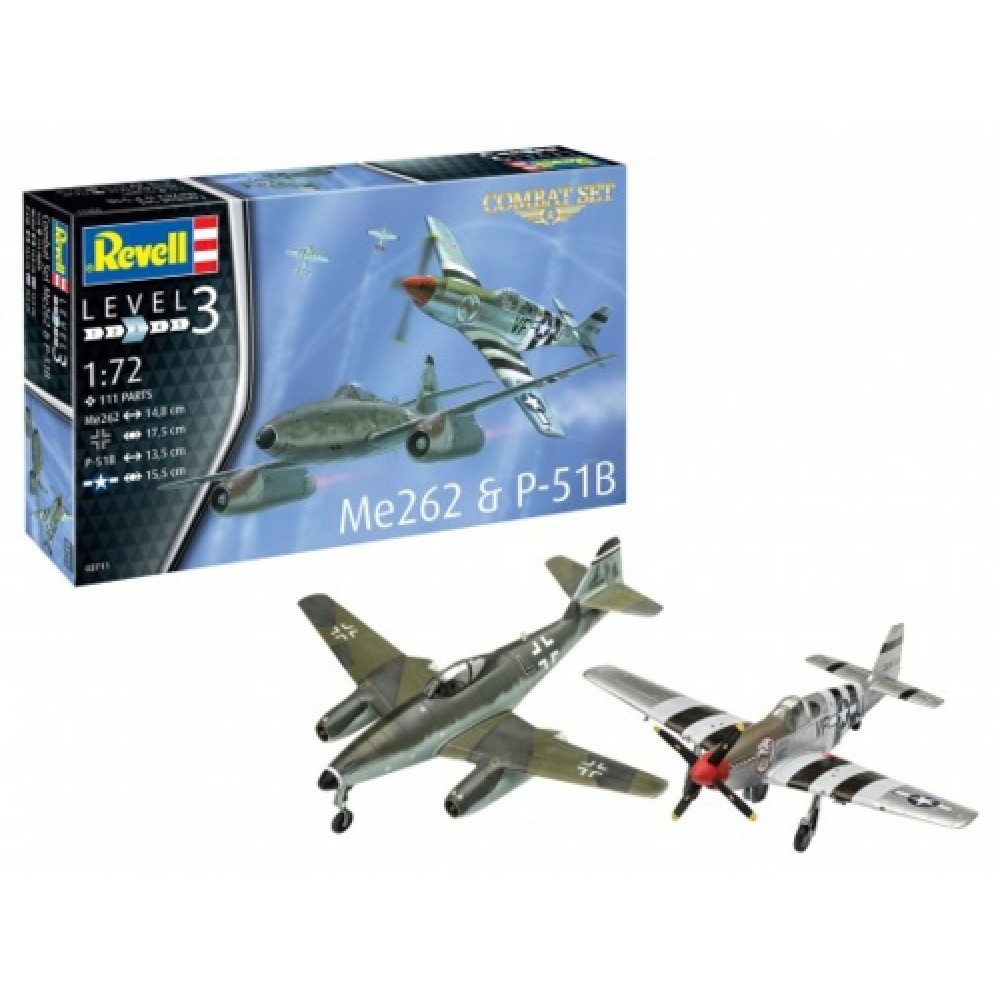
Revell 1/72nd scale model kit R03711 Combat Set Messerschmitt ME262 and Mustang P-51B. Available to pre-order at Flying Tigers.
The Messerschmitt Me 262, nicknamed Schwalbe (German for “Swallow”) in fighter versions, or Sturmvogel (“Storm Bird”) in fighter-bomber versions, is a fighter aircraft and fighter-bomber that was designed and produced by the German aircraft manufacturer Messerschmitt. It was the world’s first operational jet-powered fighter aircraft and one of two jet fighter aircraft types to see air-to-air combat in World War Two, the other being the Heinkel He 162.
The design of what would become the Me 262 started in April 1939, before World War II. It made its maiden flight on 18 April 1941 with a piston engine, and its first jet-powered flight on 18 July 1942. Progress was delayed by problems with engines, metallurgy, and interference from Luftwaffe chief Hermann Göring and Adolf Hitler. The German leader demanded that the Me 262, conceived as a defensive interceptor, be redesigned as ground-attack/bomber aircraft. The aircraft became operational with the Luftwaffe in mid-1944. The Me 262 was faster and more heavily armed than any Allied fighter, including the British jet-powered Gloster Meteor. The Allies countered by attacking the aircraft on the ground and during takeoff and landing.
One of the most advanced World War II combat aircraft, the Me 262 operated as a light bomber, reconnaissance aircraft, and experimental night fighter. The Me 262 proved an effective dogfighter against Allied fighters; German pilots claimed 542 Allied aircraft were shot down, corroborated by data from the US Navy, although higher claims have sometimes been made. The aircraft had reliability problems because of strategic materials shortages and design compromises with its Junkers Jumo 004 axial-flow turbojet engines.
Late-war Allied attacks on fuel supplies also reduced the aircraft’s readiness for combat and training sorties. Armament production within Germany was focused on more easily manufactured aircraft. Ultimately, the Me 262 had little effect on the war because of its late introduction and the small numbers that entered service.
Although German use of the Me 262 ended with World War II, the Czechoslovak Air Force operated a small number until 1951. Also, Israel may have used between two and eight Me 262s. These were supposedly built by Avia and supplied covertly, and there has been no official confirmations of their use. The aircraft heavily influenced several prototype designs, such as the Sukhoi Su-9 (1946) and Nakajima Kikka. Many captured Me 262s were studied and flight-tested by the major powers, and influenced the designs of production aircraft such as the North American F-86 Sabre, MiG-15, and Boeing B-47 Stratojet. Several aircraft have survived on static display in museums. Some privately built flying reproductions have also been produced; these are usually powered by modern General Electric CJ610 engines.
The North American Aviation P-51 Mustang is an American long-range, single-seat fighter and fighter-bomber used during World War II and the Korean War, among other conflicts. The Mustang was designed in 1940 by a team headed by James H. Kindelberger of North American Aviation (NAA) in response to a requirement of the British Purchasing Commission. The commission approached NAA to build Curtiss P-40 fighters under license for the Royal Air Force (RAF). Rather than build an old design from another company, NAA proposed the design and production of a more modern fighter. The prototype NA-73X airframe was completed on 9 September 1940, 102 days after contract signing, achieving its first flight on 26 October.
The Mustang was designed to use the Allison V-1710 engine without an export-sensitive turbosupercharger or a multi-stage supercharger, resulting in limited high-altitude performance. The aircraft was first flown operationally and very successfully by the RAF and as a tactical-reconnaissance aircraft and fighter-bomber (Mustang Mk I). In mid 1942, a development project known as the Rolls-Royce Mustang X, replaced the Allison engine with a Rolls-Royce Merlin 65 two-stage inter-cooled supercharged engine. During testing at Rolls-Royce’s airfield at Hucknall in England, it was clear the engine dramatically improved the aircraft’s performance at altitudes above 15,000 ft (4,600 m) without sacrificing range. Following receipt of the test results and after further flights by USAAF pilots, the results were so positive that North American began work on converting several aircraft developing into the P-51B/C (Mustang Mk III) model, which became the first long range fighter to be able to compete with the Luftwaffe’s fighters. The definitive version, the P-51D, was powered by the Packard V-1650-7, a license-built version of the two-speed, two-stage-supercharged Merlin 66, and was armed with six .50 caliber (12.7 mm) AN/M2 Browning machine guns.
From late 1943 into 1945, P-51Bs and P-51Cs (supplemented by P-51Ds from mid-1944) were used by the USAAF’s Eighth Air Force to escort bombers in raids over Germany, while the RAF’s Second Tactical Air Force and the USAAF’s Ninth Air Force used the Merlin-powered Mustangs as fighter-bombers, roles in which the Mustang helped ensure Allied air superiority in 1944. The P-51 was also used by Allied air forces in the North African, Mediterranean, Italian, and Pacific theaters. During World War II, Mustang pilots claimed to have destroyed 4,950 enemy aircraft.
At the start of the Korean War, the Mustang, by then redesignated F-51, was the main fighter of the United States until jet fighters, including North American’s F-86 Sabre, took over this role; the Mustang then became a specialized fighter-bomber. Despite the advent of jet fighters, the Mustang remained in service with some air forces until the early 1980s. After the Korean War, Mustangs became popular civilian warbirds and air racing aircraft.
RRP £16.00