F-39E Gripen multirole jet. Photo: Isac Nóbrega/PR
The Brazilian Air Force (Portuguese: Força Aérea Brasileira, FAB) is the air branch of the Brazilian Armed Forces and one of the three national uniformed services. The FAB was formed when the Brazilian Army and Navy air branches were merged into a single military force initially called “National Air Forces” in 1941. Both air branches transferred their equipment, installations and personnel to the new force.
According to Flight International (Flightglobal.com) and the International Institute for Strategic Studies, the Brazilian Air Force has an active strength of 80,937 military personnel and operates around 578 aircraft. The Brazilian Air Force is the largest air force in the Southern Hemisphere.
Contestado Campaign
The Contestado War was the first conflict in which Brazilian military aviation was employed. On September 19th, 1914, taking advantage of a special train driving troops, three aircraft were boarded: a Morane-Saulnier biplane, a Morane-Saulnier monoplane and a Blitzer SIT biplane. The train continued from Rio de Janeiro passing through São Paulo where it would reach the São Paulo – Rio Grande railway to the station of União da Vitória.
Along the way, sparks shot through the locomotive, hitting a gallon of gasoline in one of the wagons carrying the dismantled aircraft. The fire spread, much like the planes. After the crash, only the Morane-Saulnier remained in flying condition.
In the conflict zone, he coordinated the construction of runways and hangars to be used in União da Vitória, Canoinhas and Rio Negro. Then, two Morane-Saulnier and special ammunition were brought from Rio de Janeiro, as well as a mechanic.
The first aerial activity occurred only on January 4th, 1915, when a training flight followed the course of the Iguaçú River to the Timbo River. The first official mission took place on January 19th and the duration of the flight was just over an hour.
The following week, on February 25th, 1915, a Morane-Saulnier had an accident. During a test flight in the vicinity of the field, the engine stopped and aircraft crashed with total loss, pilot survived.
March 1, 1915 was the scheduled date for a heavy attack on the rebels. The mission was to fly over the Valley of Santa Maria, to launch bombs on the rebels’ stronghold, and to observe and direct the shots of the artillery and the advance of the infantry. Two Morane-Saulnier aircraft took off, but the attack was canceled due to adverse weather conditions, for the aircraft piloted by then lieutenant-aviator Ricardo Kirk suffered a crash, of which he was killed.
Ricardo Kirk was the first Brazilian Military Aviator. In 1891 he entered the Military Academy and was commissioned an ensign in November, 1893 and to first-lieutenant in March, 1898 and posthumously to captain in 1915.
Air actions of the Constitutionalist Revolution
Although the two sides in struggle had few airplanes during the Constitutionalist Revolution of 1932, aviation made a big impact during the conflict. The federal government had approximately 58 aircraft divided between the Navy and the Army.
On the other hand, the Paulistas had only two Potez 25 and two Waco planes, in addition to a small number of tourist planes. At the end of July, the rebel government obtained another plane, brought by Lieutenant Artur Mota Lima, who defected from Campo dos Afonsos, Rio de Janeiro. The “reds”, as the federal government planes were known, not only acted on the lines of combat, but also were used to bombard several cities of São Paulo, among them Campinas, where they caused great damage. They also served as a propaganda weapon, dropping leaflets on enemy cities and into rebel concentration camps.
For the use of aerial means, General Góis Monteiro had in his Staff of two advisers, Captains Vasco Alves Secco and Carlos Pfaltzgraff Brazil.
Major Eduardo Gomes, commander of the Joint Aviation Group, who since the outbreak of hostilities had coordinated the employment of his unit and the reinforcements of the Military Aviation School, was designated, on September 16, Commander of the Air Units of the Army Detachment of the East.
On September 6th, Major Ajalmar Vieira Mascarenhas was appointed Commander of the Air Units of the Detachment of the Southern Army.
The Navy’s aircraft were under the direct operational control of the naval authorities, operating in support of the surface ships deployed near the port of Santos, to effect a naval blockade and also in support of the Naval Flotilla of Mato Grosso, based in Ladário. They also participated in operations with Military Aviation in the Paraíba Valley and on the southern front, in escort and observation missions.
The Air Force of São Paulo was under the overall command of Major Ivo Borges, Commander of the Aviation Units of the Constitutionalist Aviation, and Major Lysias A. Rodrigues, Commander of the Constitutionalist Aviation Group.
Establishment
The establishment of the United Kingdom’s Royal Air Force in April 1918, and the creation of the Italian Air Force (Regia Aeronautica) and the French Air Force during the 1920s drove the idea of uniting Brazilian air power under the same organization. Together with these events the Brazilian strategists were also influenced by the theories of Giulio Douhet, Billy Mitchell and Hugh Montague Trenchard.

5th Aviation Regiment in Curitiba, Paraná, Brazil in 1932.
The first public manifest to create an integrated military air service came up in 1928 when an army Major called Lysias Rodrigues wrote an article called “An urgent need: The Ministry of the Air” (“Uma premente necessidade: o Ministério do Ar”). Two years later the French Military Mission, working for the Brazilian Army, made the first steps to organize a national air arm. The idea got more support when a group of Brazilian airmen came from Italy in 1934 and explained the advantages of having a military aviation unified. Also, the Spanish Revolution and the first movements of World War II at the end of the thirties showed the importance of Air power for military strategies.
One of the main supporters of the plan to create an independent air arm was the then-president Getúlio Vargas. He organized a study group early in 1940 and the whole structure of the Ministry of Aeronautics (Ministério da Aeronáutica) was established the end of that year. This new governmental agency was responsible for the all aspects of the civil and military aviation including infrastructure, regulation and organization.
Formally, the Ministry of Aeronautics was founded on January 20th, 1941, and so its military branch called “National Air Forces”, changed to “Brazilian Air Force” (Força Aérea Brasileira – FAB) on May, 22nd. The Army (Aviação Militar) and Navy (Aviação Naval) air branches were extinguished and all personnel, aircraft, installations and other related equipment were transferred to FAB.
World War II
The Brazilian Air force made important contributions to the Allied war effort in World War II, especially as part of the Brazilian Expeditionary Force on the Italian front.
From mid-1942 until the end of the war, the FAB also patrolled the Atlantic. On 31st July 1943 it claimed the German submarine U-199, which was located on the surface, off Rio de Janeiro, at 23°54′S 42°54′W. Two Brazilian aircraft, a PBY Catalina and a Lockheed Hudson, and an American PBM Mariner attacked the U-boat. The Catalina, named Ärará, was captained by 2nd Lt. Alberto M. Torres, and hit U-199 with depth charges, sinking her. Forty-nine of the crew were killed, although twelve Germans managed to escape, including the captain. This was possible due to the Catalina’s crew, who threw a lifeboat to the survivors. “1st Fighter Group”, which saw action in Italy, was formed on December 18th, 1943. Its commanding officer was Aviation Lt.Col. Nero Moura.

1º GAC P-47s carried the Senta a P?a! emblem as nose art along with the national insignia of Brazil. (U.S. Air Force photo)
The group had 350 men, including 43 pilots. The group was divided into four flights: Red (“A”), Yellow (“B”), Blue (“C”), and Green (“D”). The CO of the group and some officers were not attached to any specific flight. Unlike the BEF’s Army component, the 1º GAVCA had personnel who were experienced Brazilian Air Force pilots. One of them was Alberto M. Torres, who had piloted a PBY Catalina that had sunk U-199, operating off the Brazilian coast.
The group trained for combat in Panama, where 2º Ten.-Av. (Aviation Second Lieutenant) Dante Isidoro Gastaldoni was killed in a training accident. On May 11th, 1944, the group was declared operational and became active in the air defense of the Panama Canal Zone. On June 22, the 1º GAVCA traveled to the US to convert to the Republic P-47D Thunderbolt.
On September 19th, 1944, the 1º GAVCA left for Italy, arriving at Livorno on October 6th. It became part of the 350th Fighter Group of the USAAF, which in turn was part of the 62nd Fighter Wing, XXII Tactical Air Command, of the 12th Air Force.
The Brazilian pilots initially flew from 31st October 1944, as individual elements of flights attached to 350th FG squadrons, at first in affiliation flights and progressively taking part in more dangerous missions. Less than two weeks later, on November 11th, the group started its own operations flying from its base at Tarquinia, using its tactical callsign Jambock. Brazilian Air Force stars replaced the white U.S. star in the roundel on the FAB Thunderbolts. The 1oGAVCA started its fighting career as a fighter-bomber unit, its missions being armed reconnaissance and interdiction, in support of the US Fifth Army, to which the FEB was attached. On April 16th, 1945, the U.S. Fifth Army started its offensive along the Po Valley. By then, the strength of the Group had fallen to 25 pilots, some having been killed and others shot down and captured. Some others had been relieved from operations on medical grounds due to combat fatigue. The Group disbanded the Yellow flight and distributed the surviving pilots among the other flights. Each pilot flew on average two missions a day.
On 22nd April 1945, the three remaining flights took off at 5-minute intervals, starting at 8:30 AM, to destroy bridges, barges, and motorized vehicles in the San Benedetto region. At 10:00 AM, a flight took off for an armed reconnaissance mission south of Mantua. They destroyed more than 80 tanks, trucks, and vehicles. By the end of the day, the group had flown 44 individual missions and destroyed hundreds of vehicles and barges. On this day the group flew the most sorties of the war; consequently, Brazil commemorates April 22 Brazilian Fighter Arm Day.
In all, the 1oGAVCA flew a total of 445 missions, 2,550 individual sorties, and 5,465 combat flight hours, from 11th November 1944 to 6 May 1945. The XXII Tactical Air Command acknowledged the efficiency of the Group by noting that although it flew only 5% of the total of missions carried out by all squadrons under its control, it accomplished a much higher percentage of the total destruction wrought:
85% of the ammunition depots
36% of the fuel depots
28% of the bridges (19% damaged)
15% of motor vehicles (13% damaged)
10% of horse-drawn vehicles (10% damaged
Post World War II
After the war, the FAB began flying the British Gloster Meteor jet fighter. The jets were purchased from the British for 15,000 tons of crude cotton, as Brazil had no foreign currency reserves to spare. The jet was operated by the FAB until the mid-1960s, when it was replaced by the F-80C and TF-33A, which were later replaced by the MB-326, Mirage III and Northrop F-5 jets.
During events involving the Lobster War, between 1961 and 1964, the Brazilian Air Force played an important role in monitoring and patrolling the large area of litigation with France, making its B-17 squadrons available for observation and photo-reconnaissance of French vessels close to Brazilian coast, in addition to using its most modern anti-submarine warfare means, such as the S-2 Tracker and P-2V Neptune.
Having been given authority over all national military aircraft since 1941, from her commissioning in 1961 to 1999 the Brazilian Air Force flew the S-2 Trackers of the aircraft carrier Minas Gerais while from 1965 naval aviation flew its own helicopters. Now naval aviation is also authorized to fly its own fixed wing carrier based aircraft.
Cold War
During the Cold War, the then Brazilian military government was aligned with the United States and NATO. This meant that the Northrop F-5 could be bought cheaply from the United States, which called this jet the “Freedom Fighter”. Many other countries, such as Mexico, also benefited from this policy. But Brazil did not buy the F-5A Freedom Fighter, instead buying the F-5 Tiger II years later.

A F-5E from the 1st Fighter Aviation Group
In the middle of the Cold War, between 1970 and 1974, the Brazilian Air Force used its attack aircraft to bomb camps of internal Maoist guerrilla groups in the regions of the Vale do Ribeira and in the Araguaia River, attacking targets inside the jungles, using North American T-6 attack planes and Douglas B-26 Invader bombers armed with napalm.
In 1977 the Brazilian Air Force conducted Operation Saucer regarding alleged UFO sightings in the city of Colares, Pará State. The objects observed in the military records received the nickname of luminous bodies and were associated with phenomena reported by residents and authorities, reported by the local press, which reported alleged attacks on the civilian population. The operation was terminated after 4 months, and other related missions were carried out during 1978 by the National Intelligence Service. The Operation’s documentary collection comprises hundreds of pages of documents, such as reports, photographic images and footage.
On April 9th, 1982, the Brazilian Air Force showed its ability to guarantee Brazilian sovereignty. In the midst of the Falklands War, on a rainy Good Friday night, the radar system detected a lyushin II-62M, registration number CU-T1225, Soviet-made and belonging to Cubana, a Cuban state company about 300 km away from Brasilia. Two F-103E Mirage III fighters from the 1st Air Defense Group (1st GDA), based at Anápolis Air Base, took off at around 9:00 pm to carry out the mission to protect Brazilian airspace. Under the guidance of the ground control, the two F-103Es positioned themselves next to the Cuban invader. It was then that, from the Military Operations Center, Major José Orlando Bellon said on the radio, in English: “You were intercepted. There are two combat aircraft at your side. The order is to land in Brasilia immediately “. Under the surveillance of Brazilian fighters, they made a landing at Brasilia International Airport at 10:12 pm.
On June 3rd, 1982, two F-5E Tiger II fighters from the 1st Fighter Aviation Group, based at the Santa Cruz Air Force Base – Rio de Janeiro, intercepted an Avro Vulcan Royal Air Force that had technical problems when returning from a mission during the Falklands War in the South Atlantic Ocean off the coast of Rio de Janeiro. The aircraft was temporarily detained in Brazil.
On May 19th, 1986, a series of radar and visual contacts with unidentified flying objects (UFOs) took place across the Brazilian states of São Paulo, Rio de Janeiro, Minas Gerais and Goiás, the Santa Cruz Air Force Base was put on alert due to the presence of several unidentified radar plots around São José dos Campos. Around half an hour later, Anápolis Air Force Base reports the detection of radar echoes at radial 270 of its VOR, prompting the air base to also be put on alert. During the events of that night, 2 Northrop F-5 and 3 Dassault Mirage III fighters were activated in an attempt to intercept dozens of UFOs over the four Brazilian states. The Minister of the Air Force, Brigadier Lt. of the Air Octávio Júlio Moreira Lima granted a press conference on the 23rd of May along with the fighter pilots, confirming the events of the 19th and stating, “It’s not about believing or not [in aliens]. We can only give out technical information . There are several hypotheses. Technically, I’d tell you gentlemen that we have no explanation.”

A Brazilian Mirage IIIE of the 1st Air Defense Group. By Rob Schleiffert
The Embraer (Empresa Brasileira de Aeronáutica, Brazilian Aeronautic Co.) company has its origins as an enterprise directly managed and sponsored by the FAB. Working with Italian corporations, it developed the new AMX attack aircraft (known locally as the A-1) which makes up the backbone of the FAB’s attack force. The successful Tucano T-27 trainer and the new A-29 light attack aircraft are also Embraer types used extensively by the FAB.
During Operation Traira, in February 1991, six AT-27 Tucanos were used for close air support against a group of 40 rebels from the Revolutionary Armed Forces of Colombia), which had seized a Brazilian military detachment.
Post Cold War
In October, 2002, the Brazilian Air Force used its A-1 AMX fighter bombers to destroy clandestine airstrips used by the narcotics traffickers in the interior of the Amazon rainforest near the border with Suriname. The operation also had support from the Brazilian Army and Brazilian Federal Police with many drug dealers being arrested as a result. The AMX Bomber/Fighter was the primary plane used.
On November 21st, 2008, F-5E Tiger II fighter jets from the 1st Fighter Aviation Group based at the Santa Cruz Air Force Base intercepted a civilian cargo Douglas DC-8 from a private company in Ghana as it entered the Brazilian airspace, off the coast of Cabo Frio, littoral of Rio de Janeiro. The aircraft was escorted by the Brazilian F-5s to the Galeão Air Force Base.
On 3rd June 2009, two Brazilian Air Force A-29 Super Tucanos, guided by an Embraer R-99, intercepted a Cessna U206G engaged in drug trafficking activities. Inbound from Bolivia, the Cessna was intercepted in the region of Alta Floresta d’Oeste, and after exhausting all procedures, one of the Super Tucanos fired a warning shot from its 12.7 mm machine guns, after which the aircraft followed the Super Tucanos to Cacoal airport.
In 2010, the FAB worked on the Search & Rescue mission of Air France Flight 447. The Brazilian Air Force has started a search and rescue from the Brazilian archipelago of Fernando de Noronha, sending eight planes to search a stretch bounded by the coastal cities of Recife, Natal and the archipelago of Fernando de Noronha.
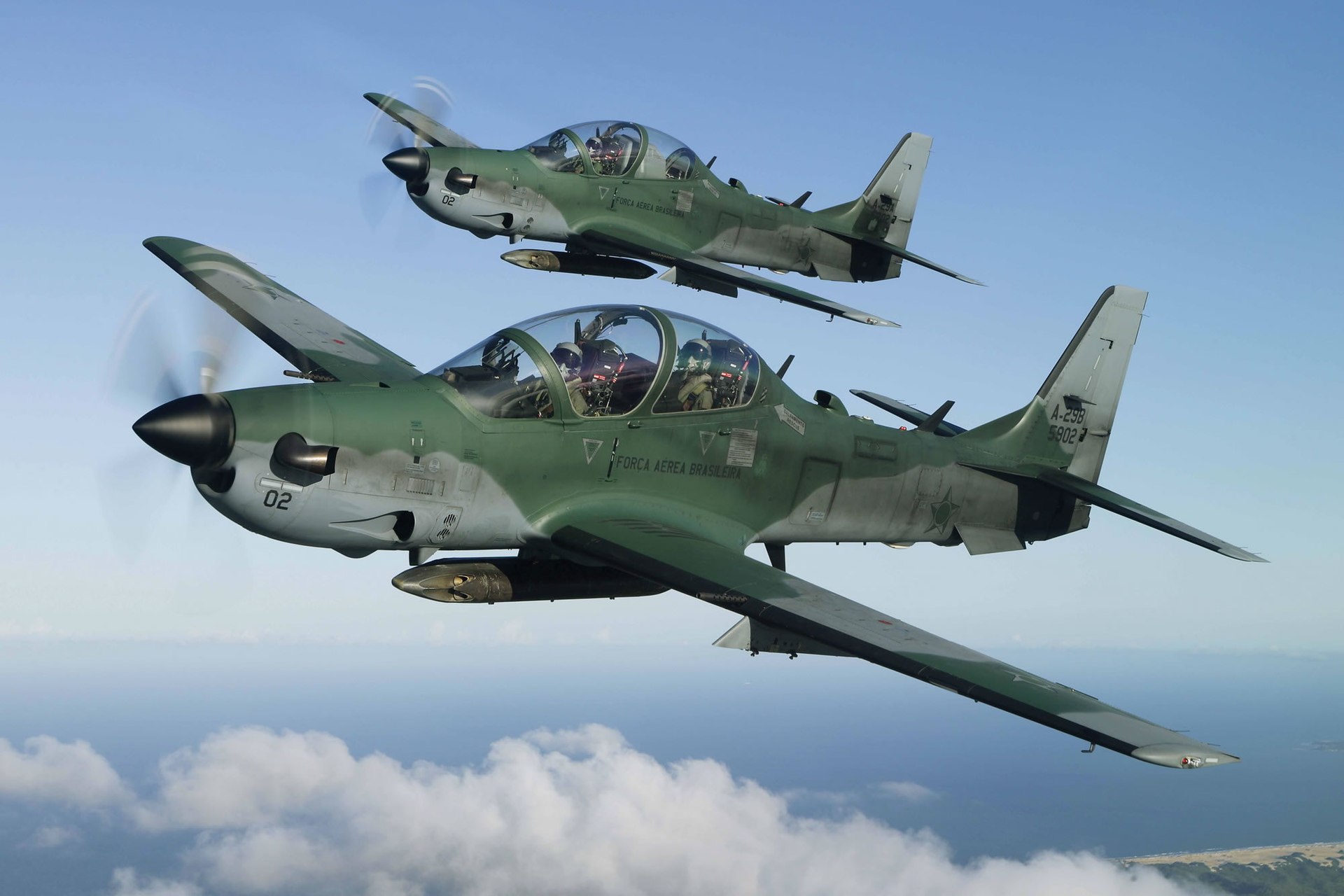
A pair of EMB-314 Super Tucanos. By Matt Morgan
On March 12th, 2012, during the Operation Agata 4, the Brazilian Air Force used two A-29 Super Tucano to destroy a clandestine runway used by drug traffickers within the Amazon rainforest.
In 2011–2013, Operation Agatha marks the start of a new decade of the twenty-first century with the consolidation of the Amazon Surveillance System (SIVAM), an intricate network of radars, meteorological sensors, digital satellite communications, and advanced air-traffic-control software, among other technological advances available to Brazilian Military personnel. The Brazilian Air Force (FAB), which deployed new tactics and methods of fighting using RQ-450 remote-controlled aircraft. Operating in conjunction with sophisticated E-99 Guardian planes, they will locate objectives for A-29 Super Tucano fighters flying in darkness. Northrop F-5EM fighters, responsible for providing air superiority.
In July 2016, Defense Aerospace Brazilian command displays participation of Brazilian Air Force at the Olympic Games Rio 2016, there will be over 15,000 military and 80 aircraft involved in the Olympics. To defense missions and aerial patrol 32 fighters (Northrop F-5M and A-29 Super Tucano), for aerial warning missions 2 radar aircraft (Embraer R-99), surveillance missions 3 Unmanned aircraft (Hermes 450 and Hermes 900), for maritime patrol missions 1 (P-3 Orion), for logistical support missions (Boeing C-767, C-130 and C-295), 15 helicopters (Mil Mi-35, UH-60 Black Hawk and EC-725).
Between 2004 and 2017, the FAB worked on the United Nations Stabilization Mission in Haiti (MINUSTAH) supporting the United Nations force (a joint Brazilian, Uruguayan, Chilean and Argentine force) deployed there.
In November 2017, while searching for the missing Argentine Submarine ARA San Juan, the Brazilian Air Force sent a C-295M search and rescue aircraft and a P-3AM Orion anti-submarine warfare aircraft to assist in the international search effort.
In January 2021, in the middle of the second wave of the COVID-19 pandemic, the Brazilian city of Manaus, located in the interior of the amazon rainforest, was left with an overburdened medical service needing medical supplies and transferring patients, a major operation was set up by Brazilian air force, mobilizing all its available transport aviation, aircraft C-130, KC-390, C-97 Brasilia, C-95M Bandeirantes, CASA C-105 and C-99 were deployed for the largest aeromedical evacuation operation in Brazilian aviation military history.
In October 2023, during the Israel-Hamas war, the Brazilian Air Force together with the Brazilian government mounted its largest repatriation operation of nationals in a conflict zone in history, employing 6 aircraft (2 Airbus A330 MRTT, 2 Embraer C-390 Millennium and 2 Embraer Lineage 1000) to rescue more than 2,700 people from the conflict zone between Hamas and Israel.

An Airbus A330-200 of the strategic transport group
Aircraft Developments
In the early 2000s, with renewed economic stability, the FAB underwent an extensive renewal of its inventory through several acquisition programs, the most ambitious of which was the acquisition of 36 new front-line interceptor aircraft to replace its aging Mirage III. Known in the late 1990s as the F-X Project, the program was postponed during the presidential mandate of Fernando Henrique Cardoso, who in the end of 2002 left the decision for his successor Luís Inácio ‘Lula’ da Silva, who postponed it again in 2003 and 2004. It was cancelled in 2005.
On July 15th, 2005, one agreement was set with the French government for the transfer of twelve Dassault Mirage 2000s (ten “C” and two “B” versions) second-hand ex-Armée de L’Air. Known as F-2000s in Brazil, the first two aircraft arrived at Anápolis Air Base on September 4th, 2006.
In 2007, Brazilian Air Force’s Institute for Advanced Studies started the 14-X development, a hypersonic scramjet demonstrator envisaged to fly at 30 km of altitude at 3 km/s, corresponding to Mach number 10th. In March 2012 a Mach 7 variation has been suggested, named as 14-X S.
On 2006, the F-X Project was restarted under a new name: “F-X2 Project”, and with a bigger budget. The competitors for acquisition were the Eurofighter Typhoon, Sukhoi Su-35, Gripen NG, Dassault Rafale, Boeing F/A-18E/F Super Hornet and, although information on Lockheed Martin’s F-35 Lightning II was requested, Lockheed Martin presented an F-16 Fighting Falcon variant (designated F-16BR). In October 2008, FAB released a shortlist of 3 aircraft: Saab Gripen NG, Dassault Rafale and Boeing F/A-18E/F Super Hornet. In February 2009, the three companies provided their final bids. In September 2009, following a surprise French visit to Brazil, Brazilian President Luiz Inácio Lula da Silva and Nicolas Sarkozy, from France, made a new military cooperation agreement. Lula, on an interview at TV5 Monde, said French Rafale was a step forward, as technology transfer would be effective.
On September 7th, 2009, Brazilian Independence Day, it was announced Brazil would negotiate 36 Dassault Rafale. But the Defence Minister did not confirm the final decision.
On January 5th, 2010, after lobbying by Air Force Officers and Commanders, it was reported that the final evaluation report by the Brazilian Air Force placed the Saab Gripen NG ahead of the other contenders. The decisive factor was apparently the overall cost of the new fighters, both in terms of unit cost, and operating and maintenance costs, and the personal preference of the test pilots. Rafale was reported not to be even the second choice. It was announced in February 2011 that the decision would be further delayed due to budget cuts. And that July the decision was put off for yet another six-month extension.
However, in 2013, yet another six-month delay was announced. In early June 2013, after a visit from US Vice President Joe Biden with Brazilian President Dilma Rousseff; Biden assured President Rousseff that the US Congress would approve technology transfer for Boeing’s F-18s.
In a move apparently following the NSA spying scandal, Russia has also offered Brazil a stake in the development of the Sukhoi PAK-FA 5th generation jet fighter with complete stealth technology transfer.
Saab won the competition on 18th December 2013. The change away from the American jet was due to the 2013 Global surveillance disclosure, according to Reuters reporting; other sources agree with the official rationale that the decision was due to cost and technological transfer. As of January 2014, Brazil is in negotiations with Saab to lease current model Gripens while they wait four years for the next generation jets on order to be developed and built.
On July 28th, 2015, the Brazilian government met with a Swedish trading commission to revisit the contract and request a low of 2.58% in interest rates to 1.98% per annum, generating a savings of 1 billion dollars in 25 years. Sweden rejected the application and signing the contract is seriously threatened with limit until October 2015. On July 29th, 2015, the Brazilian government confirmed that it had reached an agreement with Sweden to finance the purchase of a batch of 36 Gripen NG.
In September 2015 Brazil finalized the US$4.68 billion purchase of 36 Saab Gripen E fighters to be delivered between 2019 and 2024. An assembly line is being established in Brazil to build 15 of the aircraft with engineers and technicians from Brazil traveling to Sweden to begin training. Saab officials have said they believe this is just an initial order, with potential for additional sales to other Latin American countries.
Helicopter aerial refueling
In November 2020 the Brazilian Air Force (FAB), through a technical and multidisciplinary team coordinated by the Department of Aerospace Science and Technology, concluded, on October 30th, in Rio de Janeiro, the last phase of the inflight refueling tests campaign between the H-36 Caracal helicopter and the KC-130 Hercules aircraft.
The flights took place in a restricted area under military control, on the coast of Rio de Janeiro, where the refueling aircraft KC-130 Hercules of the Squadron Gordo ( “fat”, 1st / 1st GT) and H-36 Caracal helicopters from squadrons Falcão ( “Falcon” 1st / 8th GAV) and Puma (3rd / 8th GAV) met to perform the REVO procedure.
The Campaign aimed to complete the tasks foreseen in the certification process, including the unprecedented steps of transferring fuel from the KC-130 to the H-36 and the simultaneous refueling of two helicopters.
As a result, Brazil becomes the first country in South America with the ability to refuel helicopters in flight, a historic landmark for Brazilian Air Force and Brazil.
F-39E Gripen multirole jet. Photo: Isac Nóbrega/PR
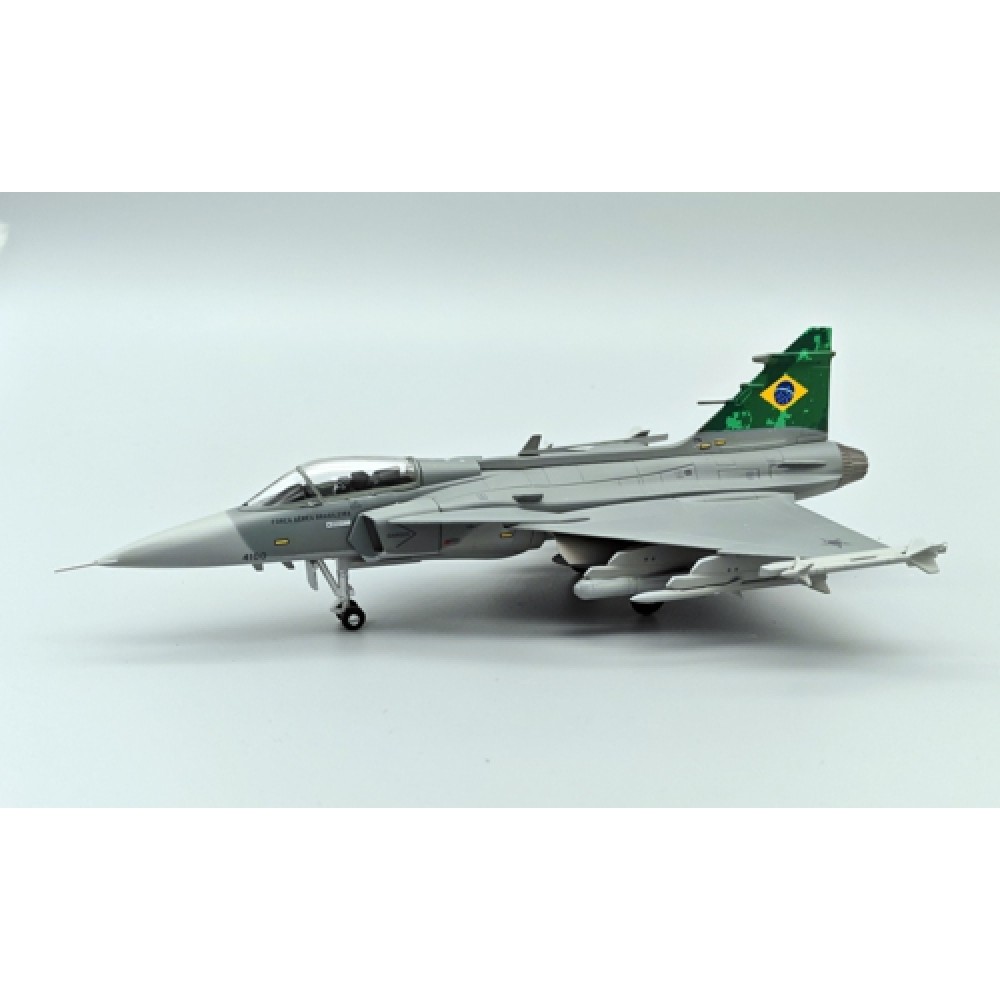
Aviation 72 1/72nd scale Saab Gripen Brazilian Air Force
Check out one of the latest Aviation 72 Saab Gripens available to pre-order from Flying Tigers. Please click on the image below or CLICK HERE to see them all.
Corgi Aviation Archive New Model Announcements!
Check out the four new releases from Corgi Aviation Archive announced today and are available to pre-order from Flying Tigers!
This release features a 1/48th scale EuroFighter Typhoon in the 2024 D-Day Anniversary Display Scheme and three Spitfire T.9’s all in 1/72 scale.
Please click on the image/ links below to go to the model page to pre-order your now.
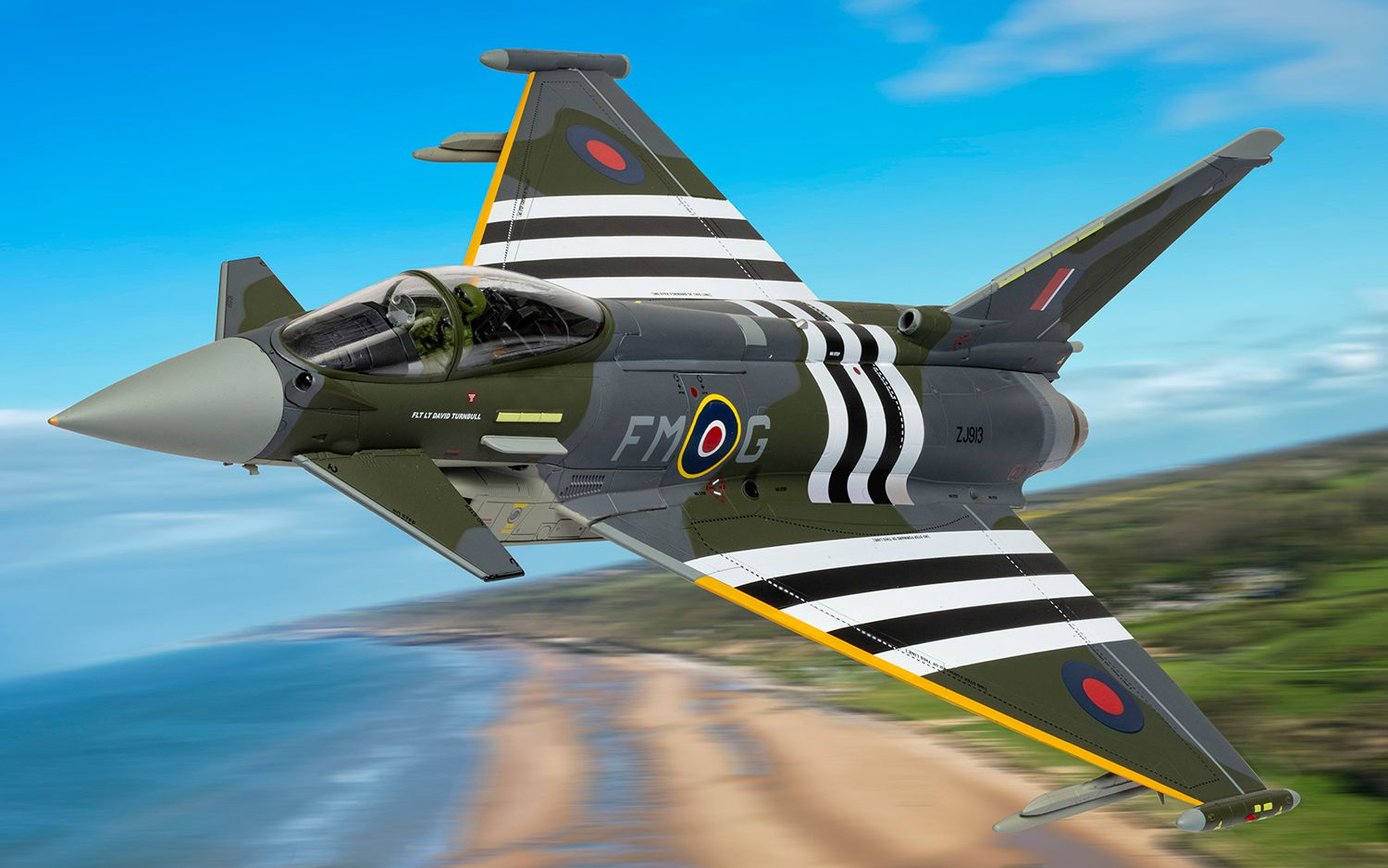
For those people who enjoy attending Airshows during the summer months across the UK, without doubt, the highest profile individual aircraft in current Royal Air Force service is their display Typhoon, an aircraft which makes a celebrity of its pilot for the duration of the season and attracts thousands of youngsters to consider a career in the RAF.
Over recent years, it has become something of a tradition for the RAF Display Team’s Typhoon display jet to wear attractive special markings, making the aircraft a highlight display act on any Airshow programme in which it appears, and unquestionably, one of the most appealing subjects for enthusiast photographers.
To mark last year’s 80th Anniversary of D-Day commemorations, the RAF presented Eurofighter Typhoon ZJ913 in the markings of a WWII Hawker Typhoon of No.257 (Burma) Squadron, one which was flown by Squadron Leader Denzil Jenkins in support of the D-Day landings during the summer of 1944.
During the Airshow season, at commemorative events in both the UK and France, and completing a successful Canadian tour, the aircraft, which its support team and enthusiasts alike referred to as ‘Moggy’, displayed the legendary agility of the Eurofighter Typhoon and highlighted the professionalism of the modern Royal Air Force in some style.
Although now retired to perform duties as an instructional airframe, ‘Moggy’ will be remembered as one of the most popular RAF aircraft of the post war era.
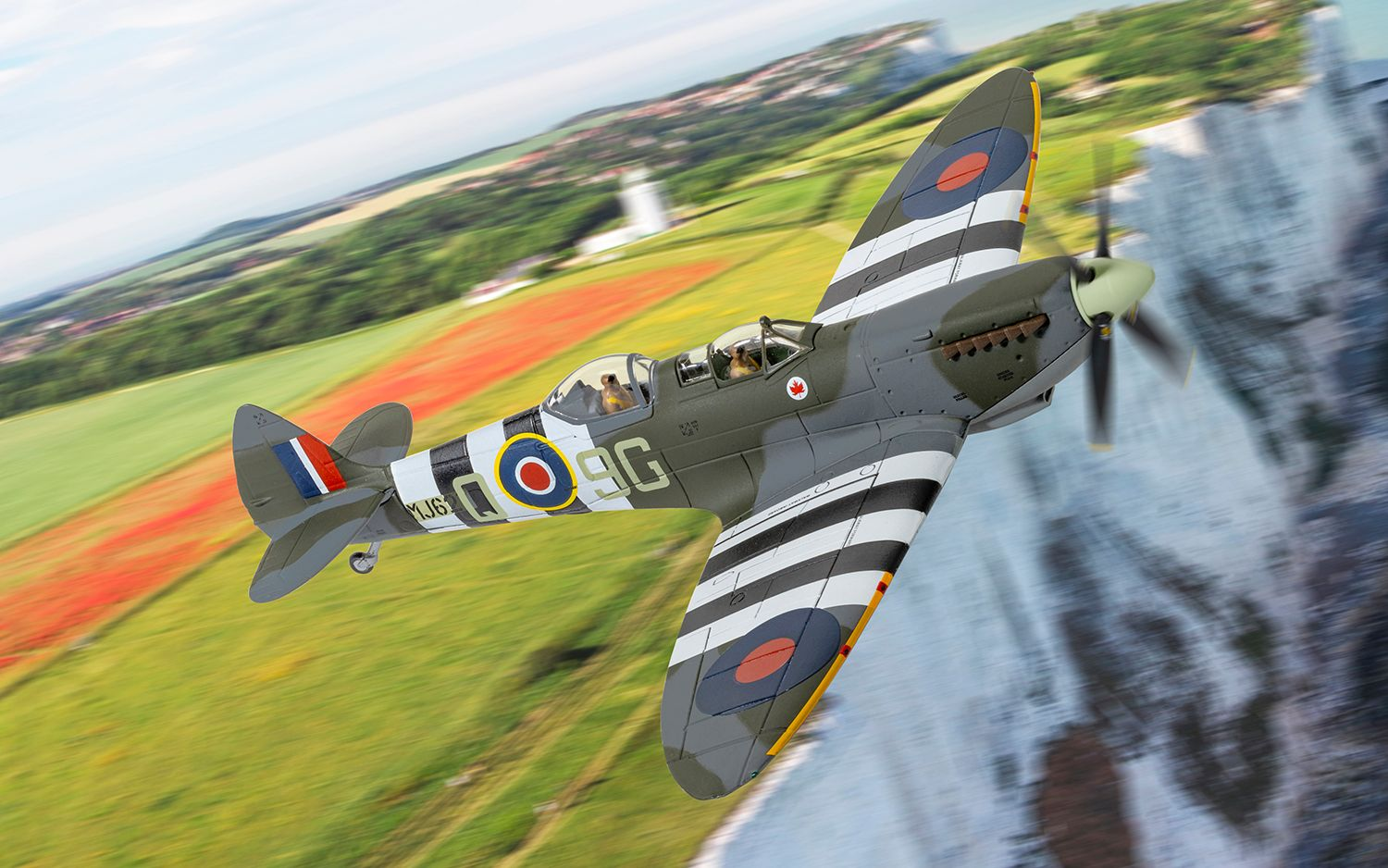
Although the Supermarine Spitfire arguably occupies the position as the world’s most famous aircraft and certainly the most famous fighting aeroplane, a more recent incarnation of this incredible aircraft is helping to preserve its legacy as a none fighting variant of the aircraft, a Spitfire which was made for two.
Although there were unofficial modifications made to a handful of Spitfires during WWII which allowed two pilots to fly in the same aircraft, it wasn’t until after the war had ended that Supermarine began marketing their famous fighter as an officially produced two-seat training aircraft.
Every single aircraft produced started life as a single seat fighter variant, mainly the Mk.IX, so it could be said that these rather placid Spitfires all had a darker side, something those fortunate enough to fly in one should remember – they may well be in a Spitfire made for two, but this is the RAF’s famous fighter at heart.
This Spitfire was originally constructed as an LF Mk.IXc in 1943, entering RAF service with No.441 (RCAF) Squadron in 1944. She actually has a combat victory to her name, having claimed a Messerschmitt Bf 109 over Arnhem just two days after making her combat debut, but would spend much of her service life performing ground attack missions, or escorting bombers.
Currently part of the Biggin Hill Heritage Hangar fleet, how would you like a flight in this incredible Warbird?
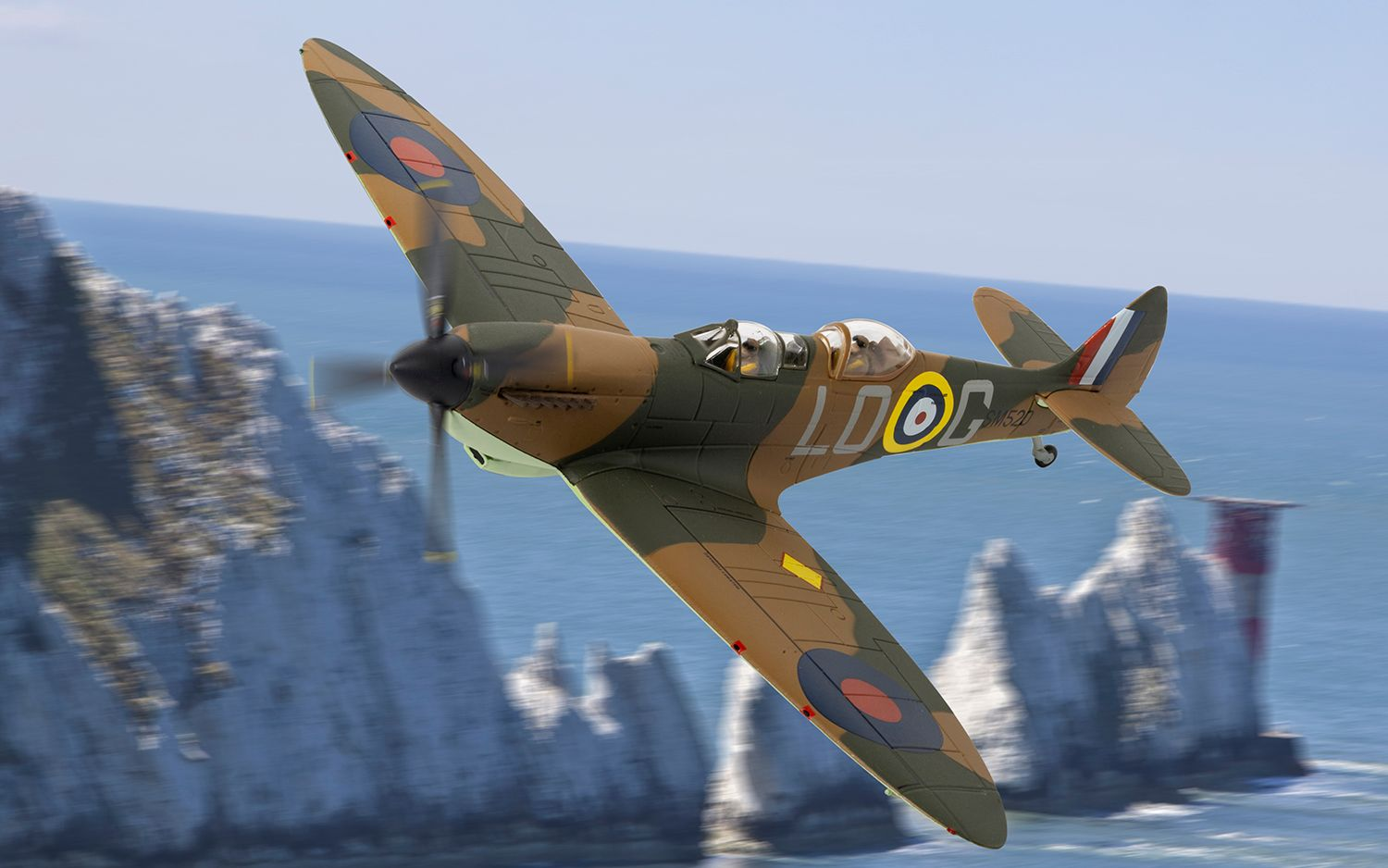
Even though the heroes of Fighter Command prevented the Luftwaffe from claiming air superiority over Britain 85 years ago this year, the sound of a Rolls Royce Merlin engine flying in the skies above us still has us all immediately gazing skyward to this day, just to catch a glimpse of the iconic aircraft which might be flying above us.
Earning an unrivalled reputation during those dark days of war which endures to this day, the Spitfire continues to inspire our nation and preserve the memory of the brave airmen who fought so valiantly to maintain our freedom against overwhelming odds, the ‘Few’ to who we owe so much.
That being the case, anyone who has a Spitfire story to tell is guaranteed an audience, and if you’ve actually flown in one, you can claim to have done something most of us would give our eye teeth to do. Thankfully, there are companies around the country who have gone to great expense in owning and operating a growing fleet of two-seat Spitfires, magnificent machines which allow members of the public to realise their dream of flying in a Spitfire.
Of all the Spitfire T.9s currently flying, surely G-ILDA will be one of the busiest in this Battle of Britain anniversary year, as she is presented in the colours of a Mk.I Spitfire flown by Pilot Officer Nigel Rose during the summer of 1940 – she really is a stunner!
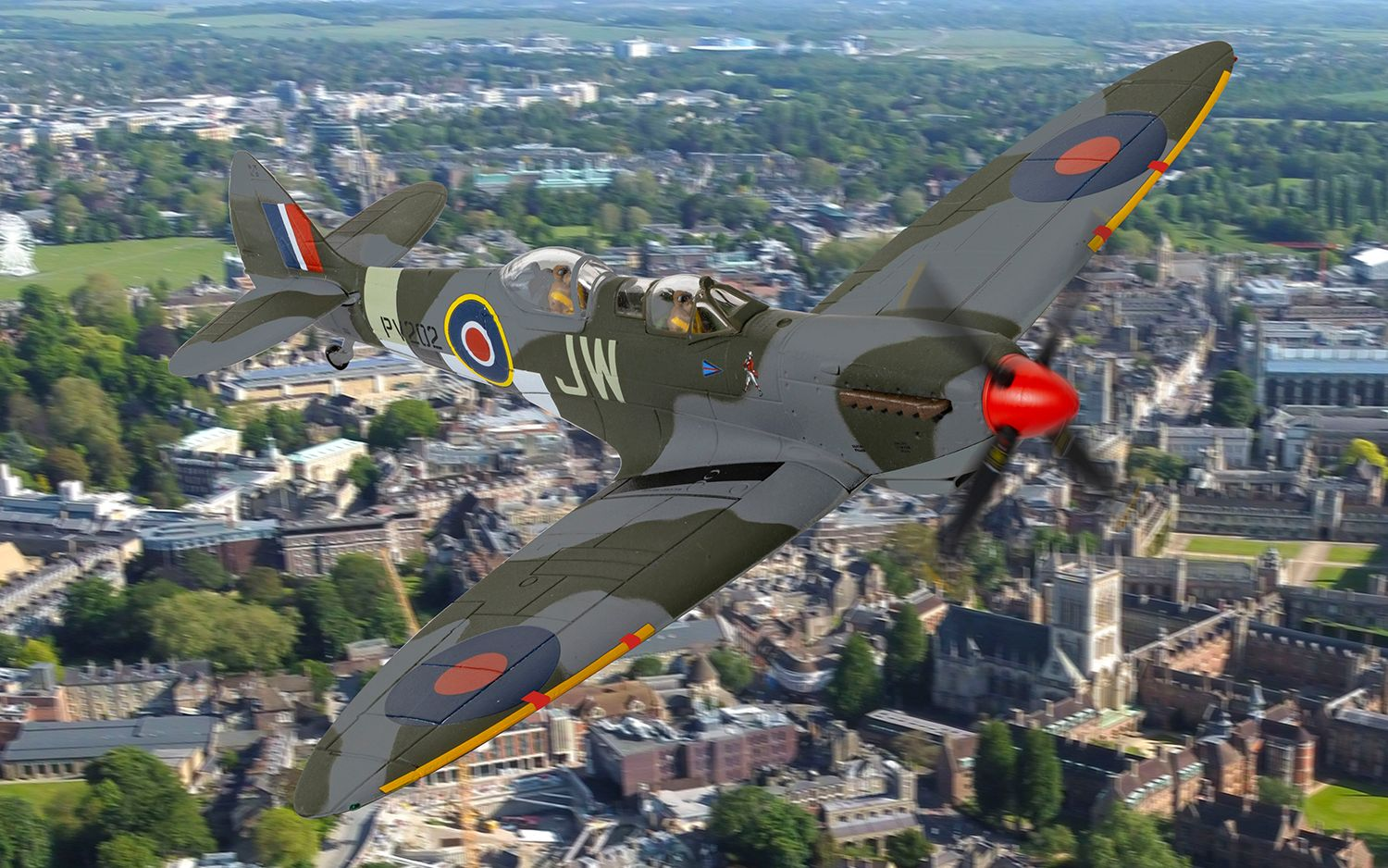
For millions of British people, the Supermarine Spitfire is much more than just an aeroplane. A fighter aircraft which was as deadly as it was beautiful to look at, the Spitfire stands as a symbol of the nation’s defiance in the face of tyranny, one which prevailed against seemingly insurmountable odds during the Battle of Britain, effectively removing the threat of invasion.
Even though the prototype Spitfire flew 89 years ago this March, the aircraft could probably claim to be even more famous now than it was back then, with airworthy examples of this magnificent aircraft gathering ever more admirers with each passing year. For those wishing to fly in a Spitfire, this dream held by so many people is now an achievable reality for those able to afford it, and for those who can, they have the very real possibility of being able to say, “I’ve flown a Spitfire!’
In order to do so, you need to speak to specialists like Duxford based Aerial Collective, and if you’re going to fly in a Spitfire, why not do so from the airfield which took delivery of the first service Spitfire back in the summer of 1938.
This beautiful Spitfire is one of their aircraft and is currently presented in the colours of Spitfire Mk.IX ML365, the personal aircraft of ace pilot Group Captain Peter Russell ‘Johnnie’ Walker CBE, DFC and DSO. Anyone fancy the flight of a lifetime?
|
|
|
|

|
|

|
|

|
|

|
|

|
|

|
|

|
|

|
|

|
|

|
|

|
|

|
|

|
|

|
|

|
|

|
|

|
|

|
|

|
|

|
|

|
|

|
|

|
|

|
|
Corgi Aviation Archive New Model Arrival … Just Arrived, Now in Stock!
Check out the latest the Corgi Aviation Archive Catalina that has just arrived and is now available from Flying Tigers today.
Please click on the images / links below to go to the model of your choice or CLICK HERE to see all Corgi Aviation Models now in stock.

Operating from its home base at US Station 365 Halesworth in Suffolk in 1945, Consolidated OA-10A Catalina 44-33915, named ‘Miss Pick Up’, was scrambled to assist another Catalina which had been sent to rescue the crew of a downed B-24 Liberator in the North Sea. The aircraft had found itself in difficulties having landed on extremely rough seas.
Managing to locate the other Catalina, ‘Miss Pick Up’ flew over it several times, sending back location coordinates to other units, before being relieved by other aircraft.
She was then directed to try and locate the position of a P-51D Mustang pilot who had been reported as ditching in the sea off the coast of the Dutch Island of Schiermonnikoog.
Unfortunately, when landing to attempt the rescue, one of the Catalina’s engines failed and it was unable to take off again or move further away from the enemy coast, so she dropped her anchor to avoid drifting further.
The following day, the stricken Catalina came under attack by a pair of Messerschmitt Me 262 jet fighters from Jagdgeschwader 7, with the German jets making two devastating strafing passes against the mighty amphibian.
Thankfully, a flight of USAAF Mustangs chased the Luftwaffe fighters away, but whilst this saved the lives of the crew, ‘Miss Pick Up’ herself was mortally wounded and soon sank to the bottom of the North Sea.
Thank you for reading this week’s Newsletter.
Richard
Flying Tigers.