NORTHROP P-61 in flight. Northrop P-61 Black Widow night fighter had pilot, radar operator, and gunner.
The Northrop P-61 Black Widow is a twin-engine United States Army Air Forces fighter aircraft of World War II. It was the first operational U.S. warplane designed as a night fighter.
Named for the North American spider Latrodectus mactans, it was an all-metal, twin-engine, twin-boom design armed with four forward-firing 20 mm (.79 in) Hispano M2 autocannon in the lower fuselage, and four .50 in (12.7 mm) M2 Browning machine guns in a dorsal gun turret. Developed during the war, the first test flight was made on 26th May 1942, with the first production aircraft rolling off the assembly line in October 1943.
Although not produced in the large numbers of its contemporaries, the Black Widow was operated effectively as a night fighter by United States Army Air Forces squadrons in the European Theatre, Pacific Theatre, China Burma India Theatre, and Mediterranean Theatre during World War II. It replaced earlier British-designed night-fighter aircraft that had been updated to incorporate radar when it became available. After the war, the P-61 was redesignated as the F-61, and served in the United States Air Force as a long-range, all-weather, day/night interceptor for Air Defense Command until 1948, and for the Fifth Air Force until 1950. The last aircraft was retired from government service in 1954.
On the night of 14th August 1945, a P-61B of the 548th Night Fighter Squadron named Lady in the Dark was unofficially credited with the last Allied air victory before VJ Day. The P-61 was also modified to create the F-15 Reporter photo-reconnaissance aircraft for the United States Army Air Forces and subsequently the United States Air Force.
Development
Origins
In August 1940, sixteen months before the United States entered the war, the U.S. Air Officer in London, Lieutenant General Delos C. Emmons, was briefed on British research in radar (RAdio Detection And Ranging), which had been underway since 1935, and had played an important role in the nation’s defense against the Luftwaffe during the Battle of Britain. General Emmons was informed of the new Airborne Intercept radar (AI for short), a self-contained unit that could be installed in aircraft, and operated independently of ground stations. In September 1940, the Tizard Mission traded British research, including the cavity magnetron that would make self-contained interception radar installations practicable, for American production.
Simultaneously, the British Purchasing Commission tasked with evaluating US aircraft declared their urgent need for a high-altitude, high-speed aircraft to intercept the Luftwaffe bombers attacking London at night. The aircraft would need to patrol continuously over the city throughout the night, requiring at least an eight-hour loiter capability. The aircraft would carry one of the early, heavy AI radar units, and mount its specified armament in “multiple-gun turrets.” The British conveyed the requirements for a new fighter to all of the aircraft designers and manufacturers they were working with. Among those contacted by the British was Jack Northrop, who realized that the speed, altitude, fuel load, and multiple-turret requirements demanded a large aircraft with multiple engines.
General Emmons returned to the U.S. with details of the British night-fighter requirements, and stated in his report that the design departments of the American aviation industry’s firms could possibly produce such an aircraft. The Emmons Board developed basic requirements and specifications, and handed them over to the Air Technical Service Command (ATSC) at Wright Field, Ohio towards the end of 1940. After considering the two biggest challenges—the heavy weight of the AI radar, and the very long (by fighter standards) loiter time of eight hours minimum—the board, including Jack Northrop, realized the aircraft would need the considerable power and resulting size of twin engines, and recommended such parameters. The United States had two twin-row radials of at least 46 liters displacement in development since the late 1930s: the Double Wasp and the Duplex Cyclone. These engines had been airborne for their initial flight tests by the 1940/41 timeframe, and were each capable, with more development, of exceeding 2,000 hp (1,500 kW).
Vladimir Pavlecka, Northrop Chief of Research, was present on unrelated business at Wright Field. On 21st October 1940, Colonel Laurence Craigie of the ATSC phoned Pavlecka, explaining the U.S. Army Air Corps’ specifications, but told him to “not take any notes, ‘Just try and keep this in your memory!’” What Pavlecka did not learn was radar’s part in the aircraft; Craigie described the then top-secret radar as a “device which would locate enemy aircraft in the dark,” and which had the ability to “see and distinguish other airplanes.” The mission, Craigie explained, was “the interception and destruction of hostile aircraft in flight during periods of darkness or under conditions of poor visibility.”
Pavlecka met with Jack Northrop the next day, and gave him the USAAC specifications. Northrop compared his notes with those of Pavlecka, saw the similarity between the USAAC’s requirements and those issued by the RAF, and pulled out the work he had been doing on the British aircraft’s requirements. He was already a month along, and a week later, Northrop pounced on the USAAC proposal.
On 5th November, Northrop and Pavlecka met at Wright Field with Air Materiel Command officers, and presented them with Northrop’s preliminary design. The Douglas XA-26A night fighter proposal was the only competition; Northrop’s design was selected.
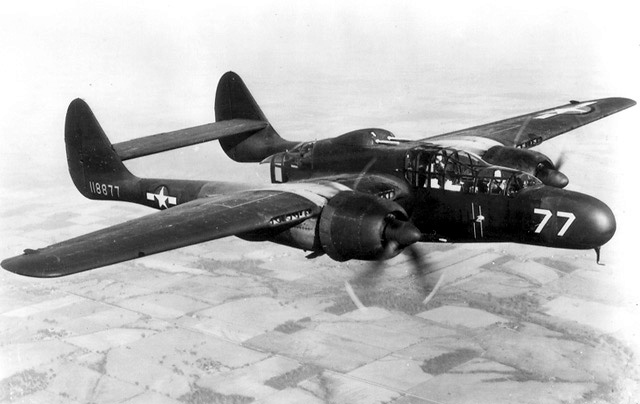
The YP-61 pre-production prototype.
Early stages
Following the USAAC acceptance, Northrop began comprehensive design work on what would become the first dedicated night fighter. The result was the largest pursuit-class aircraft flown by the U.S. during the war.
Jack Northrop’s first proposal was a long fuselage gondola between two engine nacelles and tail booms. Engines were Pratt & Whitney R-2800-10 Double Wasp 18-cylinder radials, producing 2,000 hp (1,500 kW) each. The fuselage housed the three-man crew, the radar, and two four-gun turrets. The .50 in (12.7 mm) AN/M2 Browning machine guns were fitted with 36 in (910 mm) long, lightweight “aircraft” barrels with perforated sleeves. The turrets were located in the nose and rear of the fuselage. It stood on tricycle landing gear, and featured full-span retractable flaps, or “Zap flaps” (named after aircraft engineer Edward Zaparka), in the wings.
The aircraft was huge, as Northrop had anticipated. While far larger and heavier multi-engine bombers existed, its 45.5 ft (14 m) length, 66 ft (20 m) wingspan, and projected 22,600 lb (10,251 kg) full-load weight were unheard of for a fighter, making the P-61 difficult for many to accept as a feasible fighter aircraft.
Changes to the plan
Some alternative design features were investigated before finalization. Among them were: conversion to a single vertical stabilizer/rudder; the shifting of the nose and tail gun turrets to the top and bottom of the fuselage; and the incorporation of a second gunner.
Late in November 1940, Jack Northrop returned to the crew of three and twin tail/rudder assembly. To meet USAAC’s request for more firepower, designers abandoned the ventral turret, and mounted four 20 mm (.79 in) Hispano M2 cannons in the wings. As the design evolved, the cannons were repositioned in the belly of the aircraft. Consequently, the P-61 became one of the few U.S.-designed fighter aircraft to have a quartet of 20 mm (.79 in) cannons—along with the NA-91 version of the Mustang, and the U.S. Navy’s uprated F4U-1C Corsair—as factory-standard in World War II.
On 5th December 1940, the Northrop Specification 8A was formally submitted to Army Air Materiel Command at Wright Field. Following a few small changes, Northrop’s NS-8A fulfilled all USAAC requirements, and the Air Corps issued Northrop a Letter of Authority For Purchase on 17th December. A contract for two prototypes and two scale models to be used for wind tunnel testing (with costs not to exceed $1,367,000) was awarded on 10th January 1941. The War Department then designated the Northrop Specification 8A as the XP-61.

The P-61’s upper turret is visible on the fuselage between the wings.
XP-61 development
In March 1941, the Army/Navy Standardization Committee decided to standardize use of updraft carburetors across all U.S. military branches. The XP-61, designed with downdraft carburetors, faced an estimated minimum two-month redesign of the engine nacelle to bring the design into compliance. The committee later reversed the updraft carburetor standardization decision (with the XP-61 program’s predicament likely having little influence), and prevented a potential setback in the XP-61’s development.
On 2nd April 1941, the Air Corps Mockup Board met at Northrop to inspect the XP-61 mock-up. They recommended several changes following this review. Most prominently, the four 20 mm (.79 in) M2 cannons were relocated from the outer wings to the belly of the aircraft, clustered tightly with the forward-facing ventral “step” in the fuselage to accommodate them being placed just behind the rear edge of the nose gear well. The closely-spaced, centered installation, with two cannons stacked vertically, slightly outboard of the aircraft’s centerline on each side, and the top cannon in each pair only a few inches farther outboard, eliminated the inherent drawbacks of the convergence of wing-mounted guns. Without convergence, aiming was considerably easier and faster, and the tightly grouped cannons created a thick stream of 20 mm (.79 in) projectiles. The removal of the guns and ammunition from the wings also cleaned up the wings’ airfoil, and increased internal fuel capacity from 540 to 646 US gal (2,040 to 2,450 L; 450 to 538 imp gal).
Other changes included: the provision for external fuel carriage in drop tanks; flame arrestors/dampers on engine exhausts; and redistribution of some radio equipment. While all beneficial from a performance standpoint (especially the relocation of the cannons), the modifications required over a month of redesign work, and the XP-61 was already behind schedule.
In mid-1941, the dorsal turret mount finally proved too difficult to install in the aircraft, and was changed from the General Electric ring mount to a pedestal mount like that used for the upper turrets in Boeing B-17 Flying Fortress, Consolidated B-24 Liberators, North American B-25 Mitchells, Douglas A-20s, and other American bombers. Following this modification, the turret itself became unavailable, as operational aircraft (in this case, the Boeing B-29 Superfortress) were ahead of experimental aircraft in line for the high-demand component. For flight testing, engineers used a dummy turret.
In February 1942, subcontracting manufacturer Curtiss notified Northrop that the C5424-A10 four-bladed, automatic, full-feathering propeller Northrop had planned for use in the XP-61 would not be ready for the prototype rollout or the beginning of flight tests. Hamilton Standard propellers were used in lieu of the Curtiss props until the originally planned component became available.
During the construction process of the prototype, the XP-61’s weight rose to 22,392 lb (10,157 kg) empty and 29,673 lb (13,459 kg) at takeoff. The XP-61s were then equipped with the following: engines were R-2800-25S Double Wasp radials, turning 12 ft 2 in (3.71 m) diameter Curtiss C5425-A10 four-blade propellers, both rotating counterclockwise when viewed from the front; radios included two command radios, SCR-522As, and three other radio sets—the SCR-695A, AN/APG-1, and AN/APG-2; and central fire control for the gun turret was similar to that used on the B-29, the General Electric GE2CFR12A3.
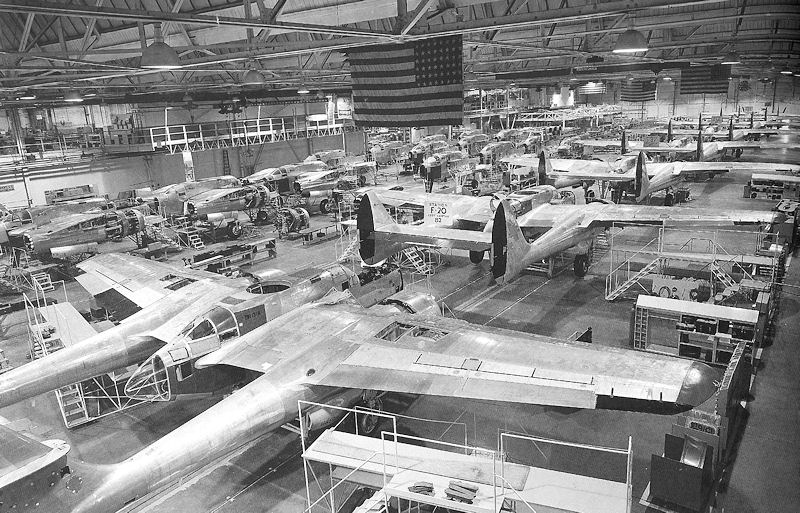
P-61Bs on the assembly line at Northrop (1944).
P-61C
The P-61C was a high-performance variant designed to rectify some of the combat deficiencies encountered with the A and B variants. Work on the P-61C proceeded quite slowly at Northrop because of the higher priority of the Northrop XB-35 flying wing strategic bomber project. In fact, much of the work on the P-61C was farmed out to Goodyear, which had been a subcontractor for production of Black Widow components. It was not until early 1945 that the first production P-61C-1-NO rolled off the production lines. As promised, the performance was substantially improved, in spite of a 2,000 lb (910 kg) increase in empty weight. This increase in performance came as a result of the new Pratt and Whitney R-2800-57, a new compound charged engine. It increased power from 2200 HP per engine to 2800 HP per engine, generating a combined total of 5600 HP. When used in conjunction with the R-2800-57 engines, the P-61C’s supercharger and turbocharger also helped climbing rates and high altitude power and efficiency, as well as allowing the P-61C to achieve higher altitudes. Maximum speed was 430 mph (690 km/h) at 30,000 ft (9,100 m), service ceiling was 41,000 ft (12,000 m), and an altitude of 30,000 ft (9,100 m) could be attained in 14.6 minutes.
The P-61C was equipped with perforated fighter airbrakes located both below and above the wing surfaces. These were to provide a means of preventing the pilot from overshooting his target during an intercept. For added fuel capacity, the P-61C was equipped with four underwing pylons (two inboard of the nacelles, two outboard) which could carry four 310 US gal (1,200 L; 260 imp gal) drop tanks. The first P-61C aircraft was accepted by the USAAF in July 1945. However, the war in the Pacific ended before any P-61Cs could see combat. The 41st and last P-61C-1-NO was accepted on 28th January 1946. At least 13 more were completed by Northrop, but were scrapped before they could be delivered to the USAAF.
Service life of the P-61C was quite brief, since its performance was being outclassed by newer jet aircraft. Most were used for test and research purposes. By the end of March 1949 most P-61Cs had been scrapped. Two entered the civilian market and two others went to museums.
F-15/RF-61C
In mid-1945, the surviving XP-61E was modified into an unarmed photographic reconnaissance aircraft. All the guns were removed, and a new nose was fitted, capable of holding an assortment of aerial cameras. The aircraft, redesignated XF-15, flew for the first time on 3rd July 1945. A P-61C was also modified to XF-15 standards. Apart from the turbosupercharged R-2800-C engines, it was identical to the XF-15 and flew for the first time on 17th October 1945. The nose for the F-15A was subcontracted to the Hughes Tool Company of Culver City, California. The F-15A was basically the P-61C with the new bubble-canopy fuselage and the camera-carrying nose, but without the fighter brakes on the wing.
F2T-1N
The United States Marine Corps had planned to acquire 75 Black Widows, but these were canceled in 1944 in favor of the Grumman F7F Tigercat. In September 1945, however, the Marines received a dozen former Air Force P-61Bs to serve as radar trainers until the Tigercats would be available in squadron strength. Designated F2T-1N these aircraft were assigned to shore-based Marine units and served briefly, the last two F2T-1s being withdrawn on 30th August 1947.
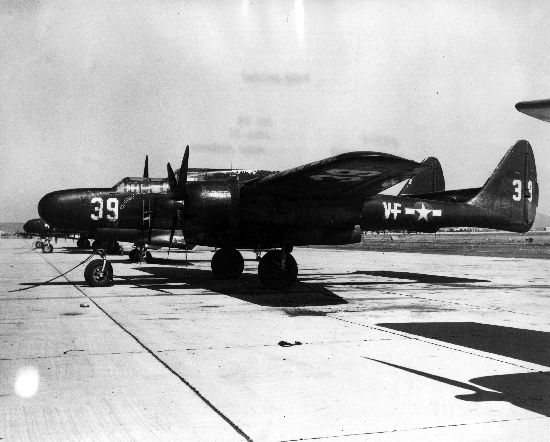
Northrop F2T-1Ns
Design
The P-61 featured a crew of three: pilot, gunner, and radar operator. It was armed with four 20 mm (.79 in) Hispano M2 forward-firing cannon mounted in the lower fuselage, and four .50 in (13 mm) M2 Browning machine guns lined up horizontally with the two middle guns slightly offset upwards in a remotely aimed dorsally mounted turret, a similar arrangement to that used with the B-29 Superfortress using four-gun upper forward remote turrets. The turret was driven by the General Electric GE2CFR12A3 gyroscopic fire control computer, and could be directed by either the gunner or radar operator, who both had aiming control and gyroscopic collimator sight assembly posts attached to their swiveling seats.
The two Pratt & Whitney R-2800-25S Double Wasp engines were each mounted approximately one-sixth out on the wing’s span. Two-stage, two-speed mechanical superchargers were fitted. In an effort to save space and weight, no turbo-superchargers were fitted, despite the expected 50 mph (80 km/h) speed and 10,000 ft (3,000 m) ceiling increases.
Main landing gear bays were located at the bottom of each nacelle, directly behind the engine. The two main gear legs were each offset significantly outboard in their nacelles, and retracted towards the tail; oleo scissors faced forwards. Each main wheel was inboard of its gear leg and oleo. Main gear doors were two pieces, split evenly, longitudinally, hinged at inner door’s inboard edge and the outer door’s outboard edge.
Each engine cowling and nacelle drew back into tail booms that terminated upwards in large vertical stabilizers and their component rudders, each of a shape similar to a rounded right triangle. The leading edge of each vertical stabilizer was faired smoothly from the surface of the tail boom upwards, swept back to 37°. The horizontal stabilizer extended between the inner surfaces of the two vertical stabilizers, and was approximately 3⁄4 the chord of the wing root, including the elevator. The elevator spanned approximately 1⁄3 of the horizontal stabilizer’s width, and in overhead plan view, angled inwards in the horizontal from both corners of leading edge towards the trailing edge approximately 15°, forming the elevator into a wide, short trapezoid. The horizontal stabilizer and elevator assembly possessed a slight airfoil cross-section.
The engines and nacelles were outboard of the wing root and a short “shoulder” section of the wing that possessed a 4° dihedral, and were followed by the remainder of the wing which had a dihedral of 2°. The leading edge of the wing was straight and perpendicular to the aircraft’s centerline. The trailing edge was straight and parallel to the leading edge in the shoulder, and tapered forward 15° outboard of the nacelle. Leading edge updraft carburetor intakes were present on the wing shoulder and the root of the outer wing, with a few inches of separation from the engine nacelle itself. They were very similar in appearance to those on the F4U Corsair—thin horizontal rectangles with the ends rounded out to nearly a half-circle, with multiple vertical vanes inside to direct the airstream properly.
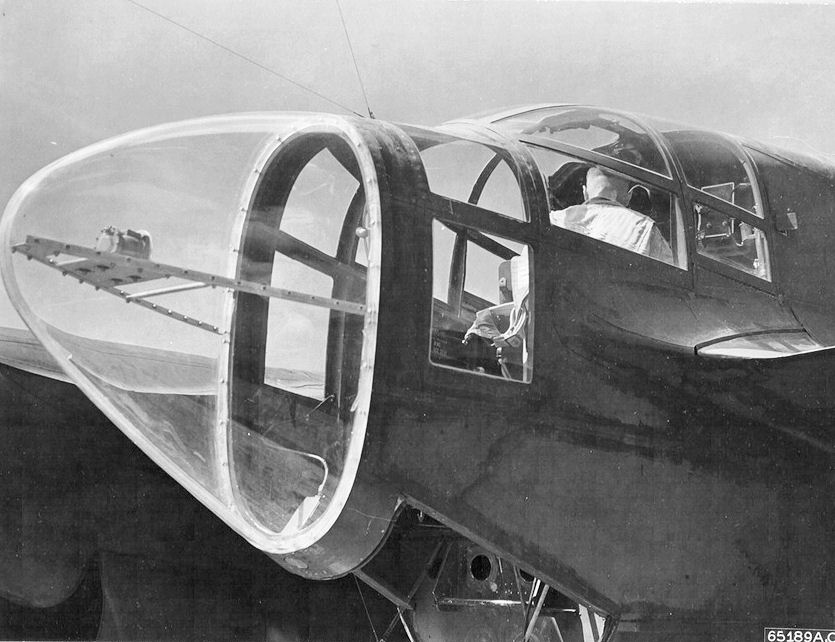
Close-up view of the P-61 radar operator’s compartment in the rear of the fuselage. East Field, Saipan, Mariana Islands, 20th July 1944.
The P-61 did not have normal-sized ailerons. Instead, it had small ailerons which allowed wider span flaps and a very low landing speed. These ailerons, known as guide ailerons, gave some roll control and provided acceptable feel for the pilot in rolling manoeuvres. Control of the aircraft about the roll axis was augmented with circular-arc spoilerons which provided about half the roll control at low speeds and most of it at high speeds. The spoilers were located outboard of the nacelle in front of the flaps.
The main fuselage, or gondola, was centered on the aircraft’s centerline. It was, from the tip of the nose to the end of the Plexiglas tail-cone, approximately five-sixths the length of one wing (root to tip). The nose housed an evolved form of the SCR-268 Signal Corps Radar, the Western Electric Company’s SCR-720A. Immediately behind the radar was the multi-framed “greenhouse” canopy, featuring two distinct levels, one for the pilot and a second for the gunner above and behind him, the latter elevated by approximately 6 in (150 mm). Combined with the nearly flat upper surface of the aircraft’s nose, the two-tiered canopy gave the aircraft’s nose a distinct appearance of three wide, shallow steps. The forward canopy in the XP-61 featured contiguous, smooth-curved, blown-Plexiglas canopy sections facing forward, in front of the pilot and the gunner. The tops and sides were framed.
Beneath the forward crew compartment was the nose gear wheel well, through which the pilot and gunner entered and exited the aircraft. The forward gear leg retracted to the rear, up against a contoured cover that when closed for flight formed part of the cockpit floor; the gear would not have space to retract with it open. The oleo scissor faced forwards. The nosewheel was centered, with the strut forking to the aircraft’s left. The nosewheel was approximately 3⁄4 the diameter of the main wheels. Nose gear doors were two pieces, split evenly longitudinally, and hinged at each outboard edge.
The center of the gondola housed the main wing spar, fuel storage and piping and control mechanisms, control surface cable sections, propeller and engine controls, and radio/IFF (Identification Friend or Foe) equipment, but was predominantly occupied by the top turret mounting ring, rotation and elevation mechanisms, ammunition storage for the turret’s machine guns, the GE2CFR12A3 gyroscopic fire control computer, and linkages to the gunner and radar operator’s turret control columns, forward and aft, respectively.
The radar operator’s station was at the aft end of the gondola. The radar operator controlled the SRC-720 radar set and viewed its display scopes from the isolated rear compartment, which he entered by way of a small hatch with a built-in ladder on the underside of the aircraft. In addition to the radar systems themselves, the radar operator had intercom and radio controls, as well as the controls and sight for the remote turret. The compartment’s canopy followed the curvature of the gondola’s rear section, with only a single rounded step to the forward canopy’s double step. The rear of the gondola was enclosed by a blown Plexiglas cap that tapered quickly in overhead plan view to a barely rounded point; the shape was somewhat taller in side profile than it was in overhead plan view, giving the end of the “cone” a rounded “blade” appearance when viewed in perspective.
The cross-section of the gondola, front to back, was generally rectangular, vertically oriented. The tip of the nose was very rounded to accommodate the main AI radar’s dish antenna, merging quickly to a rectangular cross-section that tapered slightly towards the bottom. This cross-section lost its taper but became clearly rounded at the bottom moving back through the forward crew compartment and nose gear well. Height increased at both steps in the forward canopy, with the second step being flush with the top of the aircraft (not counting the dorsal gun turret). At the rear of the forward crew compartment, the cross-section’s bottom bulged downwards considerably and continued to do so until just past the midpoint between the rear of the forward crew compartment and the front of the rear crew compartment, where the lower curvature began to recede. Beginning at the front of the rear crew compartment, the top of the cross-section began to taper increasingly inwards above the aircraft’s center of gravity when progressing towards the rear of the gondola. The cross-section rounded out considerably by the downward step in the rear canopy, and rapidly became a straight-sided oval, shrinking and terminating in the tip of the blown-Plexiglas “cone” described above.
The cross-section of the nacelles was essentially circular throughout, growing then diminishing in size when moving from the engine cowlings past the wing and gear bay, towards the tail booms and the vertical stabilizers. A bulge on the top of the wing maintained the circular cross-section as the nacelles intersected the wing. The cross-section became slightly egg-shaped around the main gear bays, larger at the bottom but still round. An oblong bulge on the bottom of the main gear doors, oriented longitudinally, accommodated the main wheels when the gear was retracted.
Wingtips, wing-to-nacelle joints, tips and edge of stabilizers and control surfaces (excluding the horizontal stabilizer and elevator) were all smoothly rounded, blended or filleted. The overall design was exceptionally clean and fluid as the aircraft possessed very few sharp corners or edges.
SCR-720 radar
The production model of the SCR-720 mounted a scanning radio transmitter in the aircraft nose; in Airborne Intercept mode, it had a range of nearly 5 mi (8.0 km). The unit could also function as an airborne beacon / homing device, navigational aid, or in concert with interrogator-responder IFF units. The XP-61’s radar operator located targets on his scope and steered the unit to track them, vectoring and steering the pilot to the radar target via oral instruction and correction. Once within range, the pilot used a smaller scope integrated into the main instrument panel to track and close on the target.
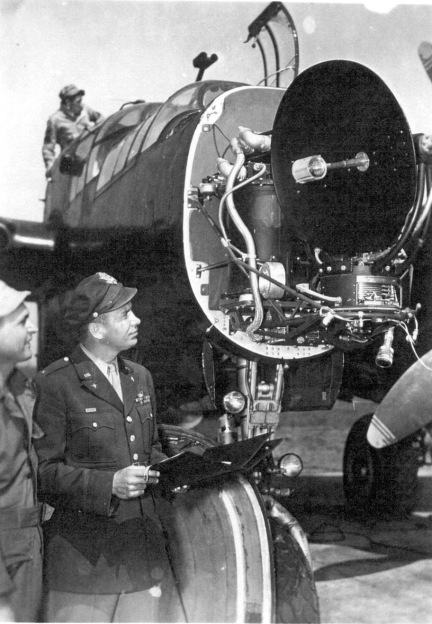
A P-61 radar
Remote turret
The XP-61’s spine-mounted dorsal remote turret could be aimed and fired by the gunner or radar operator, who both had aiming control and gyroscopic collimator sighting posts attached to their swiveling seats, or could be locked forward to be fired by the pilot in addition to the 20 mm (.79 in) cannon. The radar operator could rotate the turret to engage targets behind the aircraft. Capable of a full 360° rotation and 90° elevation, the turret could be used to engage any target in the hemisphere above and to the sides of the XP-61. A brief assessment of the turret by the British Aeroplane & Armament Experimental Establishment in 1944 found problems with the aiming and “jerky movement” of the guns.
Operational history
Training units
The first unit to receive production aircraft was the 348th Night Fighter Squadron at Orlando Army Air Base, Florida, which was responsible for training night fighter crews.
P-61 crews trained in a variety of ways. Several existing night fighter squadrons operating in the Mediterranean and Pacific theaters were to transition directly into the P-61 from Bristol Beaufighters and Douglas P-70s, though most P-61 crews were to be made up of new recruits operating in newly commissioned squadrons. After receiving flight, gunnery or radar training in bases around the U.S., the crews were finally assembled and received their P-61 operational training in Florida for transfer to the European Theater, or California for operations in the Pacific Theatre.
European theatre
The P-61 had an inauspicious start to its combat in the European theater. Some believed the P-61 was too slow to effectively engage German fighters and medium bombers, a view which the RAF shared, based on the performance of a single P-61 they had received in early May.
The 422d Night Fighter Squadron was the first to complete their training in Florida and, in February 1944, the squadron was shipped to England aboard the RMS Mauretania. The 425th NFS soon followed aboard the RMS Queen Elizabeth.
The situation deteriorated in May 1944, when the squadrons learned that several USAAF generals – including General Hoyt Vandenberg – believed the P-61 lacked the capability to successfully engage German fighters and bombers, being too slow. General Spaatz asked for de Havilland Mosquito night fighters to equip two U.S. night fighter squadrons based in the UK. The request was denied due to insufficient supplies of Mosquitoes which were in demand for a number of roles.
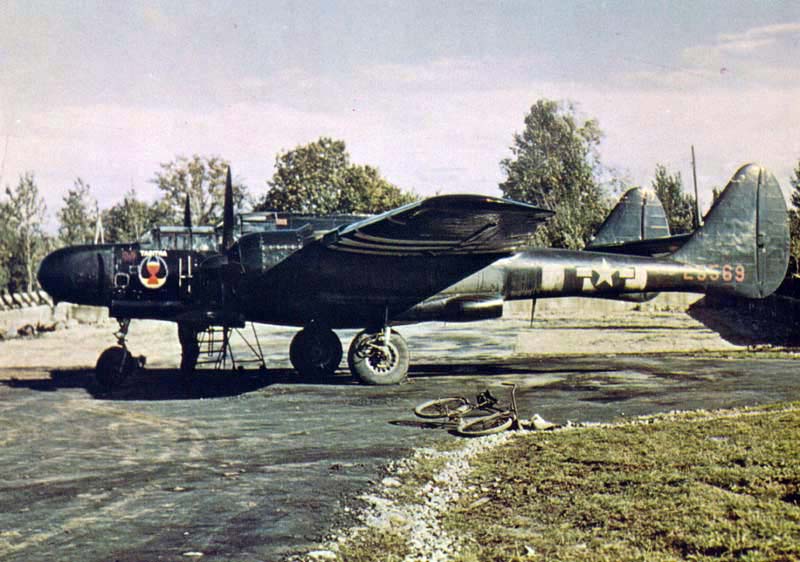
A P-61A of the 425th NFS (RAF Scorton, England)
At the end of May, the USAAF insisted on a competition between the Mosquito and the P-61 for operation in the European theatre. RAF crews flew the Mosquito Mk XVII while crews from the 422nd NFS flew the P-61. In the end the USAAF determined that the P-61 had a slightly better rate of climb and could turn more tightly than the Mosquito. Colonel Winston Kratz, director of night fighter training in the USAAF, had organized a similar competition earlier. He said of the results:
I’m absolutely sure to this day that the British were lying like troopers. I honestly believe the P-61 was not as fast as the Mosquito, which the British needed because by that time it was the one airplane that could get into Berlin and back without getting shot down. I doubt very seriously that the others knew better. But come what may, the ’61 was a good night fighter. In the combat game you’ve got to be pretty realistic about these things. The P-61 was not a superior night fighter. It was not a poor night fighter. It was a good night fighter. It did not have enough speed.
However, on 5th July 1944, General Spaatz ordered a competition be held between the P-61 – using an example from the 422nd which had been “‘tweaked’ to get maximum performance” for the competition – against a Mosquito NF.XVII, and Lieutenant Colonel Kratz made a $500 bet in favor of the Mosquito being a faster and more maneuverable night fighting platform. The “tweaked” P-61 proved Kratz wrong, as according to the 422nd’s squadron historian it “… proved faster at all altitudes, outturned the Mossie at every altitude and by a big margin and far surpassed the Mossie in rate of climb.”
In England, the 422d NFS finally received their first P-61s in late June, and began flying operational missions over England in mid-July. These aircraft arrived without dorsal turrets, so the squadron’s gunners were reassigned to another NFS that was to continue flying the P-70. The first P-61 engagement in the European Theater occurred on 15th July when a P-61 piloted by Lieutenant Herman Ernst was directed to intercept a V-1 flying bomb. Diving from above and behind to match the V-1’s 350 mph (560 km/h) speed, the P-61’s plastic rear cone imploded under the pressure and the attack was aborted. The tail cones failed on several early P-61A models before this problem was corrected. On 16 July, Lieutenant Ernst was again directed to attack a V-1 and, this time, was successful, giving the 422nd NFS and the European Theater its first P-61 kill.
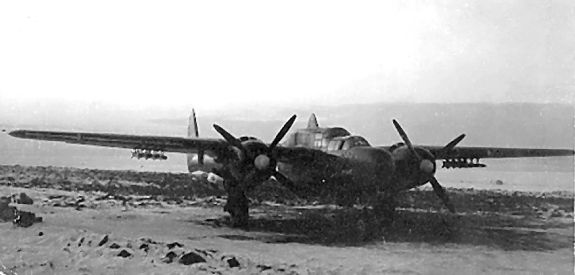
P-61 425th Squadron at Étain-Rouvres Air Base, France, with rockets mounted, c. 1944.
In early August 1944, the 422nd NFS transferred to Maupertus, France, and began to encounter German aircraft for the first time. On the night of 14th–15th August 1944, “Impatient Widow”, attempted to intercept a Heinkel He 177A-5 of 5.Staffel/Kampfgeschwader 40, flown by Hptm. Stolle. “Impatient Widow” had its starboard engine shot out along with oil lines and hydraulics, and went down north of Barfleur, Normandy. The downing was witnessed by two other Heinkels.
However, a P-61 shot down a Bf 110, and shortly afterwards, the squadron’s commanding officer Lieutenant Colonel O. B. Johnson, his P-61 already damaged by anti aircraft land fire, shot down a Fw 190. The 425th NFS scored its first kill shortly afterwards.
In October 1944, a P-61 of the 422nd NFS, now operating out of Florennes Air Base (Belgium), abandoned by the Luftwaffe in the German retreat, encountered a Messerschmitt Me 163 attempting to land. The P-61 tried to intercept it but the rocket-powered aircraft was gliding too fast. A week later, another P-61 spotted a Messerschmitt Me 262, but was also unable to intercept the jet. On yet another occasion, a 422nd P-61 spotted a Messerschmitt Me 410 Hornisse flying at tree top level but, as the P-61 dove on it, the “Hornet” sped away and the P-61 was unable to catch it. Contrary to popular stories, no P-61 ever engaged in combat with a German jet or any of the late war advanced Luftwaffe aircraft.
The most commonly encountered and destroyed Luftwaffe aircraft types were Junkers Ju 188s, Junkers Ju 52s, Bf 110s, Fw 190s, Dornier Do 217s, and Heinkel He 111s, while P-61 losses were limited to numerous landing accidents, bad weather, friendly and anti aircraft land fire. One researcher suggests 42-39515 may have been shot down by an Fw 190 of Nachtschlachtgruppe 9.
The absence of turrets and gunners in most European Theater P-61s presented several unique challenges. The 422nd NFS kept its radar operator in the rear compartment, meaning the pilot had no visual contact with the operator. As a result, several pilots continued flying their critically damaged P-61s under the mistaken belief that their radar operator was injured and unconscious, when in fact he had already bailed out. The 425th NFS moved the radar operator to the gunner’s position behind the pilot. This provided an extra set of eyes up front and moved the aircraft’s center of gravity about 15 in (380 mm) forward, changing the flight characteristics from slightly nose up to slightly nose down, which improved the P-61’s overall performance.
By December 1944, P-61s of the 422nd and 425th NFS were helping to repel the German offensive known as the Battle of the Bulge, with two flying cover over the town of Bastogne. Pilots of the 422nd and 425th NFS switched their tactics from night fighting to daylight ground attack, strafing German supply lines and railroads. The P-61’s four 20 mm cannon proved effective in destroying German locomotives and trucks.
The 422nd NFS produced three ace pilots and two ace radar operators (radar operators and gunners shared kills with the pilot), while the 425th NFS officially claimed none. Lieutenant Cletus “Tommy” Ormsby of the 425th NFS was officially credited with three victories. Ormsby was killed by friendly fire moments after attacking two Junkers Ju 87s on the night of 24th March 1945. His radar operator escaped with serious injuries, and was saved only by the quick actions of German surgeons. He later reported that they had successfully engaged and shot down both Ju 87s before being shot down themselves. This claim was corroborated by other 425th aircrew who were operating in the area at the time.
Mediterranean Theatre
In the Mediterranean Theatre, most night fighter squadrons exchanged their aging Bristol Beaufighters for P-61s too late to achieve any kills in the “Black Widow”
CBI Theatre
P-61s of the China-Burma-India (CBI) Theater were responsible for patrolling a larger area than any night-fighter squadrons of the war. The P-61 arrived too late in the CBI Theater to have any significant impact, as most Japanese aircraft had already been transferred out of the CBI Theatre by that time in order to participate in the defense of the Japanese Homeland.
Pacific Theatre
The 6th NFS based on Guadalcanal received their first P-61s in early June 1944. The aircraft were quickly assembled and underwent flight testing as the pilots changed from the squadron’s aging P-70s. The first operational P-61 mission occurred on 25th June, and the type scored its first kill on 30th June 1944 when a Japanese Mitsubishi G4M “Betty” bomber was shot down.
In the summer of 1944, P-61s in the Pacific Theatre saw sporadic action against Japanese aircraft. Most missions ended with no enemy aircraft sighted but when the enemy was detected they were often in groups, with the attack resulting in several kills for that pilot and radar operator, who would jointly receive credit for the kill.
In the Pacific Theatre in 1945, P-61 squadrons struggled to find targets. One squadron succeeded in destroying a large number of Kawasaki Ki-48 “Lily” Japanese Army Air Force twin-engined bombers, another shot down several Mitsubishi G4M “Bettys,” while another pilot destroyed two Japanese Navy Nakajima J1N1 “Irving” twin-engined fighters in one engagement but most missions were uneventful. Several Pacific Theatre squadrons finished the war with no confirmed kills. The 550th could only claim a crippled B-29 Superfortress, shot down after the crew had bailed out having left the aircraft on autopilot.
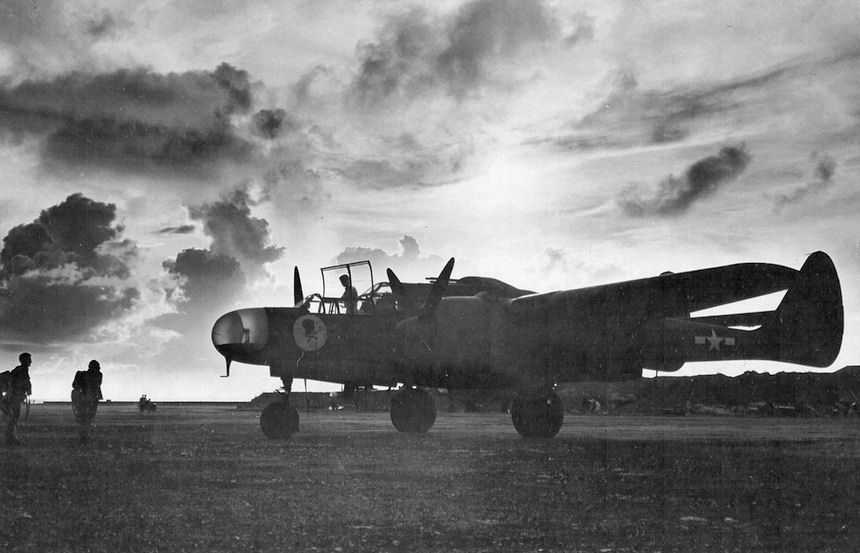
P-61A-1-NO Black Widow 42-5524, 6th Night Fighter Squadron, Being readied for a mission, East Field, Saipan, Mariana Islands, September 1944
On 30th January 1945, a lone P-61 performed a mission as part of the successful raid carried out by U.S. Army Rangers to free over 500 Allied POWs held by the Japanese at the Cabanatuan prison camp (Camp Pangatian) in the Philippines. As the Rangers crept up on the camp, a P-61 swooped low and performed aerobatics for several minutes. The distraction of the guards allowed the Rangers to position themselves, undetected within striking range of the camp.
Poet and novelist James Dickey flew 38 Pacific Theater missions as a P-61 radar operator with the 418th Night Fighter Squadron, an experience that influenced his work, and for which he was awarded five Bronze Stars. The 418th NFS produced the only US Army Air Force night fighter aces in the Pacific, a pilot-radar operator team.
Historian Warren Thompson wrote that “it is widely believed” that the last enemy aircraft destroyed in combat before the Japanese surrender was downed by a P-61B-2 named “Lady in the Dark” (s/n 42-39408) of the 548th NFS. The aircraft piloted by Lieutenant Robert W. Clyde and R/O Lieutenant Bruce K. LeFord on 14th/15th August 1945 claimed a Nakajima Ki-44 “Tojo.” The destruction of the “Tojo” came without a shot being fired; after the pilot of the “Tojo” sighted the attacking P-61, he descended to wave-top level and began a series of evasive maneuvers. These ended with his aircraft striking the water and exploding. Clyde and LeFord were never officially credited with this possible final kill of the war.
Credit for kills
Since pilots and radar operators did not always fly as a team, the kills of the pilot and radar operator were often different. On some occasions, a pilot or radar operator with only one or two kills would fly with a radar operator or pilot who was already an ace.
Summary
Though the P-61 proved itself capable against most German aircraft it encountered, it was outclassed by the new aircraft arriving in the last months of World War II. It also lacked external fuel tanks until the last months of the war, an addition that would have extended its range and saved many doomed crews looking for a landing site in darkness and bad weather. External bomb loads would also have made the type more suitable for the ground attack role it soon took on in Europe. These problems were all addressed eventually, but too late to have the impact they might have had earlier in the war. The P-61 proved capable against all Japanese aircraft it encountered, but saw too few of them to make a significant difference in the Pacific war effort.
Postwar military service
The useful life of the Black Widow was extended for a few years into the immediate postwar period due to the USAAF’s problems in developing a useful jet-powered night/all-weather fighter.
In Europe, the United States Air Forces in Europe was organized on 7 August 1945. Its night fighter force was organized with the 415th NFS at AAF Station Nordholz on 2nd October; the 417th NFS at AAF Kassel-Rothwesten on 20th August, and the 416th NFS at AAF Station Hörsching, Austria. The 414th, 422d and 425th became non-operational and their personnel were returned to the United States. The 414th’s P-61s were transferred to the 416th which was equipped with British de Havilland Mosquitos. High-hour aircraft were scrapped and P-61s in excess of operational needs were mothballed at the Erding Air Depot, Germany. All of these units were inactivated by the end of 1946, personnel and most aircraft being assigned to the 52d Fighter Group. Excess and mothballed Black Widows at Erding were sent to reclamation at Oberpfaffenhofen Air Depot near Munich.

Air Defense Command 318th Fighter Squadron Northrop P-61B-20-NO Black Widow 43-8279, Hamilton Field, California, December 1947.
In the Pacific, the 426th, 427th 548th and 550th NFS were inactivated by the end of 1945. As part of the Occupation force in Japan, the 418th and 547th NFS were transferred from Okinawa and Ie Shima to Atsugi Airfield, Japan, and the 421st NFS was reassigned from Ie Shima to Itazuke Airfield, Japan. The 6th, 418th and 421st were all inactivated, their personnel and aircraft being consolidated under the 347th Fighter Group in February 1947. They became the 339th, 4th and 68th Fighter Squadrons respectively. The 419th in the Philippines and the 449th on Guam were both inactivated. Many P-61s in the Pacific that were deemed “war weary” met their fate at reclamation facilities established on Luzon.
P-61s returned to the United States which were considered still operational were organized and allocated to the three new Major Commands established by the 21 March 1946 USAAF reorganization. All of these CONUS-based commands were allocated squadrons which were non-operational that had to be manned and equipped.
To Strategic Air Command the 57th and 58th Reconnaissance Squadrons (Weather) were assigned P-61s. The 57th and 58th NFS had been initially part of Third Air Force, Continental Air Forces and were equipped with early-model P-61Bs that had been used for training pilots in California before being reassigned to Rapid City Army Air Base, South Dakota. Under Third Air Force they were engaged in Weather Reconnaissance training immediately after the war, but the rapid demobilization of the AAF led to the 57th being inactivated by the end of the year, and 58th followed suit in May 1946.
Tactical Air Command was assigned the 415th NFS, and Air Defense Command was assigned the 414th and 425th NFS. The 414th was almost immediately transferred to TAC. Both the 414th and 415th were equipped and manned at Shaw Field, South Carolina, and by early 1947 were operationally ready. The 414th was deployed to Caribbean Air Command for defense of the Panama Canal, and the 415th was deployed to Alaskan Air Command for long-range air defense against Soviet aircraft stationed across the Bering Sea in Siberia. Both of these squadrons were soon transferred to the overseas commands by TAC, and were redesignated as Fighter Squadrons.
Air Defense Command organized its Black Widow units with the 425th NFS being reassigned to McChord Field, Washington and the new 318th Fighter Squadron at Mitchel Field, New York, in May 1947. A month later, the 52d Fighter Group (with the 2d and 5th Fighter Squadrons) were returned from Germany. With the 52d operational, the 325th Fighter Group at McChord was reassigned to Hamilton Field, near San Francisco, with the 317th and 318th squadrons. All of these squadrons were equipped with P-61Bs drawn from storage depots in the southwest. With the change in the USAF’s aircraft designation system in June 1948, all P-61s became F-61s and all F-15As became RF-61Cs. Buzz Letters “FH” were assigned.
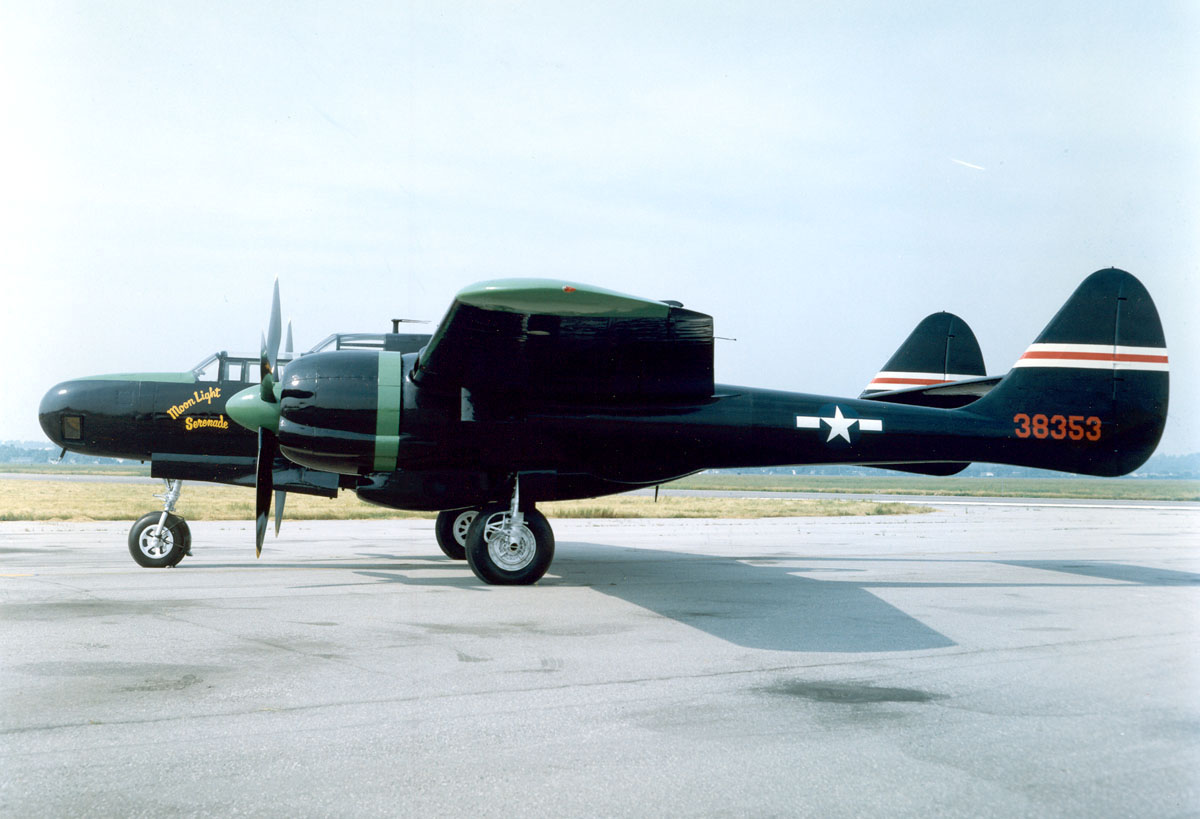
DAYTON, Ohio — Northrop P-61C Black Widow at the National Museum of the United States Air Force. (U.S. Air Force photo)
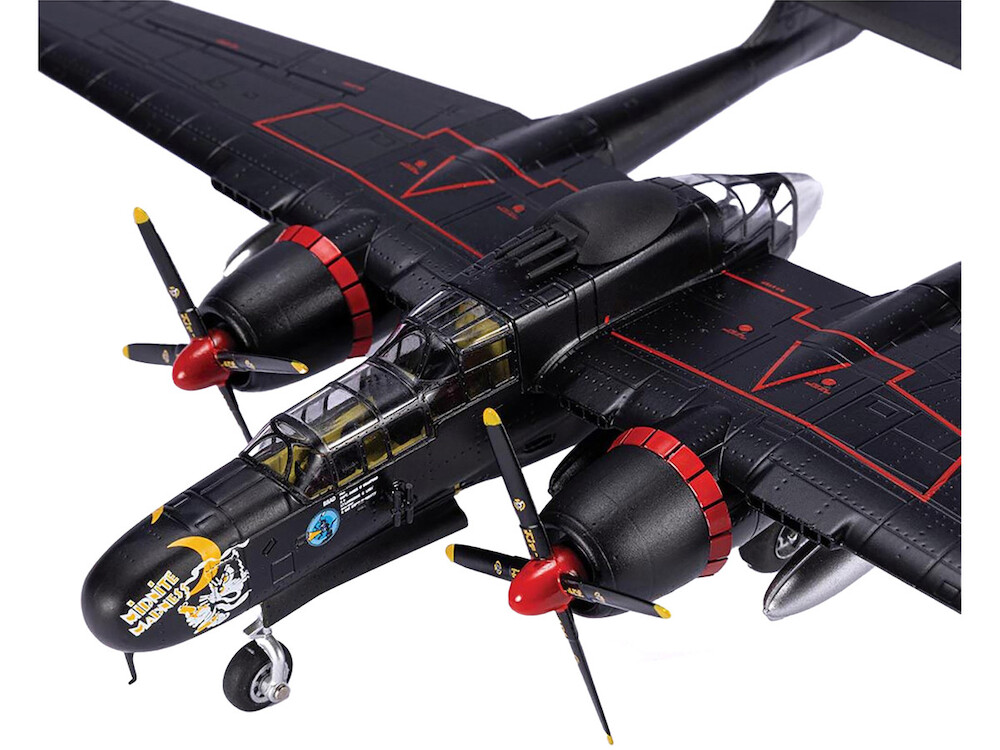
Air Force One 1/72nd scale diecast models of the P-61 Black Widow available from Flying Tigers.
Check out the Air Force One 1/72nd scale diecast models of the P-61 Black Widow available and now in stock at Flying Tigers. Please click on the image/link of your choice below to go straight to the model page and see the full model picture gallery of each model.


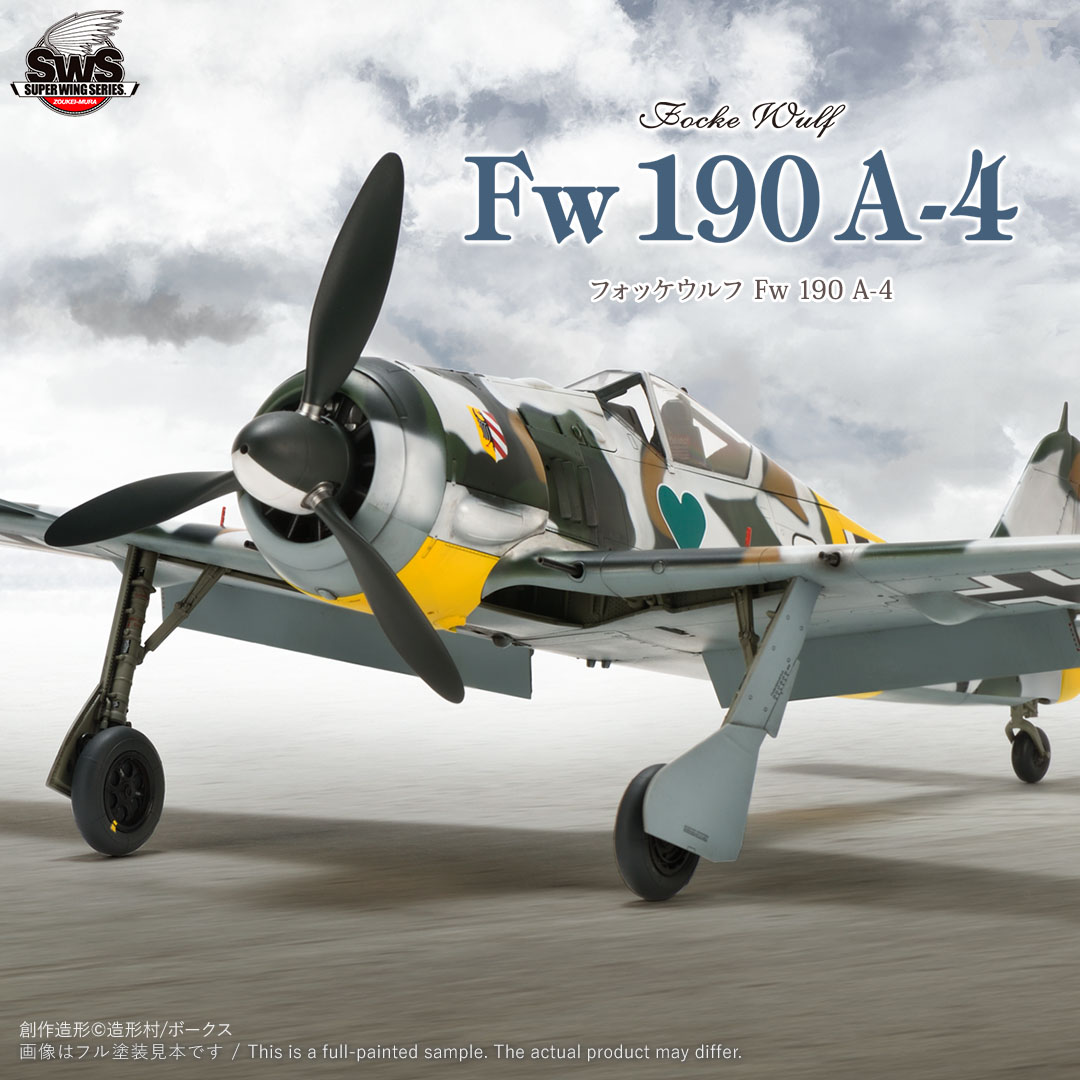
Zoukei Mura 1/32nd scale kit Focke Wulf Fw190 A-4 available to pre-order from Flying Tigers.
Check out the latest 1/32nd scale model kit available from Zoukei-Mura and Flying Tigers. Pre-order period is limited (see photo below). Please click on the images or links below to go straight to the model page to order your now.

|
|
|
|
|
|
|
|
|
|
|
|
|
|
|
|
|
|
|
|
|
|
|
|
|
|
|
|
|
|
|
|
|
|
|
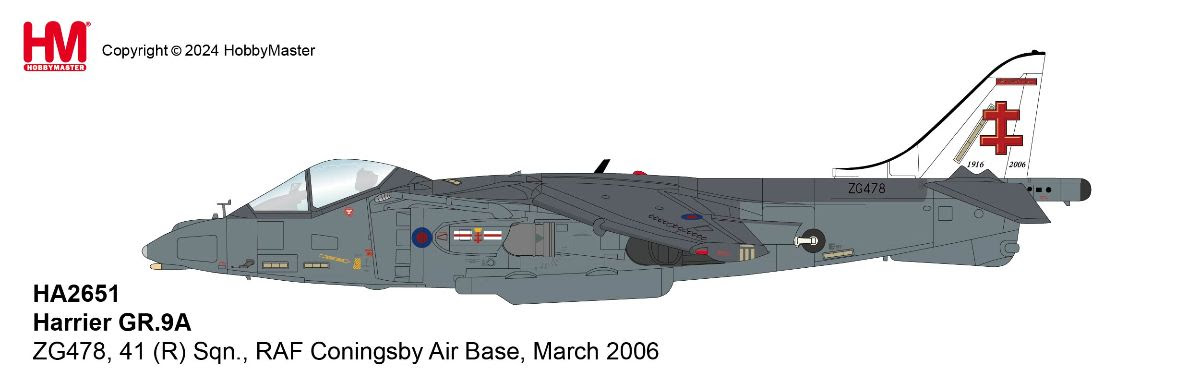
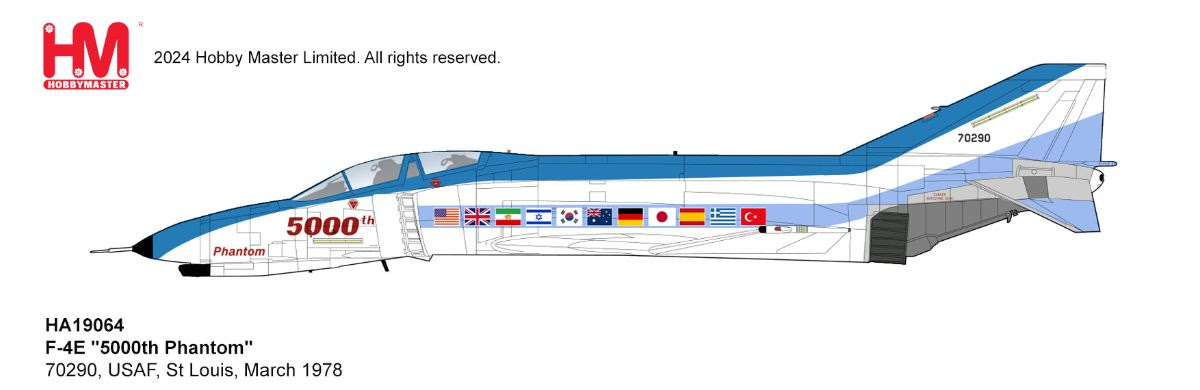
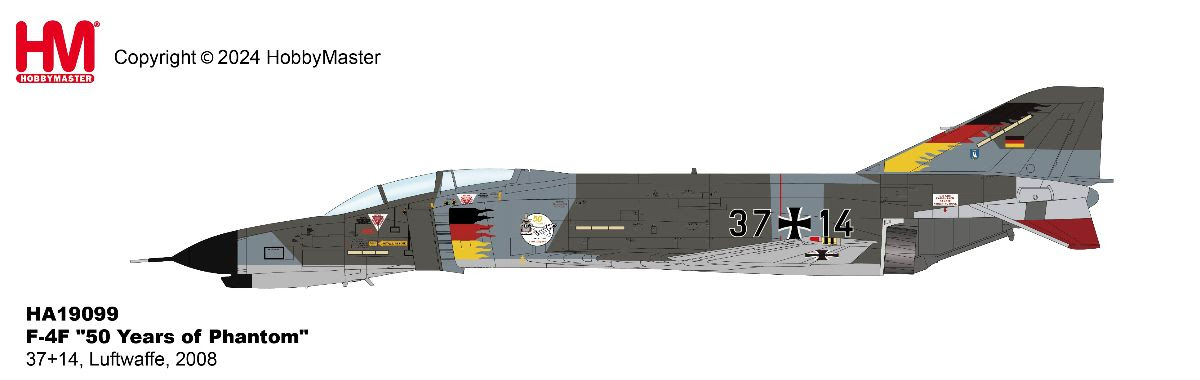
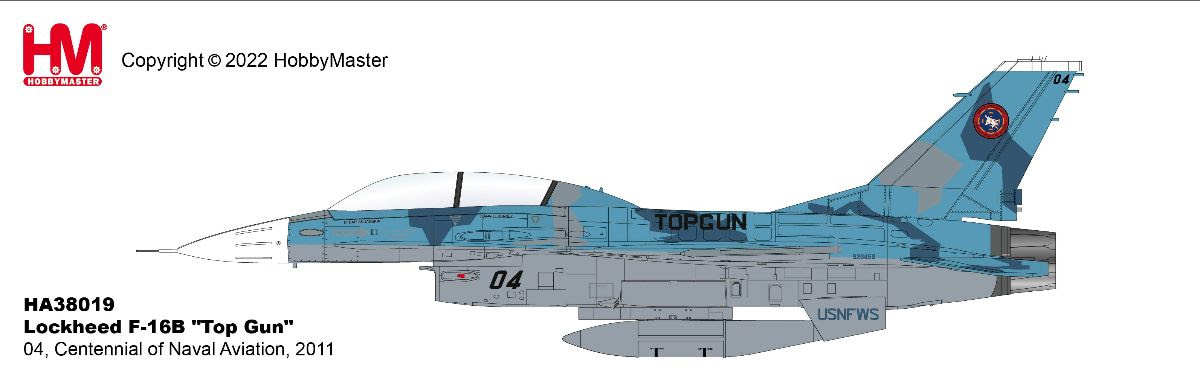
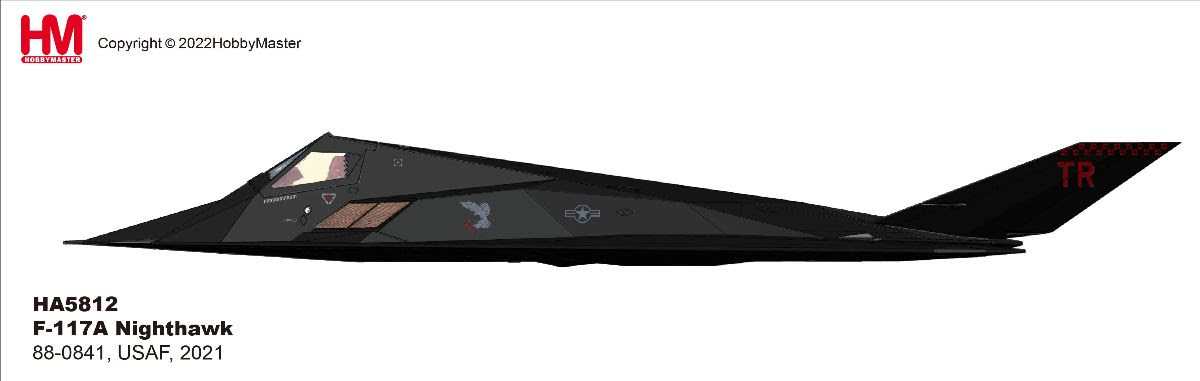
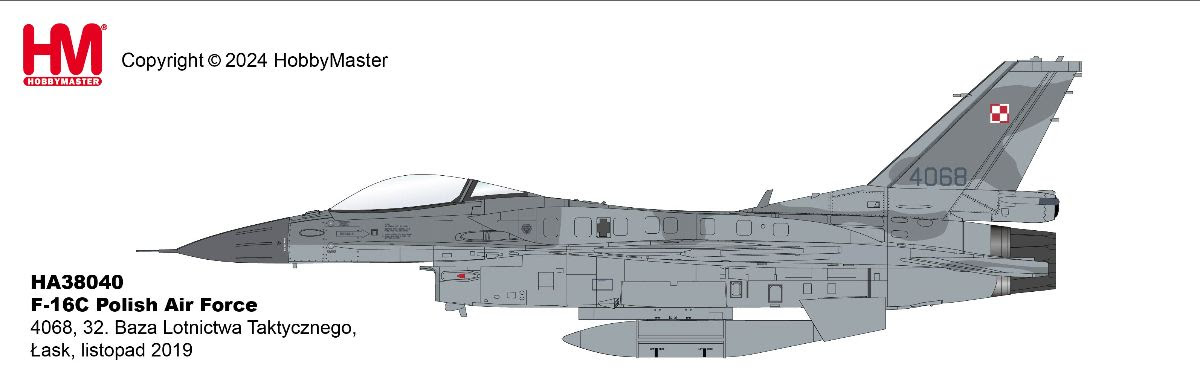
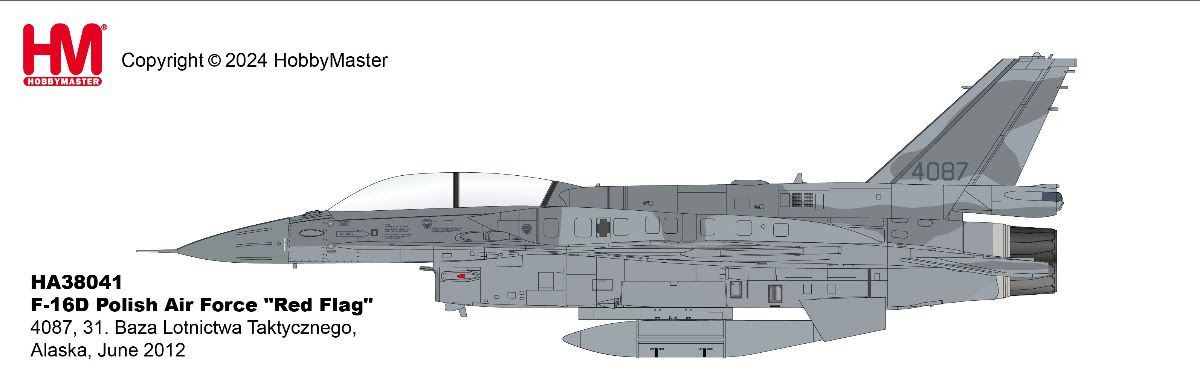
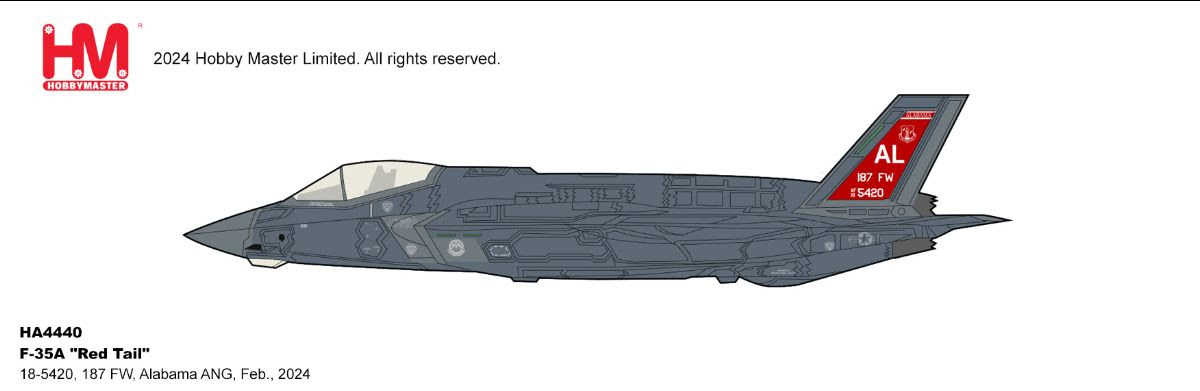
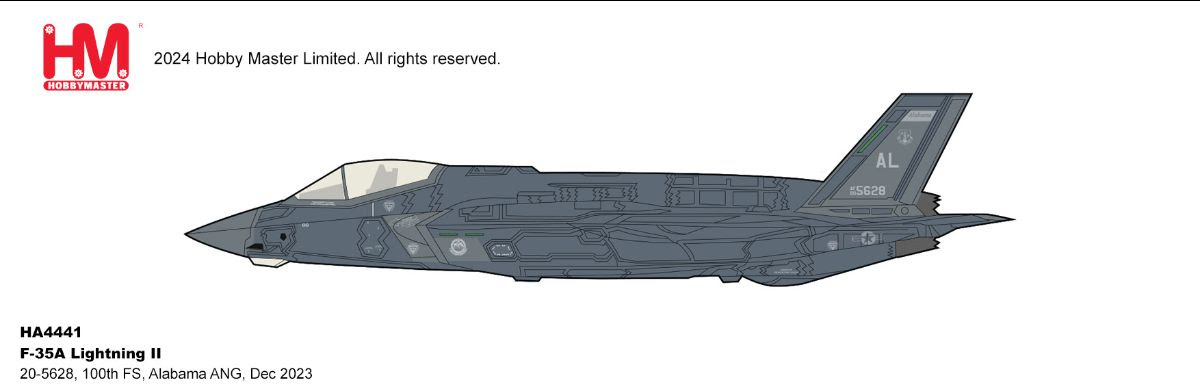
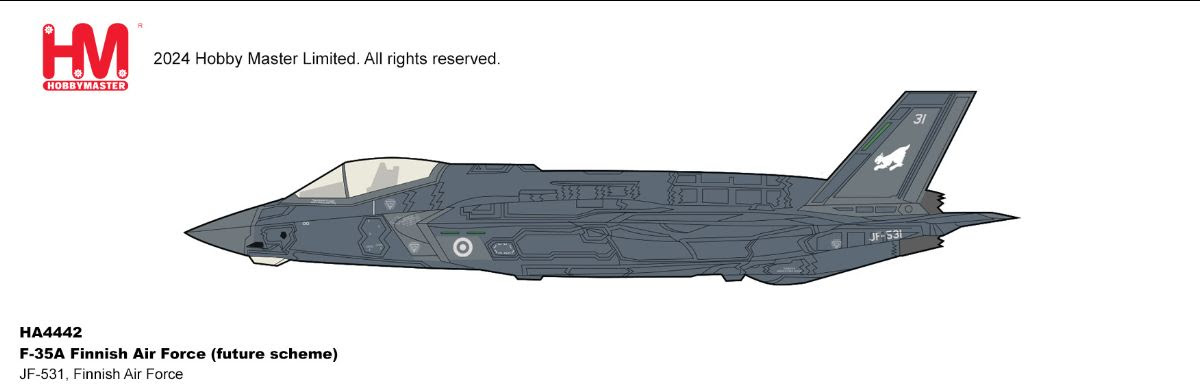
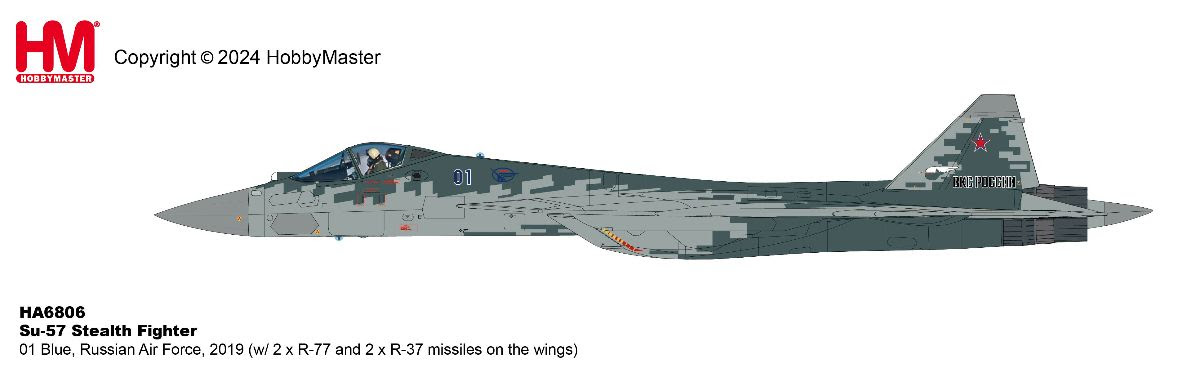
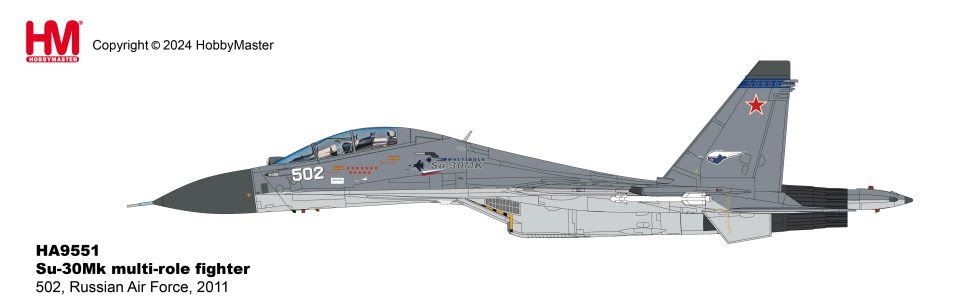
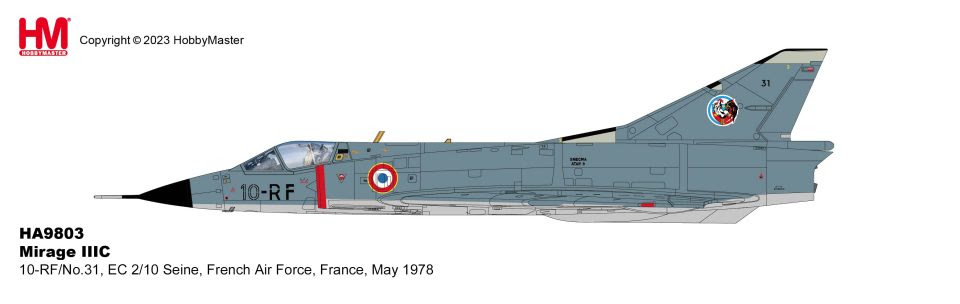
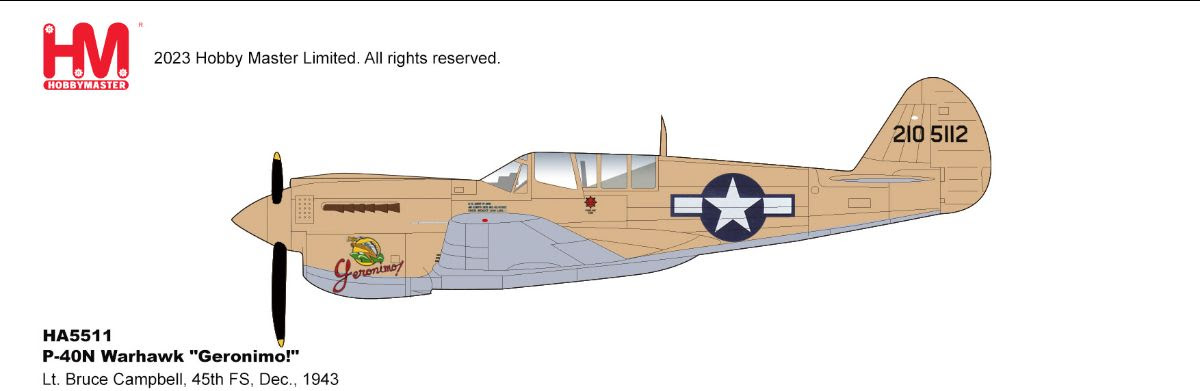
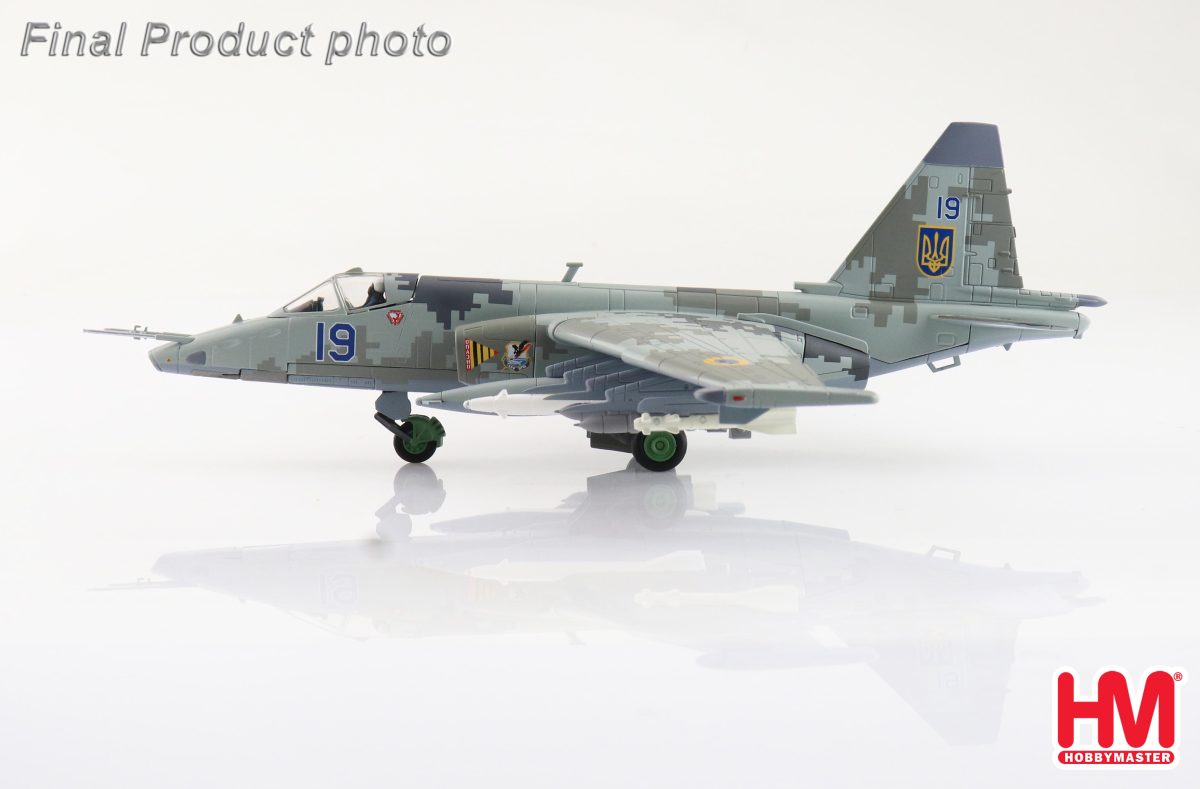
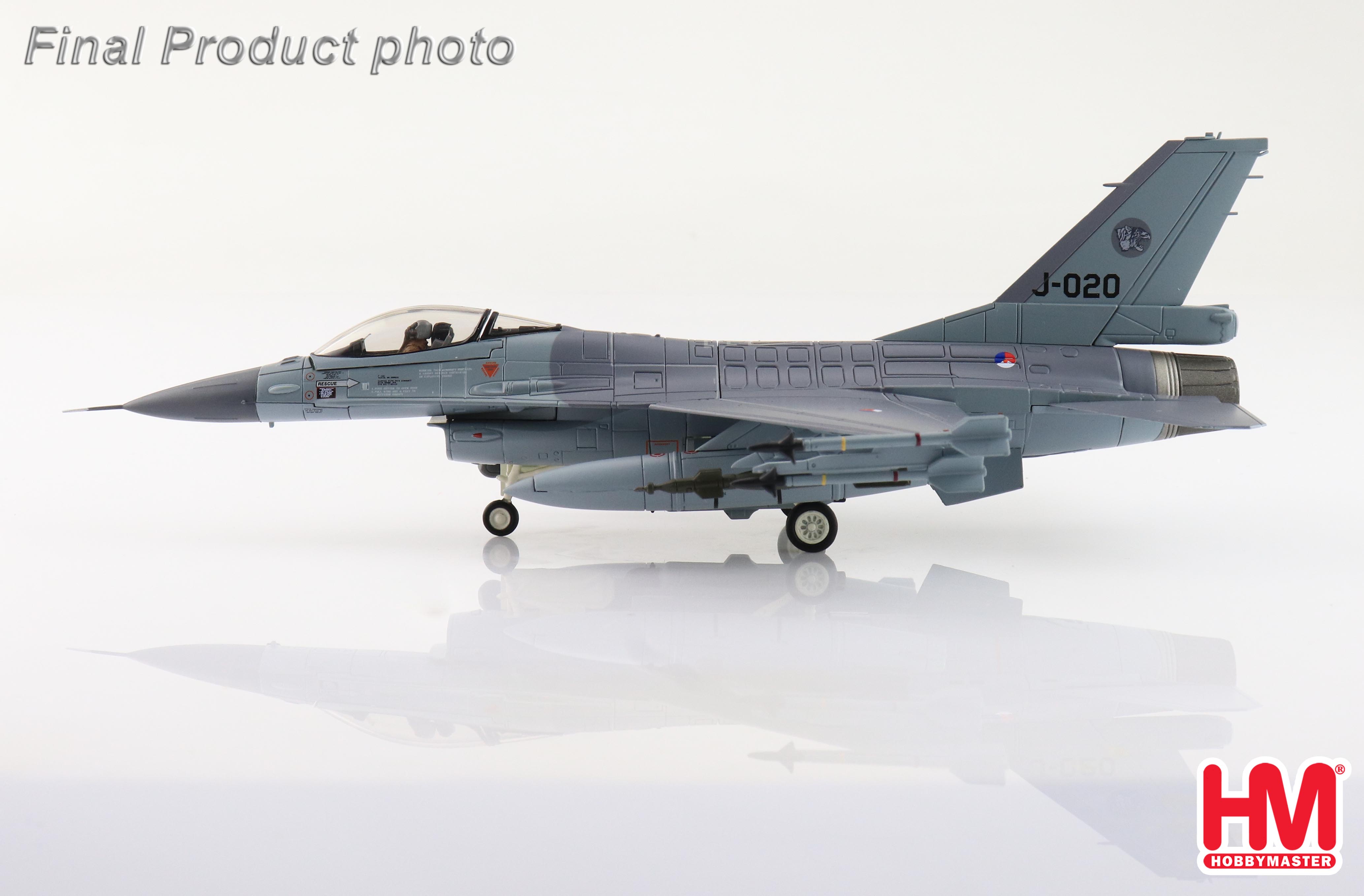
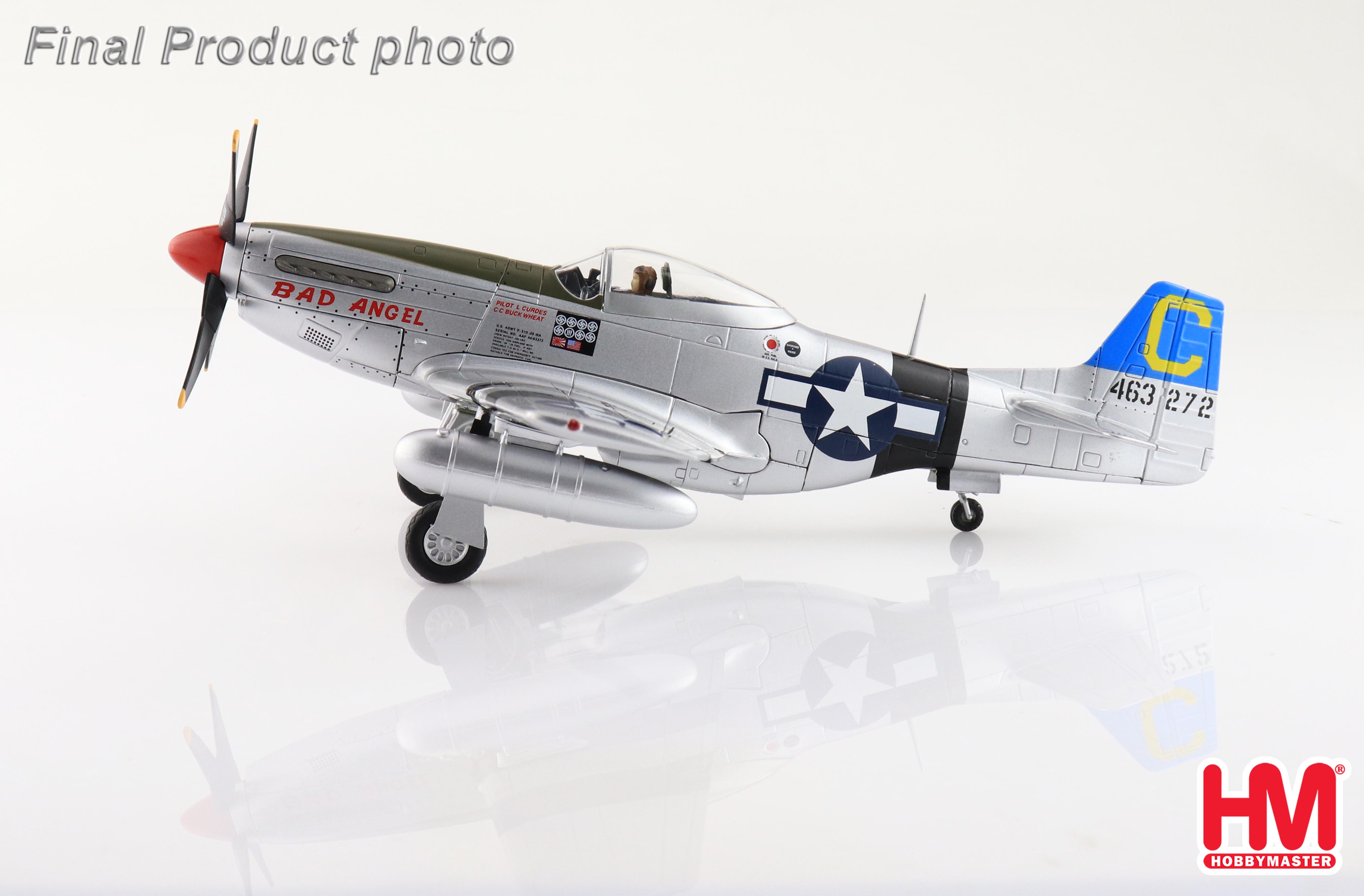
Hobbymaster updated photo gallery.
Check out the latest HM photos below. Please click on the images or links to go straight to the model page to order your model now.



|
|

|
|

|
|

|
|

|
|

|
|

|
|

|
|

|
|

|
|

|
|

|
|

|
|

|
|

|
|

|
|

|
|

|
|

|
|

|
Thank you for reading this week’s Newsletter.
Richard.
Flying Tigers.