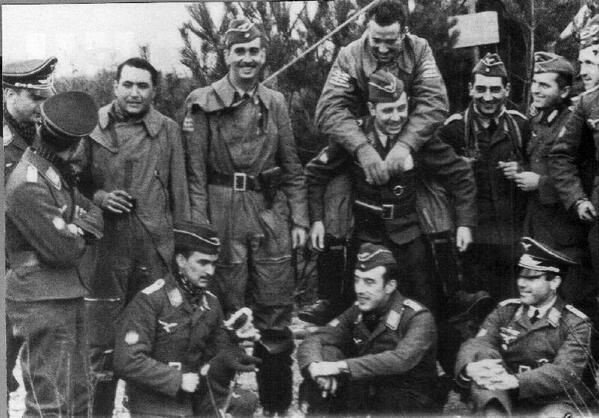
Pilots of the Blue Squadron at the Bjelov airfield, October 1941
The Blue Squadron is the name given to the group of volunteer pilots of the Spanish Air Force who during the Second World War fought alongside the Luftwaffe of Nazi Germany on the Russian Front as a counterpart to the help of the Germans with their Condor Legion, during the Spanish Civil War to the rebel side.
Between September 1941 and February 1943 five Spanish squadrons passed through the Eastern Front, assigned to the Jagdgeschwader 27 and Jagdgeschwader 51 fighter wings of the Luftwaffe.
Flying Messerschmitt fighters and Focke-Wulf fighter-bombers, Spanish pilots managed to credit the destruction of more than 160 Soviet aircraft in about two years, while losing 20 pilots to death in combat, missing or taken prisoner.21 The unit remained in central Russia, despite Muñoz Grandes’ requests for it to be attached to the Blue Division, until its complete withdrawal in early 1944.
Origins and development
In the Luftwaffe they were referred to by the name of 15. Spanische Staffel, attached to the 27th Fighter Wing (JG 27), an elite unit commanded by Wolfram von Richthofen (former Chief of Staff of the Condor Legion in the Spanish Civil War). In reality it was not a single squadron, but five squadrons that were relieved between 1941 and 1944, approximately every six months, to fight on the Russian front. Its emblem was based on that of the Blue Patrol of Joaquín García-Morato, leader of the national fighter aviation during the Spanish Civil War.
On the nose of the Messerschmitt Bf 109s of the 1st Squadron, the mechanics painted the emblem of García Morato’s hunting group, now accompanied by a Roman number two (II), in the case of the 1st Squadron (thus indicating the second fight of the members of the famous unit against communism); by the Cross of Santiago, in the 2nd; mounted on the German cross that identified the Luftwaffe aircraft, in the 3rd; superimposed on the symbol of the German hunt (the winged arrow, surrounded by a laurel wreath) on the 4th; and with a Roman numeral five (V) on the 5th, placed in the same position as the II of the 1st.
When the Francoist government decided to send an expeditionary force of volunteers, the so-called Spanish Volunteer Unit or Blue Division, to invade the Soviet Union, it decided that the ground contingent would be completed with an air component of a Fighter Squadron.
The Spanish Air Force was in many ways better prepared than the rest of the Army to join the German Army, as many of its pilots had flown alongside their German comrades in the Condor Legion in 1936-39 and knew the tactics and had put them into practice on countless occasions. Some pilots had already flown in the planes that were to be delivered to them. The Spanish air force hoped to gain knowledge and training by joining the Luftwaffe, and for this reason replacements were set up for pilots and expeditionary personnel when a period of only six months at the front had been completed.
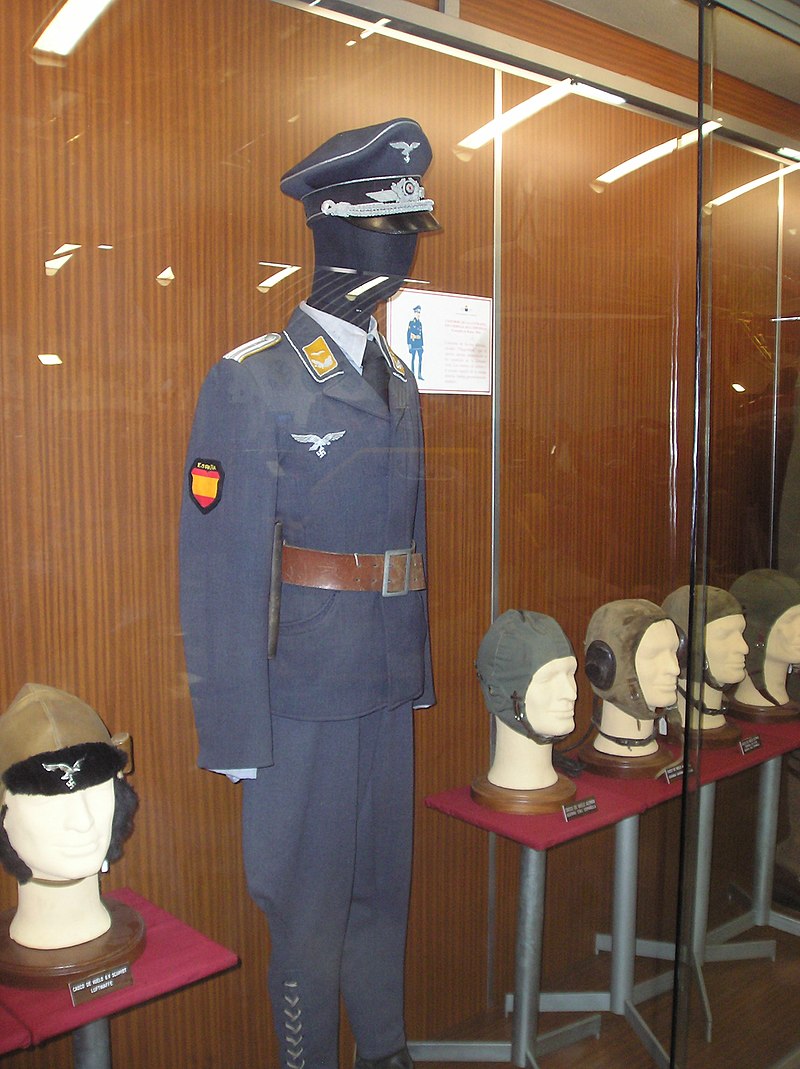
Uniform (2nd Leutnant-ensign) of a pilot of the blue squadron.
Description
1st Blue Squadron
- Commander Ángel Salas Larrazábal
- Composed of 17 pilots.
- During the stay in Russia, it flew 422 combat missions, such as bomber protection (particularly in the “Vyazma Pocket”) and free fighters. They took part in 94 dogfights, shooting down 14 aircraft. Their casualties totaled 5 officers (Cmte. Muñoz, Captain Aristides García López and Lts. Alcocer, Ruibal and Bartolomé) as well as several ground soldiers.
Officially constituted on July 14th, 1941 in Madrid. After crossing the French border, he arrived in Germany on 27th July. In addition to the Commander, the Flying Echelon was formed by his deputy, Cmte. José Muñoz-Jiménez: three captains and twelve lieutenants, all veterans of the Civil War. The Escalón de Tierra is commanded by the brother of Cmte. Ramón Salas Larrazábal. The Squadron was assigned to Jagdfliegerschule 1 in Werneuchen, near Berlin. During their two-month stay, they proceeded to the training of the Spanish pilots, which was not very popular since they were all seasoned veterans of the Spanish Civil War.
On 5th September, the Squadron receives its first fighter aircraft, twelve Messerschmitt Bf 109E-7/Bs. The Squadron departs for the front, its destination airfield is Minsk, and from there it goes to Smolensk first and finally to its airfield of operations: Moschna, NE of Smolensk. She joined the Russian Front on 24th September, as part of JG-27 (27th Fighter Wing). The Blue Squadron was the “15 Spanische Staffel”, JG-27 of the VIII Fliegerkorps, Luftflotte 2. The aircraft used were Messerschmitt Bf 109E (E-4, E-7) to which some more modern ME Bf 109F (F-2 and F-4) were added in December. The Squadron was ready to participate in the German assault on Moscow, known as “Operation Taifun” (Typhoon). The first mission was carried out on 2nd October, coinciding with the start of the operation.
On his second combat sortie, Lieutenant Luis Alcocer Moreno-Abella, a veteran of the Civil War and ace with 5 kills, and who was the son of the Mayor of Madrid Alberto Alcocer y Ribacoba, and nephew of the General of Aviation (who died a few months earlier) Luis Moreno-Abella Gil de Borja, Marquis of Borja, died in an accident, one of the pioneers of Spanish Military Aviation. Alcocer became the first casualty of the Blue Squadrons and, at the same time, the first to fall in a war mission of the Spanish Air Force. In November, two veteran pilots of the Spanish Civil War disappeared in action: Commander José Muñoz Jiménez-Millás, who had been appointed to command the 2nd Squadron, and Captain Arístides García López Rengel, an ace of the Spanish Civil War with 17 aircraft shot down. In April 1942, the squadron returned to Spain, leaving 5 pilots dead in Russia.
The 1st Blue Squadron operated from numerous bases: Moschina, to the S.W. of Smolensk, Bllelov, on the Moscow front, Kaliningrad, Staritz, Staritza, Rudsa (80 km from Moscow), Klin, Dugino, and Vitebsk, until its relief, on 7 April 1942. The first missions of the Squadron were close air support, since the E7-B version of the Bf 109 was a fighter-bomber, above the pocket formed in the Battle of Vyazma-Bryansk.
Subsequently, the Squadron would go on to carry out mainly protection work for German bombers and free fighters. In addition to using their Messerschmitts, some pilots employed the Henschel Hs 123s of a German unit operating alongside them, the I (Schl.)/LG 2, which they borrowed to perform some ground attack missions.
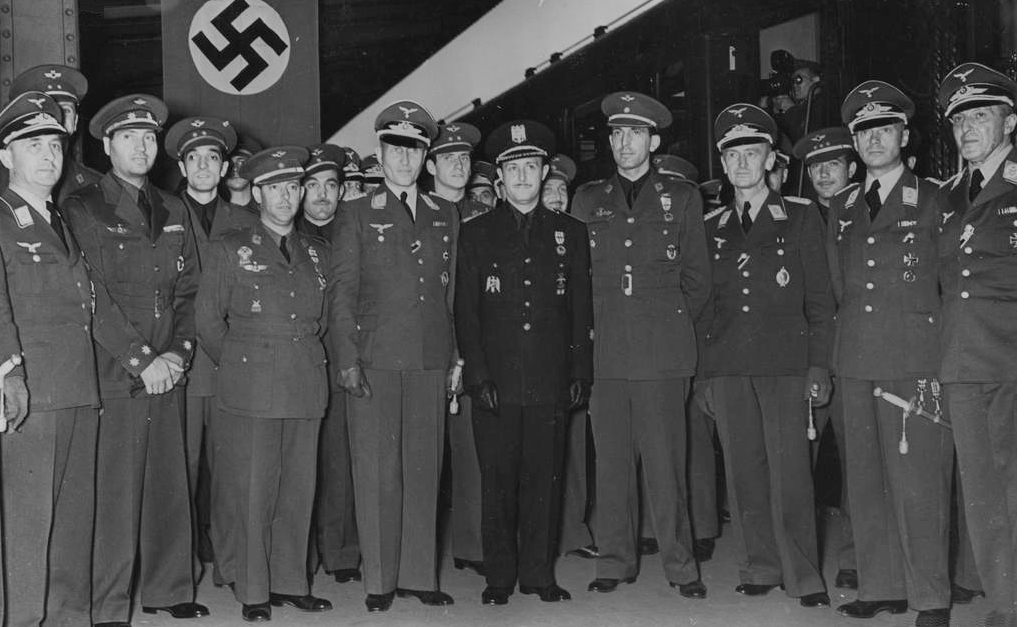
Members of the Blue Squadron in Germany, received by the Spanish ambassador in Berlin, José Finat.
2nd Blue Squadron
- Commander Julio Salvador y Díaz-Benjumea.
- Composed of 19 pilots.
- They participated in 1,312 flying missions and 117 dogfights, shooting down 13 aircraft. Three casualties were recorded (2 officers and 1 soldier).
It was established on February 6th, 1942 in Morón, and until March 2nd it received instruction at that base and at the Tablada base. On 8th June, the Squadron arrived at its base of operations at Orel-West Airfield, which was located right between Army Group Center’s southern flank and Army Group’s southern flank. The Squadron is now attached to JG-51 “Mölders”, as 15/JG 51. The unit received Messerschmitt Bf 109F-2 aircraft and was assigned a Junkers Ju 52/3m aircraft that made the Berlin-Squadron-Division route acting as a liaison and mail plane.
At first, the 2nd Squadron achieved 6 confirmed kills (and 4 more probable), with Captain Gavilán distinguishing himself in combat and having his first casualty, Captain Noriega. When the German offensive reached the Don Voronezh River, the offensive headed SE, towards Stalingrad, thus far from the base assigned to the Spaniards. This displacement of the combat would translate into minimal occasions of shooting down enemy aircraft in the following months, with Ensign Navarro and Corporal Zaro dying in mechanical accidents.
The 2nd Squadron returns from the Russian Front in November 1942.
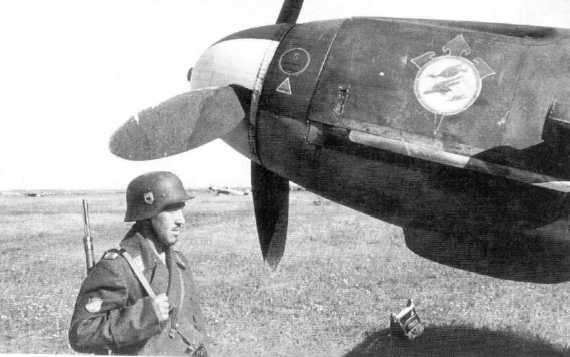
Me-109 belonging to the Blue Squadron
3rd Blue Squadron
- Commander Carlos Ferrándiz Arjonilla.
- Composed of 19 pilots.
- They participated in 1,716 flight missions, performing 112 engagements and shooting down 62 aircraft. The number of shootdowns is considerably higher than the previous ones, as the recovery of Soviet aviation is already remarkable. The 1st and 2nd had hardly any air opposition. On returning to Spain it had lost 5 pilots.
On September 1st, 1942, the 3rd Expeditionary Squadron was formed. His instruction began on the 17th in Tablada (Seville). On 23rd October, the 1st and 2nd Patrols departed for the advanced hunting training base of Saint Jean d’Angely, 50 km south of La Rochelle. The training there lasted just under a month, during which time it flew Bf 109F and G, Ar 96, Fw 56, Heinkel He 45 and Klemm Kl 35 aircraft, ending on 11th November.
On 1st December it begins its active service at Orel base, with aircraft that had previously served with the 2nd Squadron, although they will later receive some Bf 109F-4s. Since only two-thirds of its nominal pilot staff had been incorporated, 7 airmen from 2nd Squadron would remain attached to the new unit until the arrival of the rest of the contingent at the front.
The squadron continues with the Messerschmitt ME Bf 109F2s, but completed with some G4s. The front was quite active in the winter of 1942-43 and so on January 27th 7 enemy planes were shot down, between February 22nd and 24th 11 more, and between March 7th and 10th another 7. In mid-March, the continuous heavy bombing of the Orel base by the Soviet air force left the Squadron practically without aircraft. Since the surviving aircraft were already beginning to show intense wear and tear, it was decided to equip the unit with Fw 190 aircraft, in A-2 and A-3 versions. Instead of sending the Squadron to the rear to begin the conversion to the new aircraft, as was customary, it was decided to send a pilot to the JG-51 Staff Squadron. The chosen driver was Gonzalo Hevia, who at that time had 5 confirmed kills and spoke German.
On April 21st, 1943, pilots will be able to count on some Fw 190A-4s, with modified landing gear to improve stability on icy ground. The powerful armament of the Focke-Wulf will allow the 403 combats to score the downing of 16 enemy aircraft. The 2nd Squadron is committed to support the German retreat from the Rhzev salient. It began flying with the new aircraft on the 25th, and in addition a Patrol moved to Smolensk. In the following two months, until they were relieved by the 4th Squadron, 29 more enemy aircraft were shot down (it should be noted that there was only fighting for 6 days).
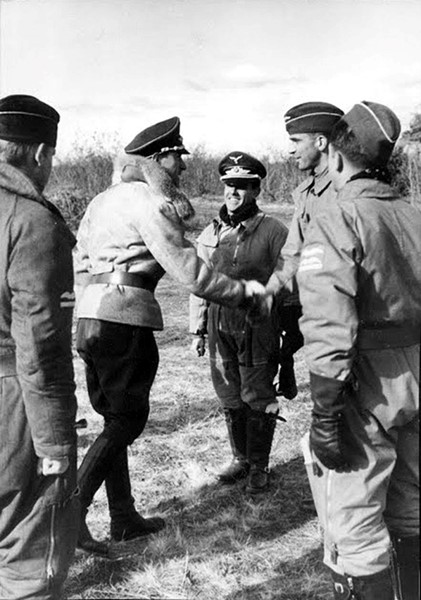
Oberstleutnant Werner Molders, meeting with Commander Muñoz
4th Blue Squadron
- Commander Mariano Cuadra Medina.
- Composed of 20 pilots.
- The first victory is achieved by Alf. José Mateos Recio the day after the arrival of the 4th Squadron, in partnership with Lt. Lucas, when shooting down a LAGG-5 in combat against nine opposing aircraft.
They participated in 1,918 flight missions, engaged in 277 aerial combats and shot down 74 aircraft, mainly in the different operations that are part of Operation Citadel. By the time it withdrew from the front in January 1944, it had lost 7 pilots (four officers killed and three missing), to which must be added three seriously wounded, representing 50% casualties. The 4th Squadron diversifies and multiplies its missions, particularly in ground attacks, covering the German retreat from Kharkiv. It is undoubtedly the most active squadron, with seven of its members receiving the individual military medal.
It was established in Alcalá de Henares on April 2nd, 1943, a base in which a month of training was completed. After this period, part of the nominal contingent of pilots was assigned to the Colomiers air base near Toulouse on 18th May. After another month of training at the German base, on June 15th part of his troops left for the front. As with the 3rd Squadron, the incorporation of the pilots to the front was done gradually, so that 4 pilots from the previous squadron were added until the arrival of the last Patrol of this new relief. Another novelty was the introduction of another Ju 52 link, registration CJAC, to replace the previous one during technical inspections and to better coordinate the long Madrid-Berlin flights.
He joined the front on 5th July 1943, just at the start of Operation Citadel, the German summer offensive in Kursk. It is part of JG-51, VIII Fliegerkorps, Luftflotte 4. They used the Focke-Wulf Fw 190 G and A-8, but casualties were replaced by Messerschmitt Bf 109G-6.
Because of their “inexperienced” status at the front, the Spanish pilots were assigned to bases relatively far from the Kursk salient: one patrol to Bryansk (the closest to the Kursk salient), another to Witebsk and the remaining to Seschtshinskaja. However, the first shot down of the squadron would come soon, on 7 July, at the hands of Alf. José Mateos Recio when he managed to shoot down a Lavochkin in unequal combat: 2 Spanish Fw 190 against 9 Soviet La-5s.
During August, the Soviet counterattack was especially intense in the central area of the front, over the Orel and Kharkov salients. It was precisely the area near Orel that was in charge of being defended by the Spanish pilots. Throughout the month, in the intense fighting of the later Battle of Orel, the highest number of victories in a single month to date was achieved: 43 enemy aircraft destroyed. In return, 2 pilots of the 3rd Patrol who had just joined in the same month were discharged.
In September, the German lines have no choice but to fall back in the face of the Soviet push, and the Blue Squadron with them. First to Smolensk, then to Orsha and finally to Stara-Bychow, make up the airfield changes made in that month. The front finally stabilizes in October, and the onset of winter paralyzes the vast majority of air operations. On 25th November, the Squadron moved permanently to Bobruisk, in Belarus, from where it carried out its last missions until it was relieved by the 5th Blue Squadron.

Blue Squadron pilot posing with his Me-109
5th Blue Squadron
- Commander Francisco Javier Murcia Rubio.
- Composed of 20 pilots and part of the same Fighter Group as the 4th, JG-51 (JagdGeschwader No. 51).
- They participated in 86 flight missions, participating in 6 combats without crediting any kills. He did not even join the full force, nor did he claim any demolition.
It was created on October 26th, 1943, in Alcalá de Henares. Given the direction the war was taking, the 1st Patrol crossed the French border with special security and discretion (the 2nd Patrol would do so even more incognito), arriving at the base of Saint Jean d’Angely on 27th November, where it would complete its training a month later. The 2nd Patrol was posted to another base, Bergerac, beginning training on 15th January and ending it on 6th February 1944.
The relief by the 5th Blue Squadron took effect on 23rd February 1944 at Bobruisk airfield, where the 1st and 2nd Patrols had already arrived (the 3rd would never reach the front). They would no longer receive service from the Ju 52 liaison troops, since the Spanish government had already made the decision to repatriate all the Spanish volunteers fighting in Russia from the front. In addition, the increasingly active Allied fighter posed a serious danger to these slow-moving Luftwaffe-bearing aircraft.
The squadron was equipped with Messerschmitt Bf 109G-6. This was a minor inconvenience for the Spanish pilots and mechanics, who had completed the training in France with Focke Wulf 190. He returned in June, losing a pilot (Lt. Segurola). The short period of stay at the front did not allow any enemy aircraft to be shot down and yet the loss of two Bf 109G-6s had to be endured, although not because of the enemy.

Spanish pilots of the Blue Squadron
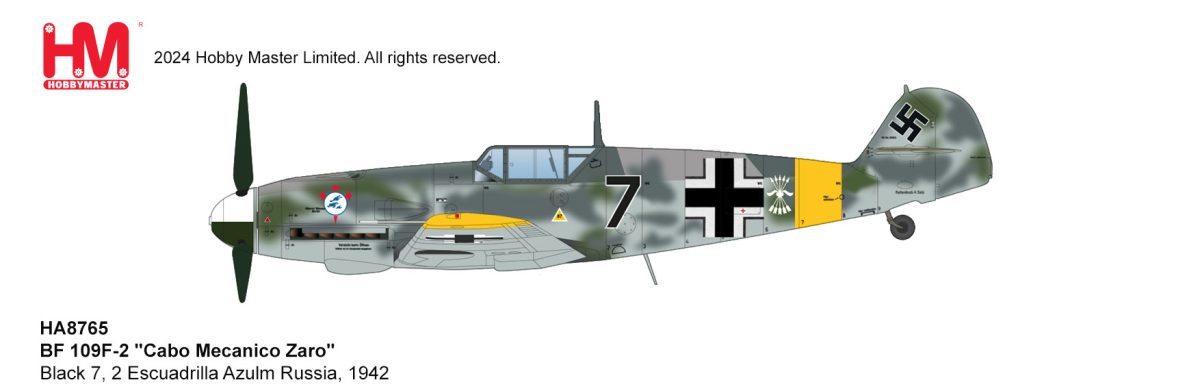
Hobbymaster 1/48th scale BF 109F-2 “Cabo Mecanico Zaro” Black 7, 2 Escuadrilla Azul, Russia, 1942
Check out the 1/48th scale BF 109F-2 “Cabo Mecanico Zaro” Black 7, 2 Escuadrilla Azul from Hobbymaster which is available to pre-order from Flying Tigers. Please click on the image or links below to go straight to the model page to order yours now.
Hobbymaster models now in stock at Flying Tigers.
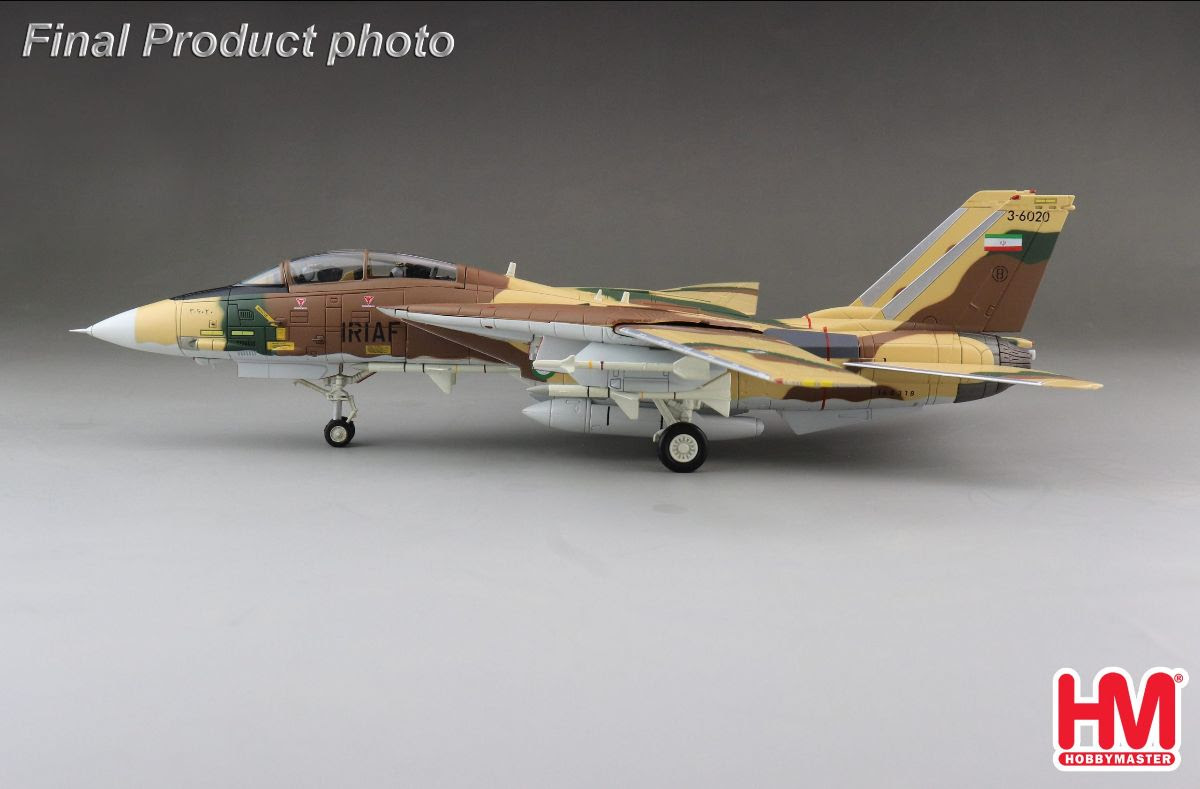
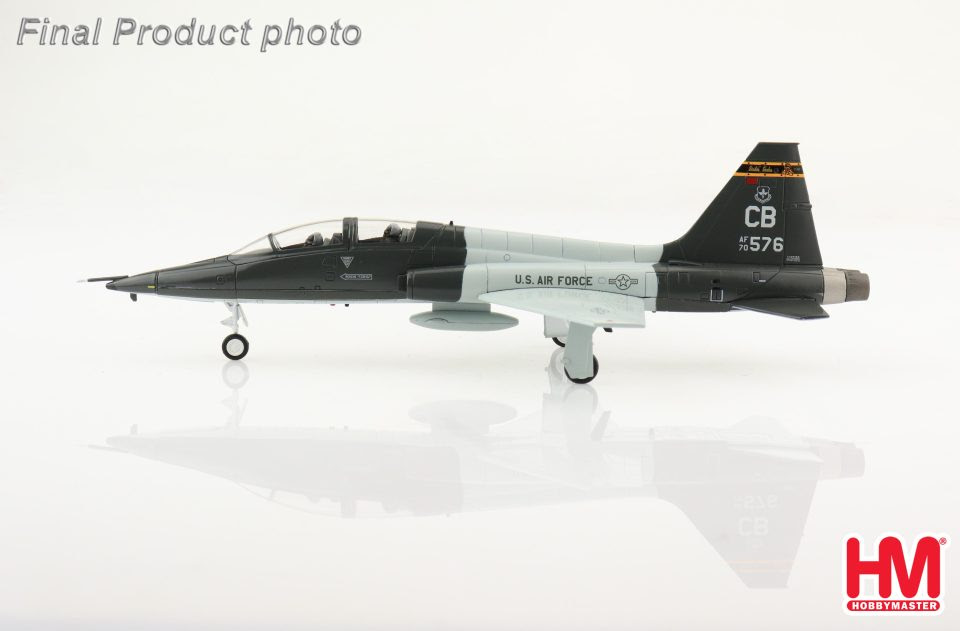
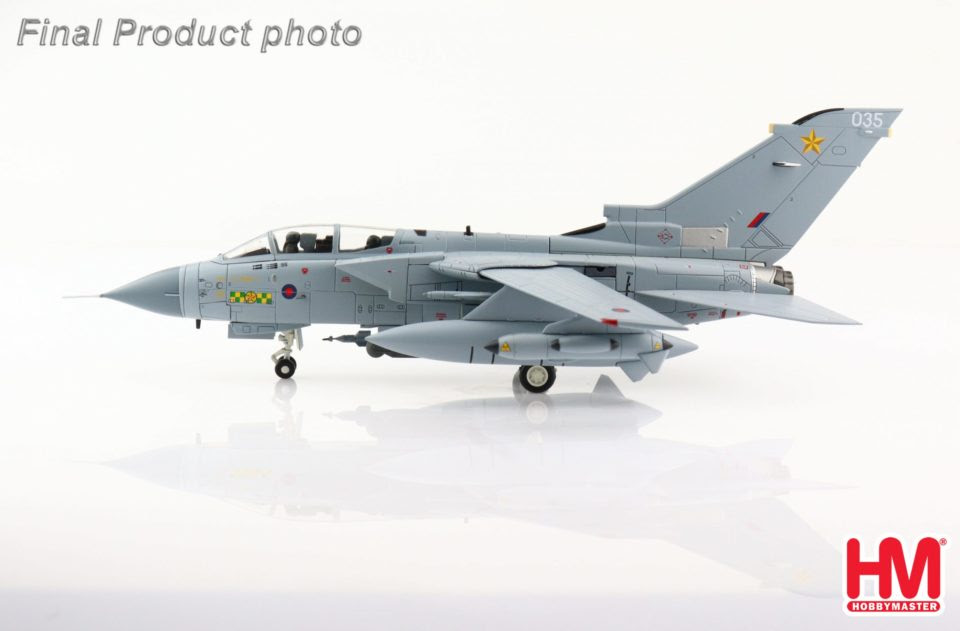
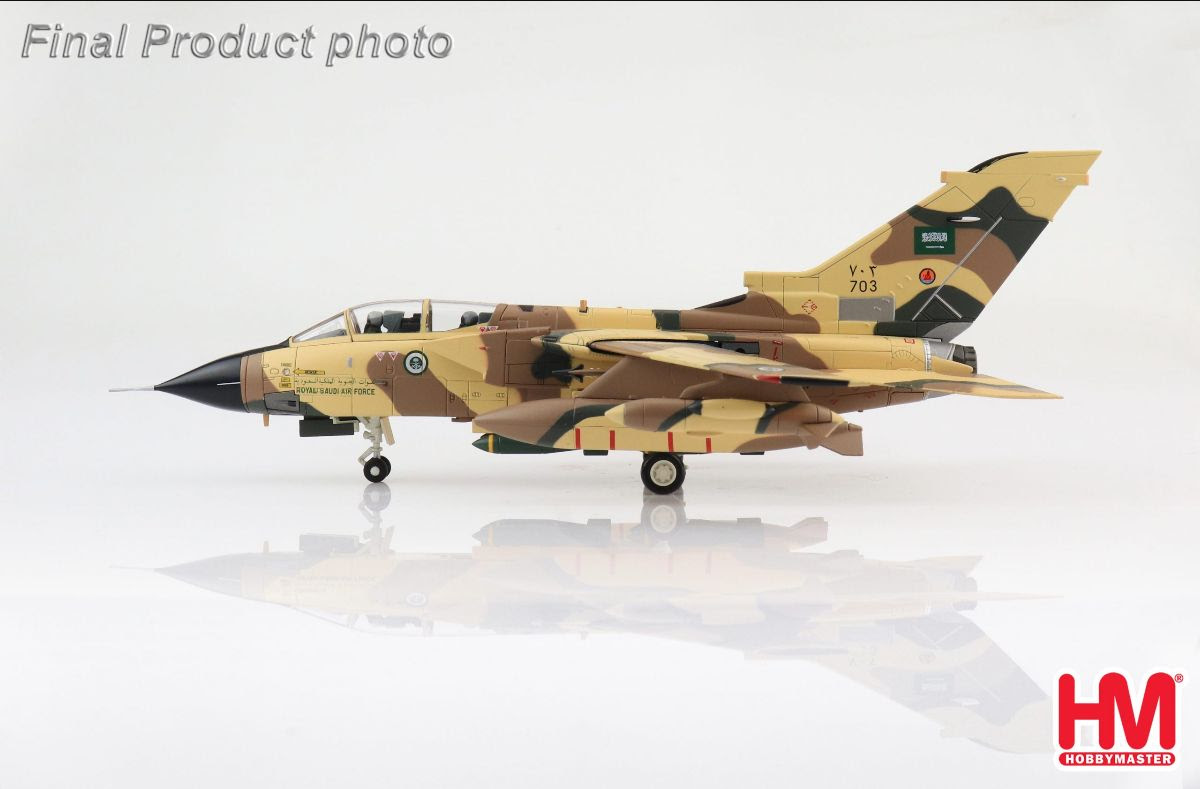
The following Hobbymaster models have just arrived at Flying Tigers and are now in stock today.
Flying Tigers will also consolidate your orders to save on postage costs across all brands !
Please click on the images / links below to go to the model of your choice, or CLICK HERE to see them all.
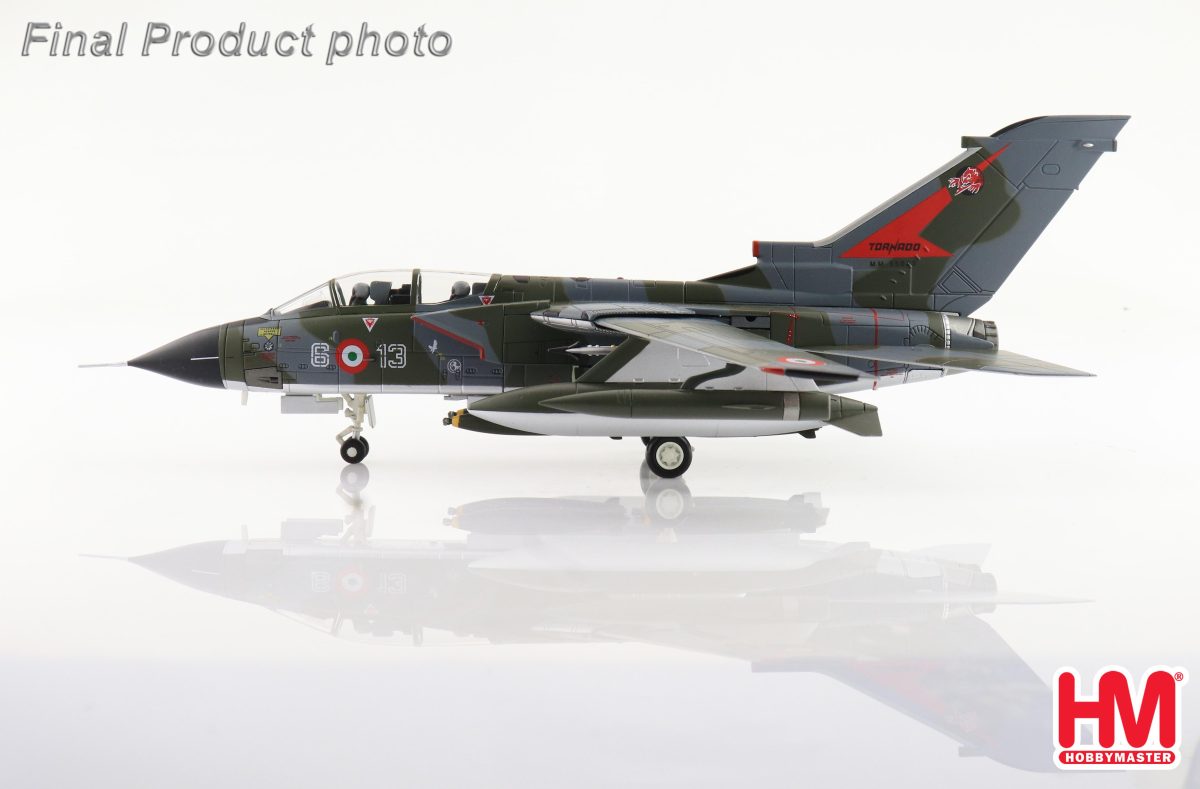
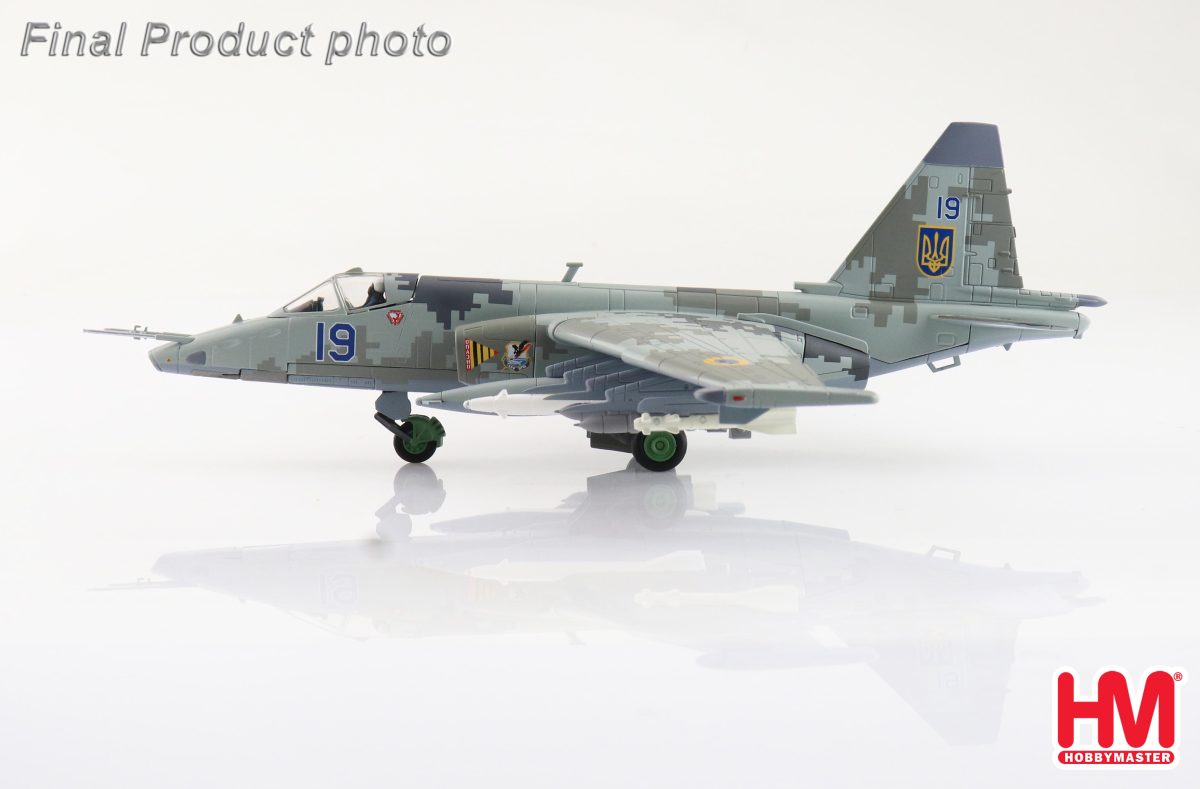
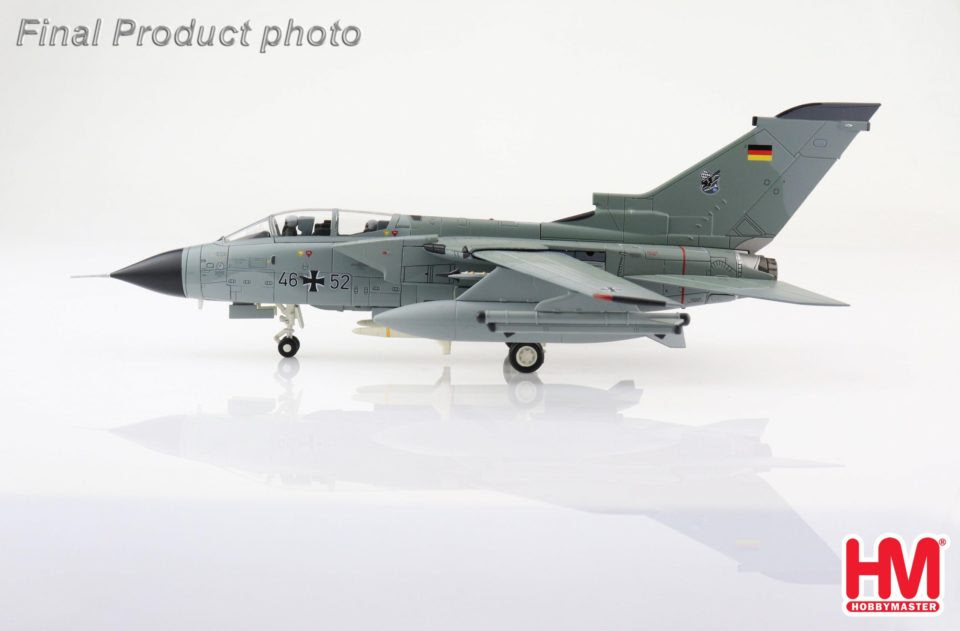
HA6720 Hobbymaster 1/72nd scale Tornado IDS 154° Gruppo “Red Devils”, 6º Stormo , Italian Air Force, 1980s RRP £104.00 Flying Tigers only £77.99 SORRY, SOLD OUT AT PRE-ORDER STAGE
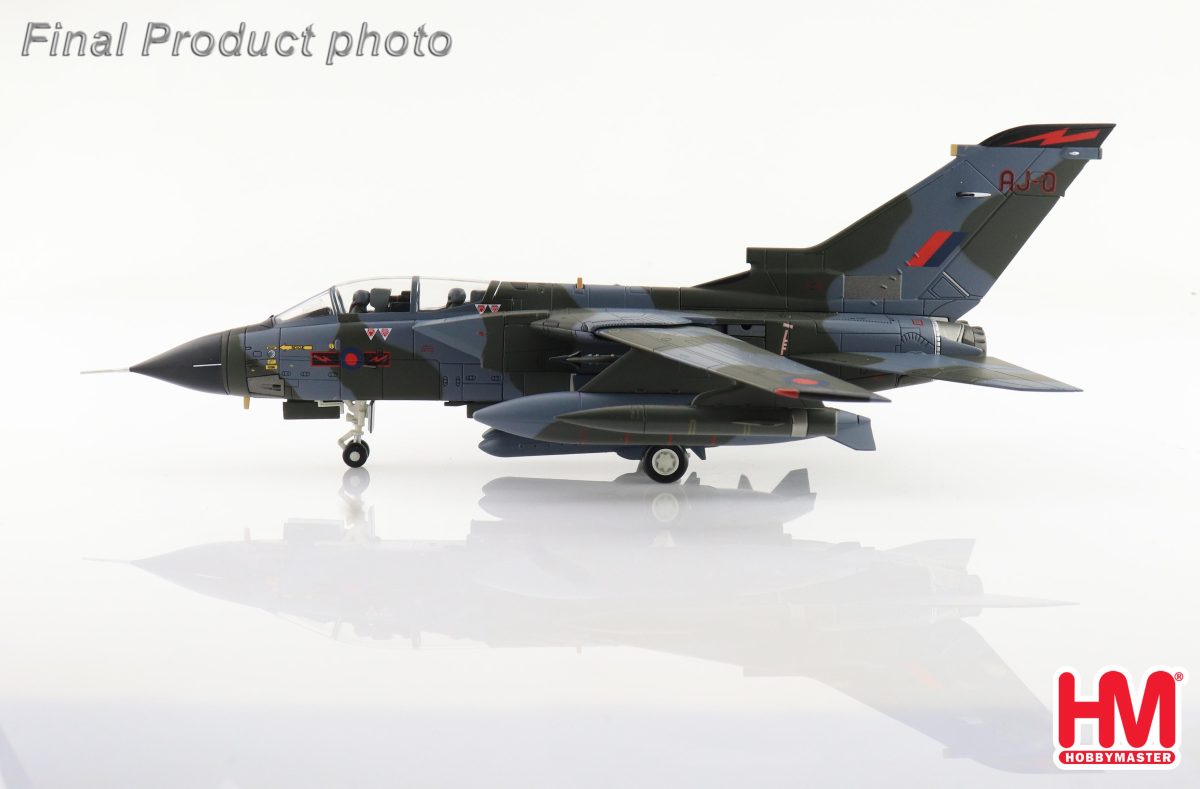
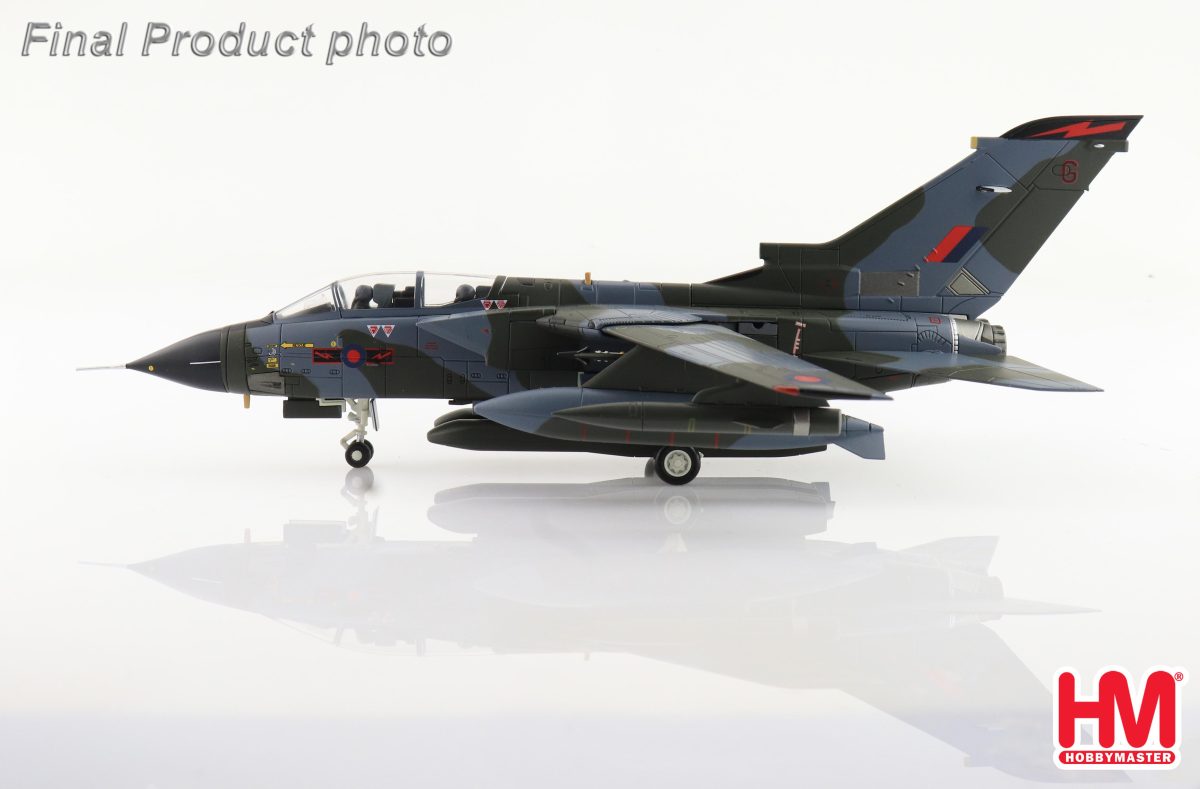
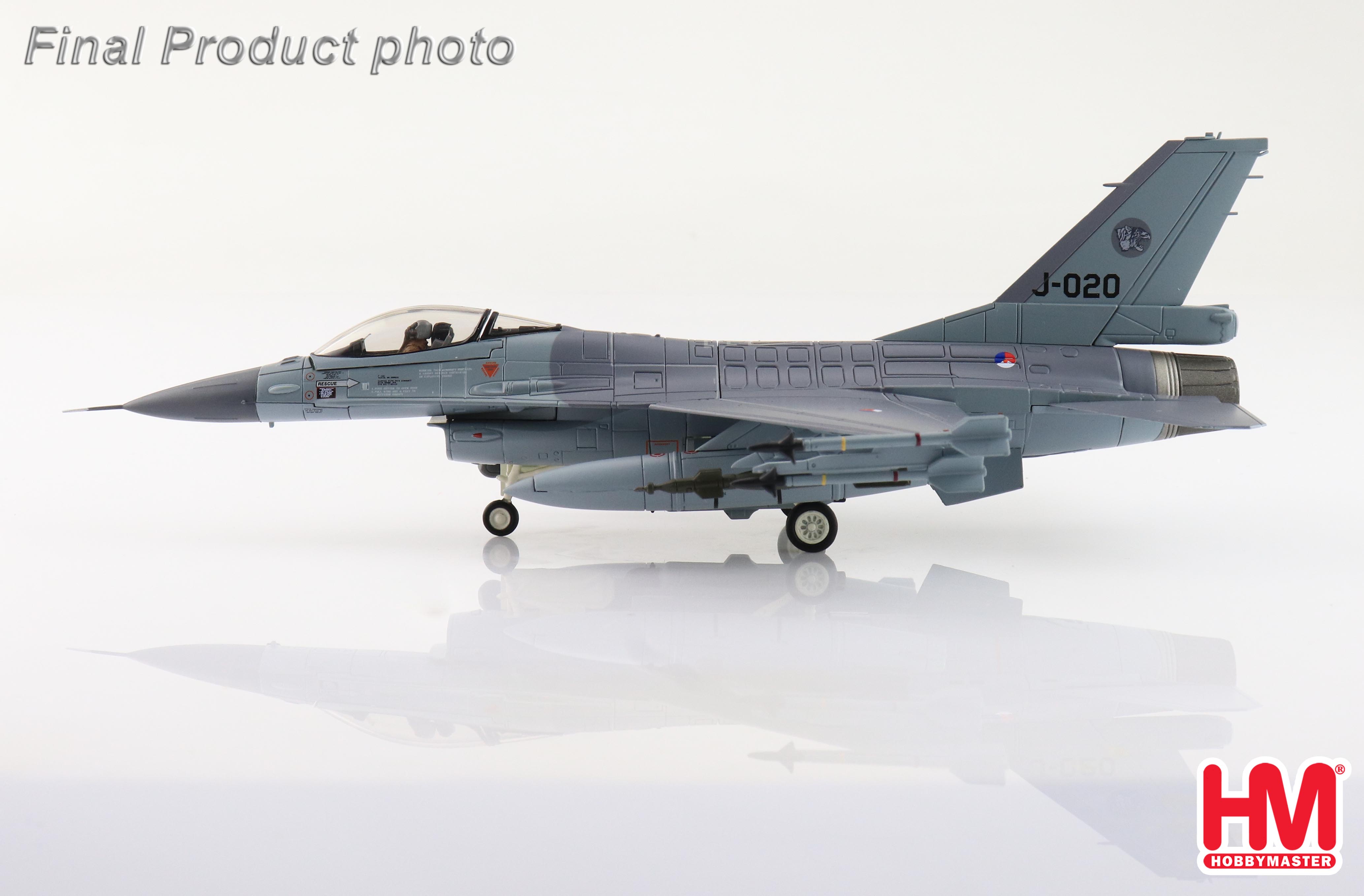
HA6721 Hobbymaster 1/72nd scale Tornado GR.1B AJ-Q/ZA456, N0. 617 Sqn “Dambusters”, RAF Lossiemouth, 1995 (with 2 x Sea Eagle Missiles) RRP £109.00 Flying Tigers only £82.99 SORRY, SOLD OUT AT PRE-ORDER STAGE


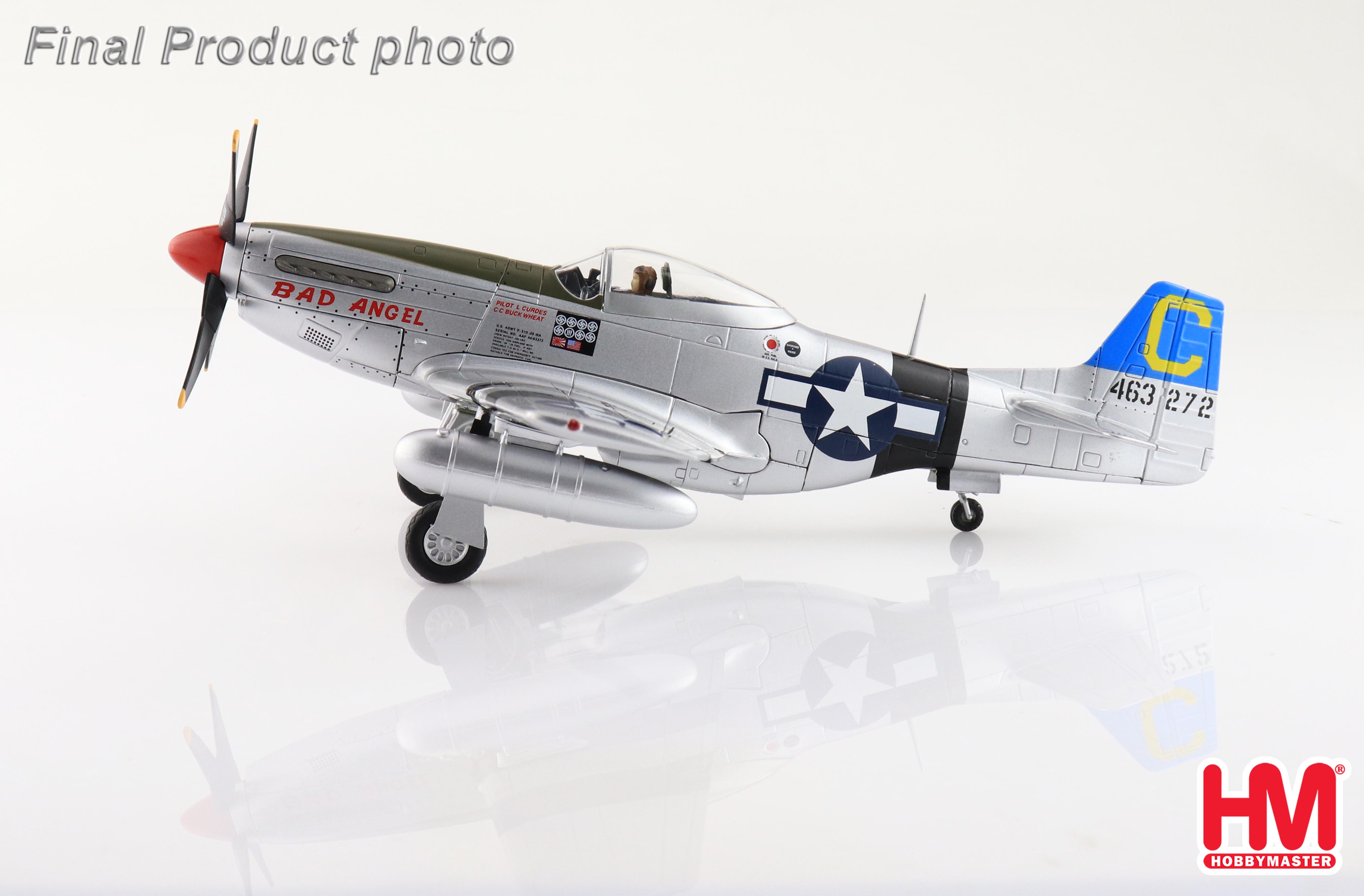


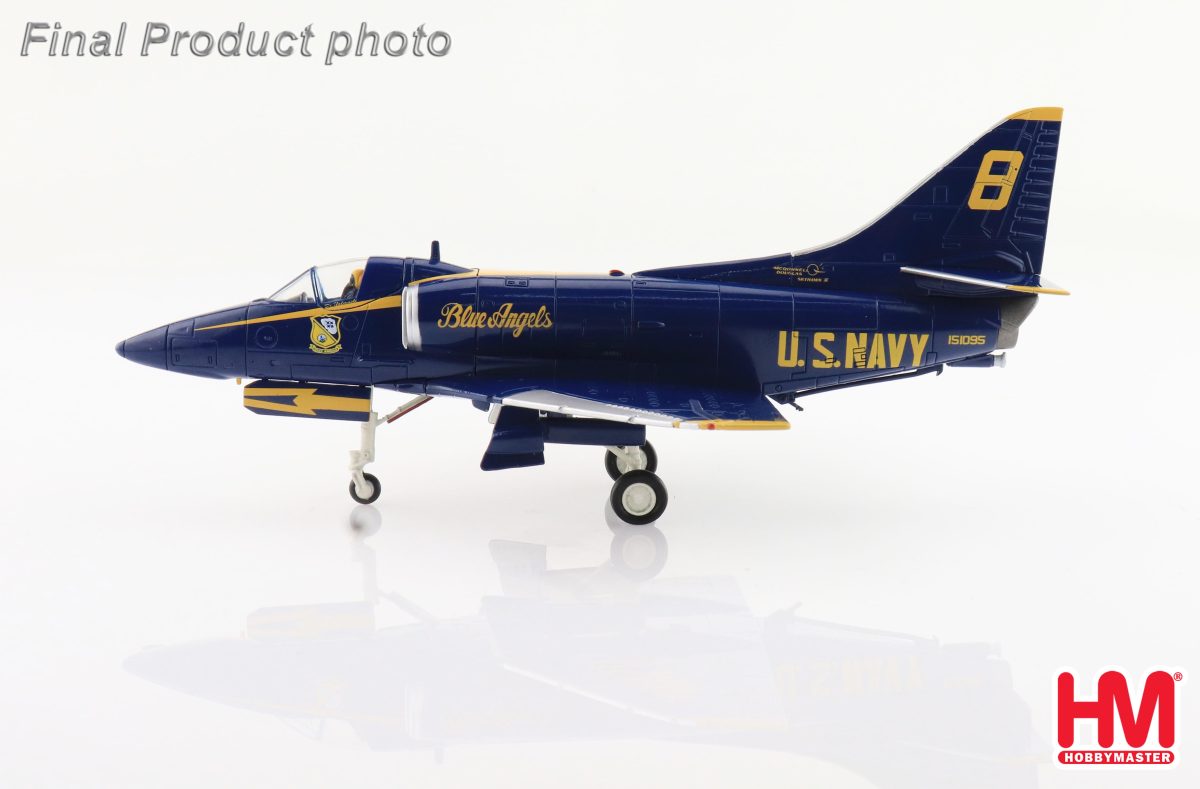
HA1438B Hobbymaster 1/72nd scale Douglas A-4F Skyhawk “Blue Angels” No.1 airplane, US Navy, 1979 season (with No.1 to No.6 airplanes decal) RRP £92.00 Flying Tigers only £67.99 SORRY, SOLD OUT AT PRE-ORDER STAGE



|
|

|
|

|
|
|
|

|
|

|
|

|
|

|
|

|
|
|
|
|
|
|
|
|
|
|

|
|
|
|

|
|

|
|
|
|

|
|
|
|

|
|

|
|
|
|
|
|
|
|
|

|
|

|
|

|
|

|
|

|
|

|
|

|
|

|
|

|
|

|
|

|
|

|
|

|
|

|
|

|
|

|
|

|
|

|
|

|
|

|
|

|
|

|
|

|
|

|
|

|
Thank you for reading this week’s Newsletter.
Richard
Flying Tigers.