A-10 Thunderbolt II
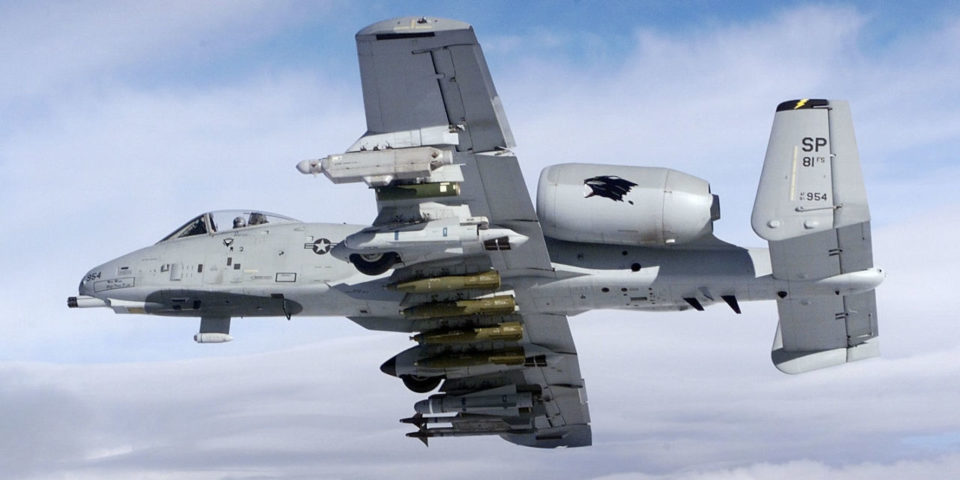
The Fairchild Republic A-10 Thunderbolt II is a single seat, twin turbofan engine, straight wing jet aircraft developed by Fairchild-Republic for the United States Air Force. Commonly referred to by its nicknames “Warthog” or “Hog”, its official name comes from the Republic P-47 Thunderbolt, a fighter particularly effective at close air support. The A-10 was designed for close-in support of ground troops, close air support (CAS), providing quick-action support for troops against helicopters, vehicles, and ground troops. It entered service in 1976 and is the only production-built aircraft that has served in the USAF that was designed solely for CAS. Its secondary mission is to provide forward air controller – airborne (FAC-A) support, by directing other aircraft in attacks on ground targets. Aircraft used primarily in this role are designated OA-10.
The A-10 was intended to improve on the performance of the A-1 Skyraider and its poor firepower. The A-10 was designed around the 30 mm GAU-8 Avenger rotary cannon. Its airframe was designed for durability, with measures such as 1,200 pounds (540 kg) of titanium armour to protect the cockpit and aircraft systems, enabling it to absorb a significant amount of damage and continue flying. Its short take-off and landing capability permits operation from airstrips close to the front lines, and its simple design enables maintenance with minimal facilities. The A-10 served in Operation Desert Shield, and Operation Desert Storm, the American intervention against Iraq’s invasion of Kuwait, where the A-10 distinguished itself. The A-10 also participated in other conflicts such as Operation Urgent Fury in Grenada, the Balkans, Afghanistan, Iraq, and against ISIS in the Middle East.

The A-10A single-seat variant was the only version produced, though one pre-production airframe was modified to become the YA-10B twin-seat prototype to test an all-weather night capable version. In 2005, a program was started to upgrade remaining A-10A aircraft to the A-10C configuration with modern avionics for use of precision weaponry. The Air Force had stated the F-35 would replace the A-10 as it entered service, but this remains highly contentious within the Air Force and in political circles. With a variety of upgrades and wing replacements, the A-10’s service life may be extended to 2040.
On 10th February 1976, Deputy Secretary of Defense Clements authorized full-rate production, with the first A-10 being accepted by the Air Force Tactical Air Command on 30th March 1976. Production continued at a rate of 15 aircraft per month, which was believed to be the best rate Fairchild could deliver. A total of 715 airplanes, including the two prototypes, were delivered by 1984.
When A-10 full rate production was first authorized the planned service life was 6,000 hours. A small reinforcement to the design was quickly adopted when the A-10 failed initial fatigue testing at 80% of testing; with the fix, the A-10 passed the fatigue tests. 8,000 flight hour service lives were becoming common at the time, so fatigue testing of the A-10 continued with a new 8,000 hour target. Fatigue testing for the new target quickly discovered serious cracks at Wing Station 23 (WS23) where the outboard portions of the wings are joined to the fuselage. The first production change was to add cold working at WS23 to address this problem. Soon after that, the Air Force determined that the real world A-10 fleet fatigue was harsher than estimated forcing them to change their fatigue testing, introducing “spectrum 3” equivalent flight hour testing.

YA-10A Thunderbolt II Prototype
Spectrum 3 fatigue testing started in 1979. This round of testing quickly determined that more drastic reinforcement would be needed. The second change in production, starting with aircraft #442, was to increase the thickness of the lower skin on the outer wing panels. A tech order was issued to retrofit the “thick skin” to the whole fleet, but the tech order was rescinded after roughly 242 planes leaving roughly 200 planes with the original “thin skin”. Starting with aircraft #530, cold working at WS0 was performed, and this retrofit was performed on earlier aircraft. A fourth, even more drastic change was initiated with aircraft #582, again to address the problems discovered with spectrum 3 testing. This change increased the thickness on the lower skin on the centre wing panel but it required modifications to the lower spar caps to accommodate the thicker skin. The Air Force determined that it was not economically feasible to retrofit earlier planes with this modification.
The A-10 has a cantilever low-wing monoplane wing with a wide chord. The aircraft has superior maneuverability at low speeds and altitude because of its large wing area, high wing aspect ratio, and large ailerons. The wing also allows short take-offs and landings, permitting operations from primitive forward airfields near front lines. The aircraft can loiter for extended periods and operate under 1,000 ft (300 m) ceilings with 1.5 mi (2.4 km) visibility. It typically flies at a relatively low speed of 300 knots (350 mph; 560 km/h), which makes it a better platform for the ground-attack role than fast fighter-bombers, which often have difficulty targeting small, slow-moving targets.
The leading edge of the wing has a honeycomb structure panel construction, providing strength with minimal weight; similar panels cover the flap shrouds, elevators, rudders and sections of the fins. The skin panels are integral with the stringers and are fabricated using computer-controlled machining, reducing production time and cost. Combat experience has shown that this type of panel is more resistant to damage. The skin is not load-bearing, so damaged skin sections can be easily replaced in the field, with makeshift materials if necessary. The ailerons are at the far ends of the wings for greater rolling moment and have two distinguishing features: The ailerons are larger than is typical, almost 50 percent of the wingspan, providing improved control even at slow speeds; the aileron is also split, making it a deceleron.
The A-10 is designed to be refuelled, rearmed, and serviced with minimal equipment. Its simple design enables maintenance at forward bases with limited facilities. Also, most repairs can be done in the field. An unusual feature is that many of the aircraft’s parts are interchangeable between the left and right sides, including the engines, main landing gear, and vertical stabilizers. The sturdy landing gear, low-pressure tires and large, straight wings allow operation from short rough strips even with a heavy aircraft ordnance load, allowing the aircraft to operate from damaged airbases, flying from taxiways or even straight roadway sections.

A-10 Offset landing gear
The front landing gear is offset to the aircraft’s right to allow placement of the 30 mm cannon with its firing barrel along the centre line of the aircraft. During ground taxi, the offset front landing gear causes the A-10 to have dissimilar turning radii. Turning to the right on the ground takes less distance than turning left. The wheels of the main landing gear partially protrude from their nacelles when retracted, making gear-up belly landings easier to control and less damaging. All landing gears are hinged toward the aircraft’s rear; if hydraulic power is lost, a combination of gravity and wind resistance can open and lock the gear in place.
The A-10 is exceptionally tough, being able to survive direct hits from armour-piercing and high-explosive projectiles up to 23 mm. It has double-redundant hydraulic flight systems, and a mechanical system as a back up if hydraulics is lost. Flight without hydraulic power uses the manual reversion control system; pitch and yaw control engages automatically, roll control is pilot-selected. In manual reversion mode, the A-10 is sufficiently controllable under favourable conditions to return to base, though control forces are greater than normal. The aircraft is designed to fly with one engine, one half of tail, one elevator, and half of a wing missing.
The cockpit and parts of the flight-control system are protected by 1,200 lb (540 kg) of titanium aircraft armour, referred to as a “bathtub”. The armour has been tested to withstand strikes from 23 mm cannon fire and some strikes from 57 mm rounds. It is made up of titanium plates with thicknesses from 0.5 to 1.5 inches (13 to 38 mm) determined by a study of likely trajectories and deflection angles. The armour makes up almost 6 percent of the aircraft’s empty weight. Any interior surface of the tub directly exposed to the pilot is covered by a multi-layer nylon spall shield to protect against shell fragmentation. The front windscreen and canopy are resistant to small arms fire.
The A-10’s durability was shown on 7th April 2003 when Captain Kim Campbell, while flying over Baghdad during the 2003 invasion of Iraq, suffered extensive flak damage. Iraqi fire damaged an engine and crippled the hydraulic system, requiring the aircraft’s stabilizer and flight controls to be operated via the ‘manual reversion mode’. Despite this damage, Campbell flew the aircraft for nearly an hour and landed safely.

The unique externally mounted twin engines of the A-10 Warthog
The A-10 was envisioned to fly from forward air bases and semi-prepared runways with high risk of foreign object damage to the engines. The unusual location of the General Electric TF34-GE-100 turbofan engines decreases ingestion risk, and allows the engines to run while the aircraft is serviced and rearmed by ground crews, reducing turn-around time. The wings are also mounted closer to the ground, simplifying servicing and rearming operations. The heavy engines require strong supports, four bolts connect the engine pylons to the airframe. The engines’ high 6:1 bypass ratio have a relatively small infrared signature, and their position directs exhaust over the tail planes further shielding it from detection by infrared homing surface-to-air missiles. The engines and exhausts are angled upward by nine degrees to cancel out the nose-down pitching moment that would otherwise generate from being mounted above the aircraft’s centre of gravity and avoids the need to trim the control surfaces to prevent pitching.
To reduce the likelihood of damage to the A-10’s fuel system, all four fuel tanks are located near the aircraft’s centre and are separated from the fuselage; projectiles would need to penetrate the aircraft’s skin before reaching a tank’s outer skin. Compromised fuel transfer lines self-seal; if damage exceeds a tank’s self-sealing capabilities, check valves prevent fuel flowing into a compromised tank. Most fuel system components are inside the tanks so that fuel will not be lost due to component failure. The refuelling system is also purged after use. Reticulated polyurethane foam lines both the inner and outer sides of the fuel tanks, retaining debris and restricting fuel spillage in the event of damage. The engines are shielded from the rest of the airframe by firewalls and fire extinguishing equipment. In the event of all four main tanks being lost, two self-sealing sump tanks contain fuel for 230 miles (370 km) of flight.

Although the A-10 can carry considerable disposable stores, its primary built-in weapon is the 30 mm GAU-8/A Avenger Gatling-type cannon. One of the most powerful aircraft cannon ever flown, it fires large depleted uranium armour-piercing shells. In the original design, the pilot could switch between two rates of fire: 2,100 or 4,200 rounds per minute; this was changed to a fixed rate of 3,900 rounds per minute. The cannon takes about half a second to come up to speed, so 50 rounds are fired during the first second, 65 or 70 rounds per second thereafter. The gun is accurate enough to place 80 percent of its shots within a 40-foot (12.4 m) diameter circle from 4,000 feet (1,220 m) while in flight. The GAU-8 is optimized for a slant range of 4,000 feet (1,220 m) with the A-10 in a 30-degree dive.

General Electric GAU-8/A displayed next to a Volkswagen Beetle for size comparison. (U.S. Air Force photo)
The fuselage of the aircraft is built around the cannon. The GAU-8/A is mounted slightly to the port side; the barrel in the firing location is on the starboard side at the 9 o’clock position so it is aligned with the aircraft’s centre line. The gun’s 5-foot, 11.5-inch (1.816 m) ammunition drum can hold up to 1,350 rounds of 30 mm ammunition, but generally holds 1,174 rounds. To prevent enemy fire from causing the GAU-8/A rounds to fire prematurely, armour plates of differing thicknesses between the aircraft skin and the drum are designed to detonate incoming shells. A final armour layer around the drum protects it from fragmentation damage. The gun is loaded by Syn-Tech’s linked tube carrier GFU-7/E 30 mm ammunition loading assembly cart.

A-10 Warthog firing Maverick missile.
The AGM-65 Maverick air-to-surface missile is a commonly used munition, targeted via electro-optical (TV-guided) or infrared. The Maverick allows target engagement at much greater ranges than the cannon, and thus less risk from anti-aircraft systems. During Desert Storm, in the absence of dedicated forward-looking infrared (FLIR) cameras for night vision, the Maverick’s infrared camera was used for night missions as a “poor man’s FLIR”. Other weapons include cluster bombs and Hydra rocket pods. The A-10 is equipped to carry laser-guided bombs. A-10s usually fly with an ALQ-131 ECM pod under one wing and two AIM-9 Sidewinder air-to-air missiles under the other wing for self-defence.
The first unit to receive the A-10 Thunderbolt II was the 355th Tactical Training Wing, based at Davis-Monthan Air Force Base, Arizona, in March 1976. The first unit to achieve full combat-readiness was the 354th Tactical Fighter Wing at Myrtle Beach Air Force Base, South Carolina, in 1978. Deployments of A-10As followed at bases both at home and abroad, including England AFB, Louisiana; Eielson AFB, Alaska; Osan Air Base, South Korea; and RAF Bentwaters/RAF Woodbridge, England. The 81st TFW of RAF Bentwaters/RAF Woodbridge operated rotating detachments of A-10s at four bases in Germany known as Forward Operating Locations (FOLs): Leipheim, Sembach Air Base, Nörvenich, and Ahlhorn.
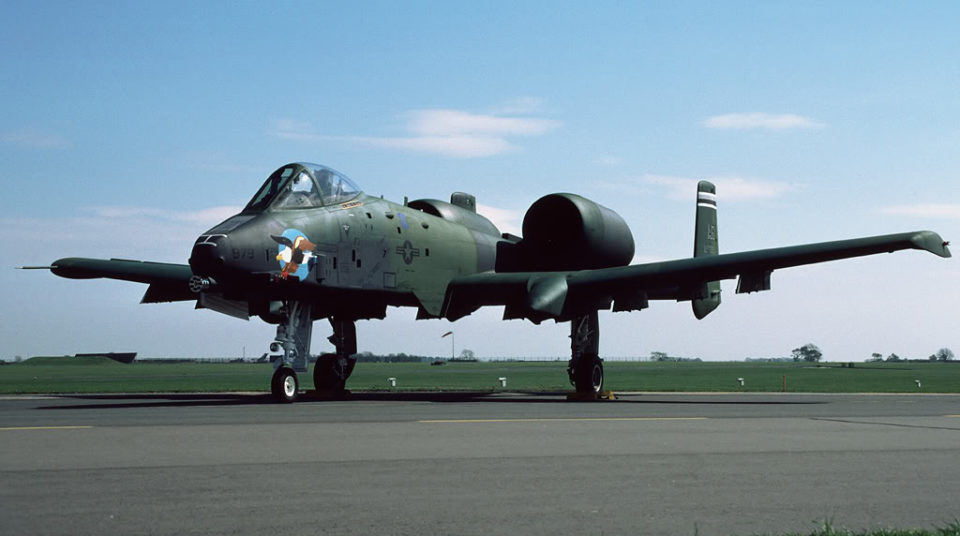
Fairchild A-10 Thunderbolt II RAF Alconbury
A-10s were initially an unwelcome addition to many in the Air Force. Most pilots switching to the A-10 did not want to because fighter pilots traditionally favoured speed and appearance. In 1987, many A-10s were shifted to the forward air control (FAC) role and re-designated OA-10. In the FAC role the OA-10 is typically equipped with up to six pods of 2.75 inch (70 mm) Hydra rockets, usually with smoke or white phosphorus warheads used for target marking. OA-10s are physically unchanged and remain fully combat capable despite the re-designation.
A-10s of the 23rd TFW were deployed to Bridgetown, Barbados during Operation Urgent Fury, the American Invasion of Grenada. They provided air cover for the U.S. Marine Corps landings on the island of Carriacou in late October 1983, but did not fire weapons as Marines met no resistance.
The A-10 was used in combat for the first time during the Gulf War in 1991, destroying more than 900 Iraqi tanks, 2,000 other military vehicles and 1,200 artillery pieces. A-10s also shot down two Iraqi helicopters with the GAU-8 cannon. The first of these was shot down by Captain Robert Swain over Kuwait on 6 February 1991 for the A-10’s first air-to-air victory. Four A-10s were shot down during the war, all by surface-to-air missiles. Another three battle-damaged A-10s and OA-10As returned to base but were written off, some sustaining additional damage in crash landings. The A-10 had a mission capable rate of 95.7 percent, flew 8,100 sorties, and launched 90 percent of the AGM-65 Maverick missiles fired in the conflict. Shortly after the Gulf War, the Air Force abandoned the idea of replacing the A-10 with a close air support version of the F-16.

U.S. Air Force A-10 aircraft fired approximately 10,000 30 mm rounds in Bosnia and Herzegovina in 1994–95. Following the seizure of some heavy weapons by Bosnian Serbs from a warehouse in Ilidža, a series of sorties were launched to locate and destroy the captured equipment. On 5th August 1994, two A-10s located and strafed an anti-tank vehicle. Afterward, the Serbs agreed to return remaining heavy weapons. In August 1995, NATO launched an offensive called Operation Deliberate Force. A-10s flew close air support missions, attacking Bosnian Serb artillery and positions. In late September, A-10s began flying patrols again.
A-10s returned to the Balkan region as part of Operation Allied Force in Kosovo beginning in March 1999. In March 1999, A-10s escorted and supported search and rescue helicopters in finding a downed F-117 pilot. The A-10s were deployed to support search and rescue missions, but over time the Warthogs began to receive more ground attack missions. The A-10’s first successful attack in Operation Allied Force happened on 6th April 1999; A-10s remained in action until combat ended in late June 1999.

U.S. Air Force A-10 Thunderbolt II aircraft taxi toward a parking area upon arriving at Bagram Airbase Afghanistan.
During the 2001 invasion of Afghanistan, A-10s did not take part in the initial stages. For the campaign against Taliban and Al Qaeda, A-10 squadrons were deployed to Pakistan and Bagram Air Base, Afghanistan, beginning in March 2002. These A-10s participated in Operation Anaconda. Afterwards, A-10s remained in-country, fighting Taliban and Al Qaeda remnants.
Operation Iraqi Freedom began on 20th March 2003. Sixty OA-10/A-10 aircraft took part in early combat there. United States Air Forces Central Command issued Operation Iraqi Freedom: By the Numbers, a declassified report about the aerial campaign in the conflict on 30th April 2003. During that initial invasion of Iraq, A-10s had a mission capable rate of 85 percent in the war and fired 311,597 rounds of 30 mm ammunition. A single A-10 was shot down near Baghdad International Airport by Iraqi fire late in the campaign. The A-10 also flew 32 missions in which the aircraft dropped propaganda leaflets over Iraq.

This A-10 suffered extensive damage during Operation Iraqi Freedom in 2003
In September 2007, the A-10C with the Precision Engagement Upgrade reached initial operating capability. The A-10C first deployed to Iraq in 2007 with the 104th Fighter Squadron of the Maryland Air National Guard. The A-10C’s digital avionics and communications systems have greatly reduced the time to acquire a close air support target and attack it.
A-10s flew 32 percent of combat sorties in Operation Iraqi Freedom and Operation Enduring Freedom. The sorties ranged from 27,800 to 34,500 annually between 2009 and 2012. In the first half of 2013, they flew 11,189 sorties in Afghanistan. From the beginning of 2006 to October 2013, A-10s flew 19 percent of CAS operations in Iraq and Afghanistan, more than the F-15E Strike Eagle or B-1B Lancer, but less than the 33 percent of CAS missions flown by F-16s during that time period.
In March 2011, six A-10s were deployed as part of Operation Odyssey Dawn, the coalition intervention in Libya. They participated in attacks on Libyan ground forces there.

A-10 Warthogs in support of Operation Inherent Resolve.
In September 2014, the USAF 122nd Fighter Wing revealed it would be deploying to the Middle East in the next month, which includes 12 of the unit’s 21 A-10 aircraft. Although the deployment had been planned a year in advance in a support role, the timing coincided with the ongoing Operation Inherent Resolve against Islamic State militants. Since mid-November, U.S. commanders began sending A-10s to hit IS targets in central and north-western Iraq on an almost daily basis. In about two months time, A-10s flew 11 percent of all USAF sorties since the start of operations in August 2014. On 15th November 2015, two days after the ISIL attacks in Paris, A-10s and AC-130s destroyed a convoy of over 100 ISIL-operated oil tanker trucks in Syria. The attacks were part of an intensification of the U.S.-led intervention against ISIL called Operation Tidal Wave II (named after the original Operation Tidal Wave during World War II, a failed attempt to raid German oil fields that resulted in heavy aircraft and aircrew loss) in an attempt to cut off oil smuggling as a source of funding for the group.

In 2007, the A-10 was expected to be in USAF service until 2028 and possibly later, when it may be replaced by the Lockheed Martin F-35 Lightning II. Critics have said that replacing the A-10 with the F-35 would be a “giant leap backwards” given the A-10’s performance and the F-35’s high costs. In 2012, the Air Force considered the F-35B STOVL variant as a replacement CAS aircraft, but concluded that the aircraft could not generate sufficient sorties. In August 2013, Congress and the Air Force examined various proposals, including the F-35 and the MQ-9 Reaper unmanned aerial vehicle filling the A-10’s role. Proponents state that the A-10’s armour and cannon are superior to aircraft such as the F-35 for ground attack, that guided munitions other planes rely upon could be jammed, and that ground commanders frequently request A-10 support.
In the USAF’s FY 2015 budget, the service considered retiring the A-10 and other single-mission aircraft, prioritizing multi-mission aircraft; cutting a whole fleet and its infrastructure was seen as the only method for major savings. The U.S. Army had expressed interest in obtaining some A-10s should the Air Force retire them, but later stated there was “no chance” of that happening. The U.S. Air Force stated that retirement would save $3.7 billion from 2015 to 2019. Guided munitions allow more aircraft to perform the CAS mission, reducing the requirement for a specialized aircraft; since 2001, multirole aircraft and bombers performed 80 percent of CAS missions. The Air Force stated the A-10 is also more vulnerable to advanced anti-aircraft defences. The Army stated that the A-10 is invaluable for its versatile weapons loads, psychological impact, and reduced logistics needs on ground support systems.
In 2015, Boeing revealed that it was holding initial discussions on the prospects of selling retired or stored A-10s in near-flyaway condition to international customers. However, the Air Force subsequently stated that it will not permit the aircraft to be sold !

Latest Hobbymaster A-10 Warthogs available to pre-order now.
Please click on the images or links below to go straight to the models of your choice.


New Hobbymaster Viking Photos.
I have just added the latest Hobbymaster photos of the latest Vikings which are available to pre-order now. Sorry for bringing up Christmas so early !!


Hobbymaster 1/48th scale Hurricane Offers !
Two offers this week, one Hurricane on offer at a special low price for a limited time, and the other a very special signed version with very limited stocks.


That’s all for this week.
Thank you for reading this week’s Newsletter.
Richard.
Flying Tigers.